成语——不屈不挠

Meaning of the Idiom

bu qu bu nao(the candle moth flies into the fire — to bring destruction on oneself)

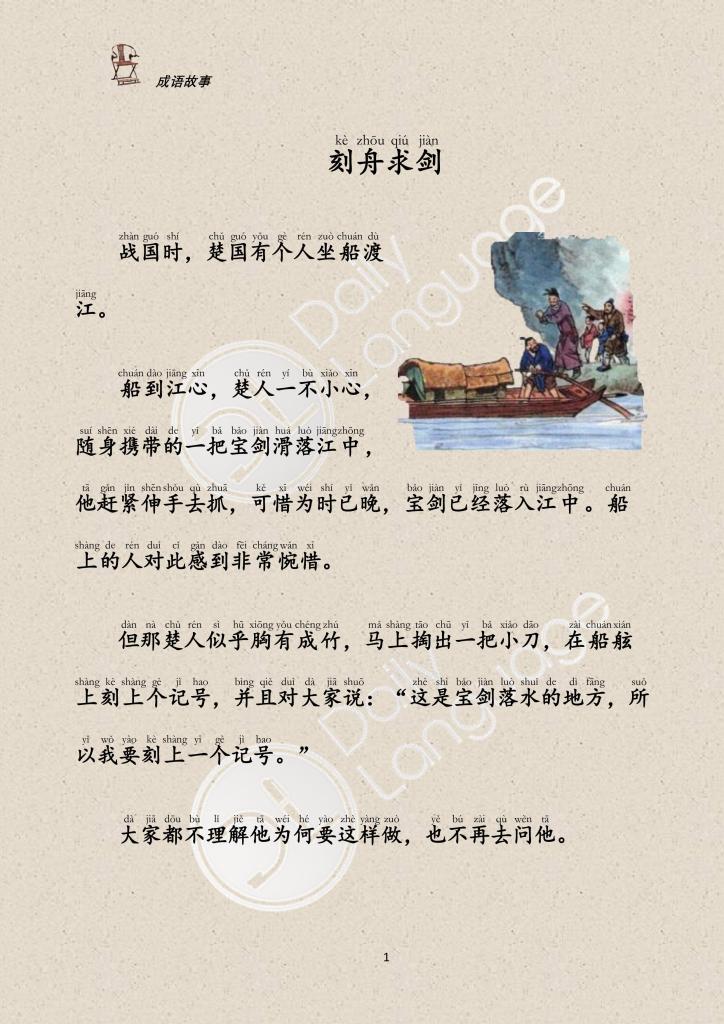
Wang Shang was a minister of the Western Han Dynasty and served as the prime minister of Emperor Cheng of Han. He is honest and upright. However, Emperor Cheng’s uncle Wang Feng often used the emperor’s name to make money for himself. Wang Shang criticized Wang Feng’s practice, and Wang Feng became dissatisfied with him.

Once, the capital was suddenly rumored to have a flood. The whole city was in chaos. When the news reached the palace, Emperor Cheng summoned senior officials to confer. Wang Feng panicked and thought that the emperor should get on the ship as soon as possible. Other officials and people rushed to hide on the wall. All the ministers agreed with Wang Feng. Only Wang Shang firmly opposed it. He thought that it must be a rumor, and that the order to mount the wall at this critical moment would further disturb the people. Emperor Cheng of Han adopted Wang Shang’s advice. After a few days, the city also gradually calm down, the results of the investigation confirmed that. Emperor Cheng of Han considered Wang Shang honest and stable and often praised his opinions. However, Wang Feng regretted his wrong words and became more resentful towards Wang Shang.

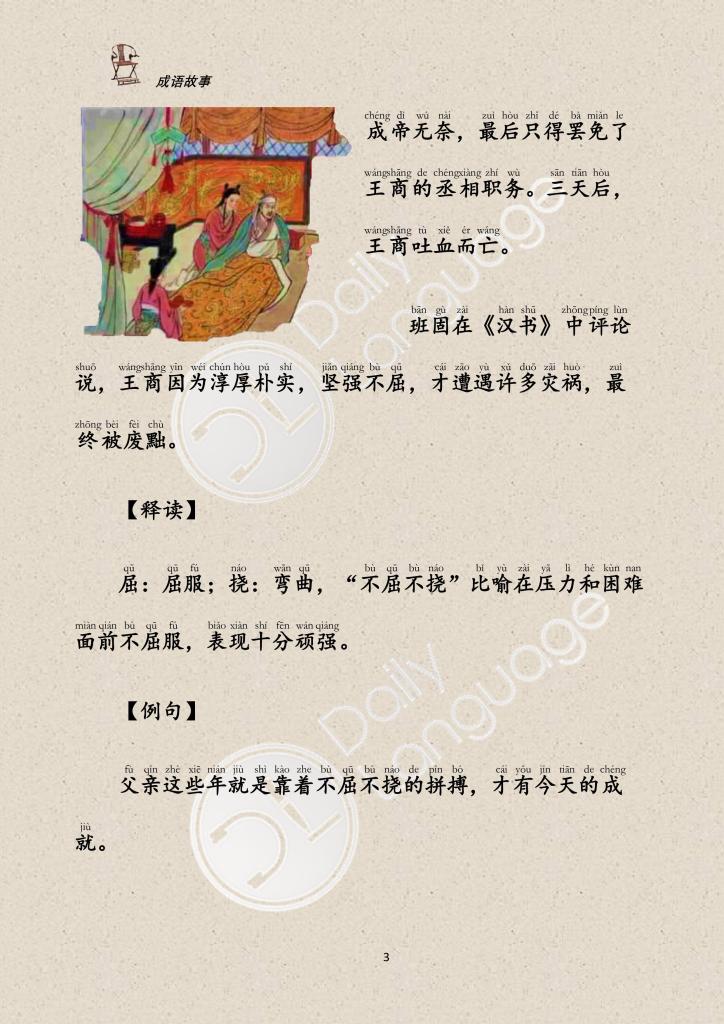
When one of Wang Feng’s relatives failed to perform his managerial duties, Wang Shang arranged for him to be scrutinized. Wang Feng asked Wang Shang for mercy, but Wang Shang insisted on his principles. Wang Feng is more resentful of Wang Shang, he made one thousand ways to search for his shortcomings, and then sent someone framed. Emperor Cheng of Han did not believe him, so he issued an edict to prevent excessive investigation. But Wang Feng stubbornly insisted, Emperor Cheng had no choice but to dismiss Wang Shang as Prime minister. Three days later, Wang Shang vomited blood and died.

Ban Gu commented in the Book of Han that Wang Shang suffered many disasters and was deposed because of his honesty and unyielding spirit.

不屈不挠

[fēi é pū huǒ],屈:屈服;挠:弯曲,不屈不挠比喻在压力和困难面前不屈服,表现十分顽强。

出自东汉·班固《汉书·叙传下》。

例句

要更上一层楼,唯一的途径就是艰苦奋斗,不屈不挠

不屈不挠的精神帮助他对抗病魔。

我们只有不屈不挠才能战胜自然灾难。

Reading The Paragraphs!
Meaning of Words

 

词语华文解释英文解释
耿直意思是(性格)正直、直爽。
例句:他不但才华横溢,而且为人耿直
upright
骄横跋扈基本意思为形容骄傲放肆,目中无人。
例句:当贵族依旧骄横跋扈时,整个国家充满了不满情绪。
overbearing and unbridled
独揽大权意思是一个人把持着权力,独断专行。
例句:公司里只有他独揽大权,根本听不进其他人的意见。
grasp at authority by oneself
谣传指广为流传而无明确基础或来源的信息。
例句:那些谣传一点也不可靠。
rumour
惊慌失措意思是由于惊慌,一下子不知怎么办才好。
例句:我们被那消息弄得惊慌失措
panicked
附和指对别人的言行因赞同而表示应和、追随,也指随和别人的言行。
例句:对他们的意见要加以分析,不要随声附和
echo
老成持重指人经验丰富,办事老练稳重,不轻举妄动。
例句:陌生人摆出一副老成持重的神色,将这句话重复了一下。
experienced and prudent
千方百计意思是想尽种种办法;用出种种计谋。
例句:医生千方百计想使他活下来,但无济于事。
make every effort to
诬陷意思是伪造事实,加以陷害他人。
例句:我需要查出谁试图诬陷我。
framed
器重意思是上因才能对下看重;重视。
例句:上司似乎很器重你,你要抓住机会表现。
regard highly
废黜(chù)指罢免;革除(官职)。
例句:总统在军事政变中被废黜
depose

成语——飞蛾扑火

Meaning of the Idiom

fei e pu huo(the candle moth flies into the fire — to bring destruction on oneself)

During the Southern and Northern Dynasties, Dao Gai, a diligent man in the Liang Dynasty, became an official.

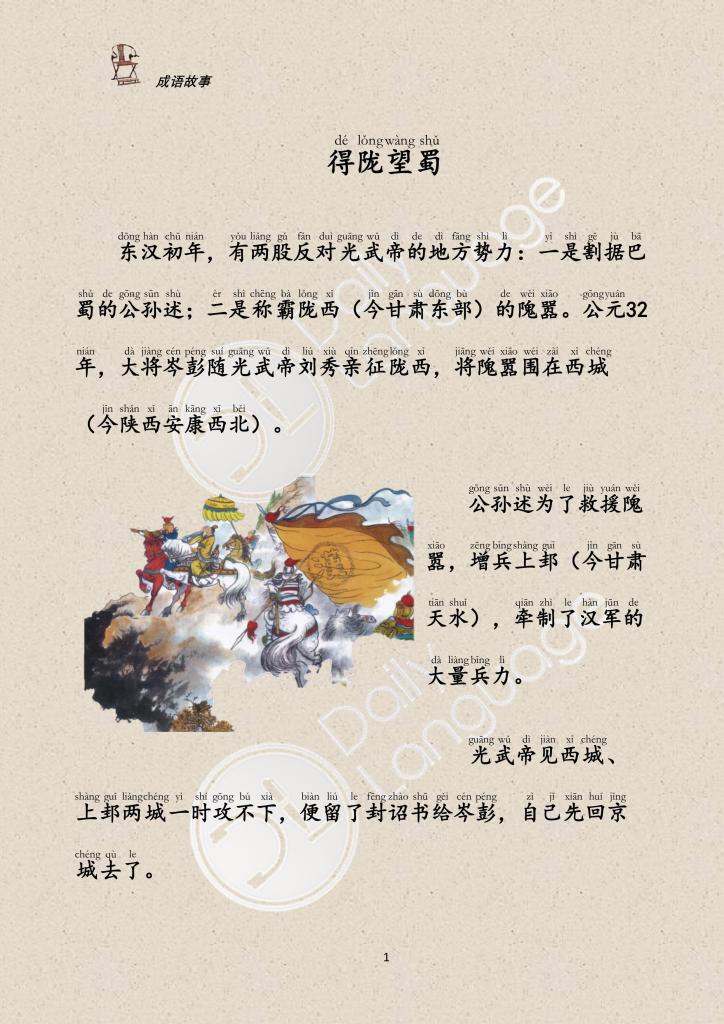
Dao Gai had a grandson named Jin, who was very clever since he was a child. Dao Gai liked him very much and would accompany him to read and write poems whenever he had time. Dao Jin’s achievements in poetry and literature surpassed Dao Gai’s when he was an adult, and he was greatly appreciated by Emperor Wu of Liang.

Once, Emperor Wu of Liang joked with Dao Gai, “I can write articles with ink stone and brush brush with ease. It was like a moth to a flame, completely forgetting that it might be destroyed. You are an old man, and your grandson writes so well. Why not let your grandson write instead of you?”

Dao Jin was soon appointed as an official by Emperor Wu of Liang.

飞蛾扑火

[fēi é pū huǒ],意思是飞蛾扑到火上,比喻自找死路,自取灭亡。

出自隋·姚察等《梁书·到溉传》。

例句

他这样做犹如飞蛾扑火,自取灭亡。

这家伙畏罪潜逃,今天自己送上门来,岂不是飞蛾扑火

事情过去了就算了,再去理论就等于飞蛾扑火

Reading The Paragraphs!

Meaning of Words
 

词语华文解释英文解释
潜心苦学意思是静下心集中精力,刻苦学习某类知识和技能。
例句:王羲之每日潜心苦学,终成一代书法大师。
Study hard
豪放指气魄大而不拘小节,也指处理事情果断有魄力。
例句:他这个人做事豪放不羁。
bold and unconstrained

成语——得陇望蜀

Meaning of the Idiom

de long wang shu(to have insatiable desires)

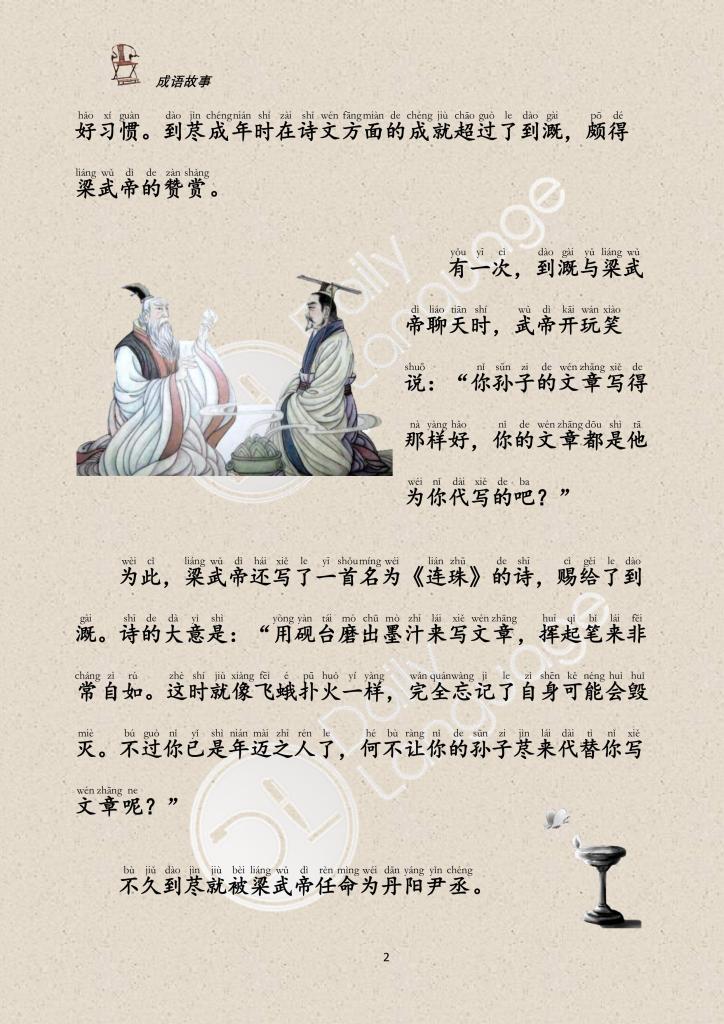
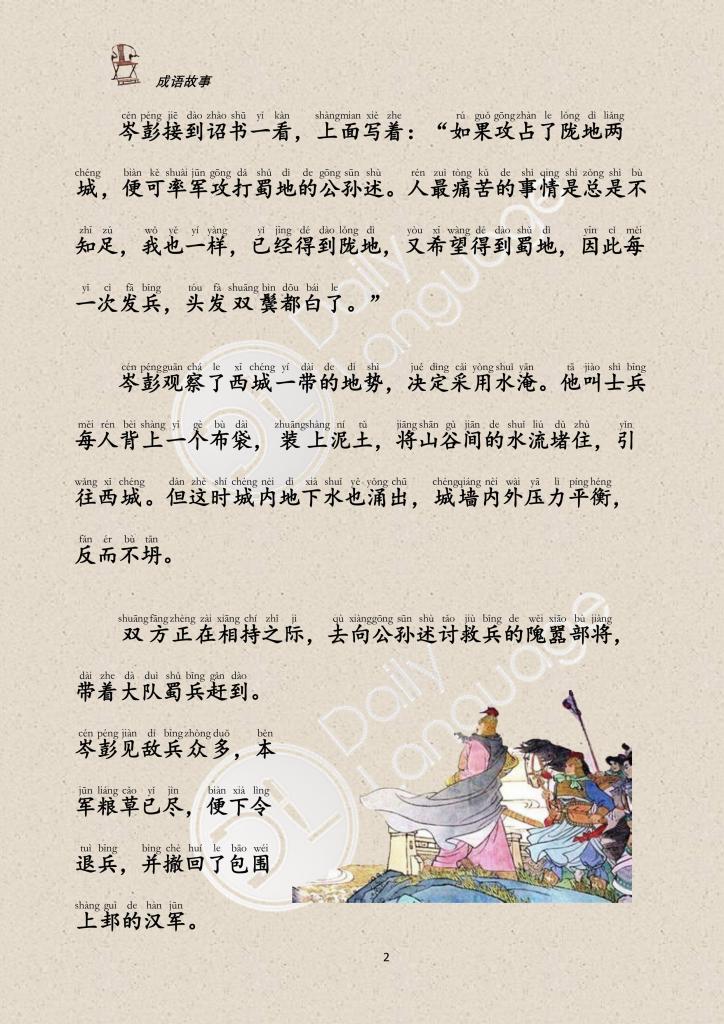
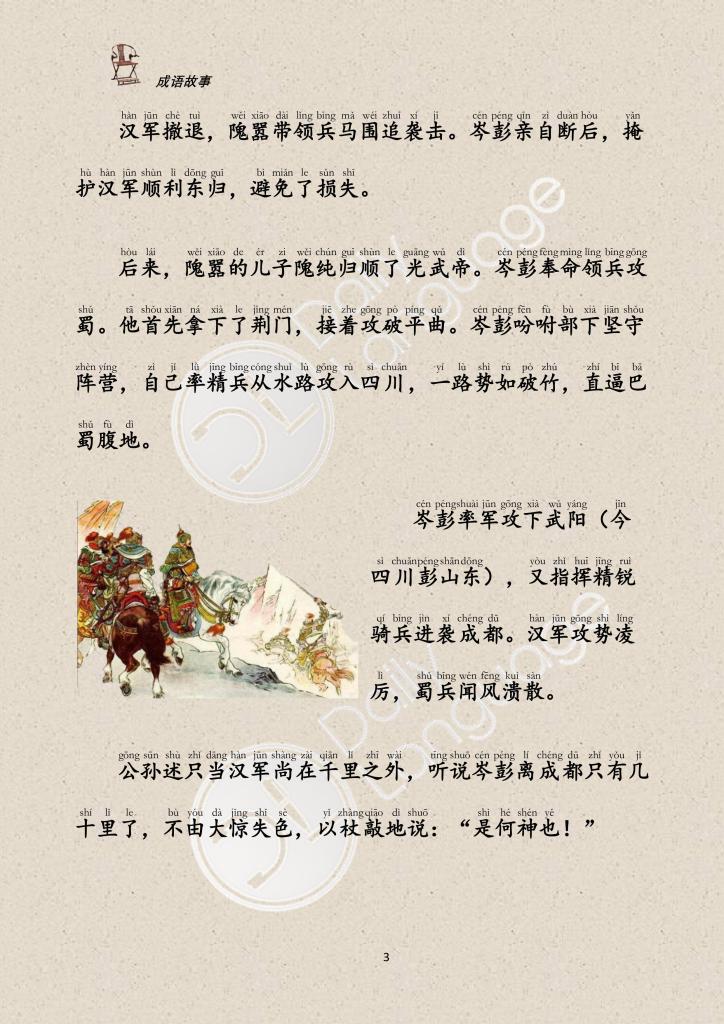
During the Eastern Han Dynasty, after Wang Mang usurped the Han Dynasty and established a new dynasty, a man named Cen Peng served as a county magistrate in his hometown. Later, Liu Xiu raised troops hoping to rebuild the Han Dynasty, so Cen Peng led his troops to join him and was appointed as a general. He made a lot of contributions and won Liu Xiu’s trust and appreciation.

After Cen Peng followed Liu Xiu to conquer Tianshui, he besieged the rebel general Kui Xiao in Xicheng. At this time, Liu Xiu had to return to the capital Luoyang because of other important matters.

Before leaving, Liu Xiu left a letter telling Cen Peng: “After capturing Xicheng, you can directly attack Gongsun Shu in Xishu.”

The letter also said: “People’s hearts are always suffering from insatiability! After conquering Longxi, I look forward to marching into Western Shu!”

Later, Liu Xiuzhen eliminated Kui Xiao from Julong and Gongsun Shu from Shu, and restored the Han Dynasty regime.

The idiom “Delong Wangshu” evolved from here, and it is used to describe insatiable greed and unsatisfied.

得陇望蜀

[dé lǒng wàng shǔ],原意是指已经取得陇右,还想攻取西蜀(陇:今甘肃一带;蜀:今四川一带),后成为讥讽人不知道满足、总想得到更多的意思。

出自《东观汉记·隗嚣传》。

例句

他们就是这样得陇望蜀,永远无法心满意足。

人家已尽了最大心力帮忙了,我们不好得陇望蜀,再提出别的要求。

人心不足蛇吞象,得陇望蜀的人最终结果是交不到好朋友。

Reading The Paragraphs!

Meaning of Words
 

词语华文解释英文解释
割据意思是以武力占据部分地区,在一个国家内形成分裂对抗的局面。
例句:我们无法接受自己国家的割据分裂。
set up a separatist regime by force of arms
称霸意思为依仗权势、武力横行霸道,欺压别人。
例句:他否认他的国家想称霸欧洲。
Dominate
牵制意思指约束;控制;拖住使不能自由行动。
例句:如果没有应急计划,你就会受许多意料不到的事情的牵制
control
相持指双方对立、争持,互不相让。
例句:双方相持不下,看来短时间内很难有结果。
refuse to budge
断后军队撤退时,派一部分人在后面掩护。
例句:这位骑士让国王先走,自己带领几个人在小路上断后
cover the rear
掩护采取警戒、牵制、压制等手段,保障人员行动的安全。 
例句:他们设法在夜色掩护下逃跑了。
cover for
归顺指向外部势力归附投诚。
例句:这几个武士非常佩服将军,立刻放下刀剑表示归顺
come over and pledge allegiance
势如破竹指形势如同劈竹子一样,劈开上头几节,下面各节就顺着刀口裂开了。后比喻节节胜利,毫无阻碍。
例句:在战胜了这个强劲对手后,接下来的比赛就势如破竹,最终他取得了冠军。
Like a hot knife cutting through butter
直逼指迅速的靠近。
例句:本地股指骤降,直逼3000点大关。
approach
凌厉指凌空高飞;意气昂扬,气势猛烈。
例句:他画画笔锋粗犷凌厉
swift and fierce
闻风意思是指听到音讯或传闻。
例句:当地人闻风丧胆,视此为禁地。
To hear news or hearsay
大惊失色形容十分慌张,吓得脸色都变了。
例句:她发现孩子不见了,大惊失色
be greatly frightened
夙愿意思是一向怀有的愿望。
例句:她一直未能实现当名作家的夙愿
long-cherished wish

成语——畏罪潜逃

Meaning of the Idiom

wei zui qian tao(abscond to avoid punishment)

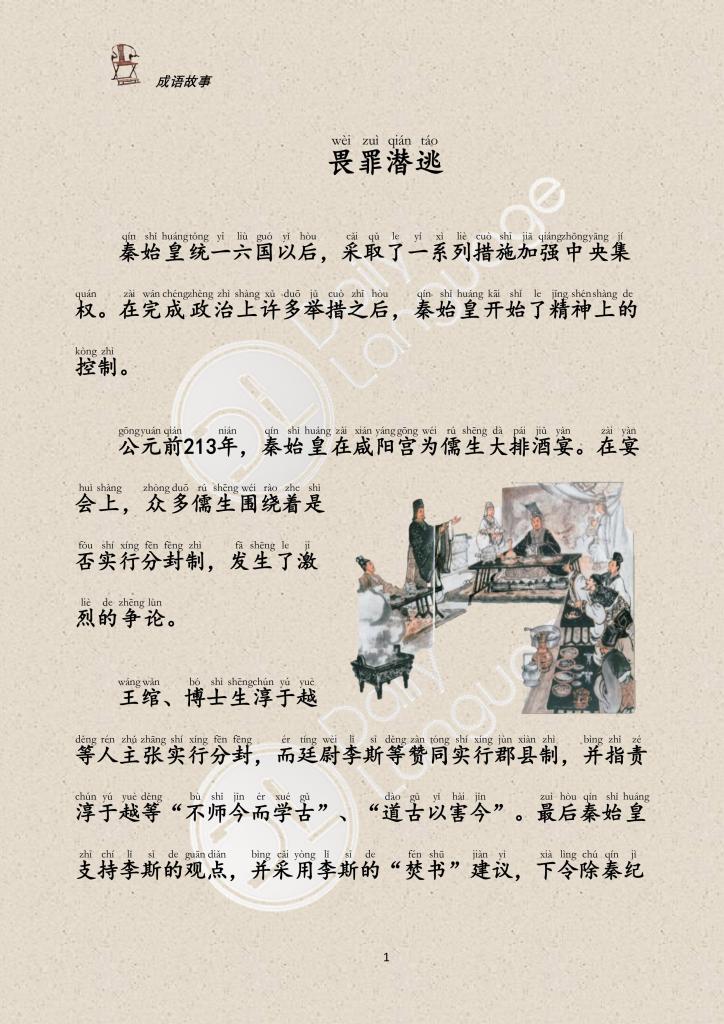
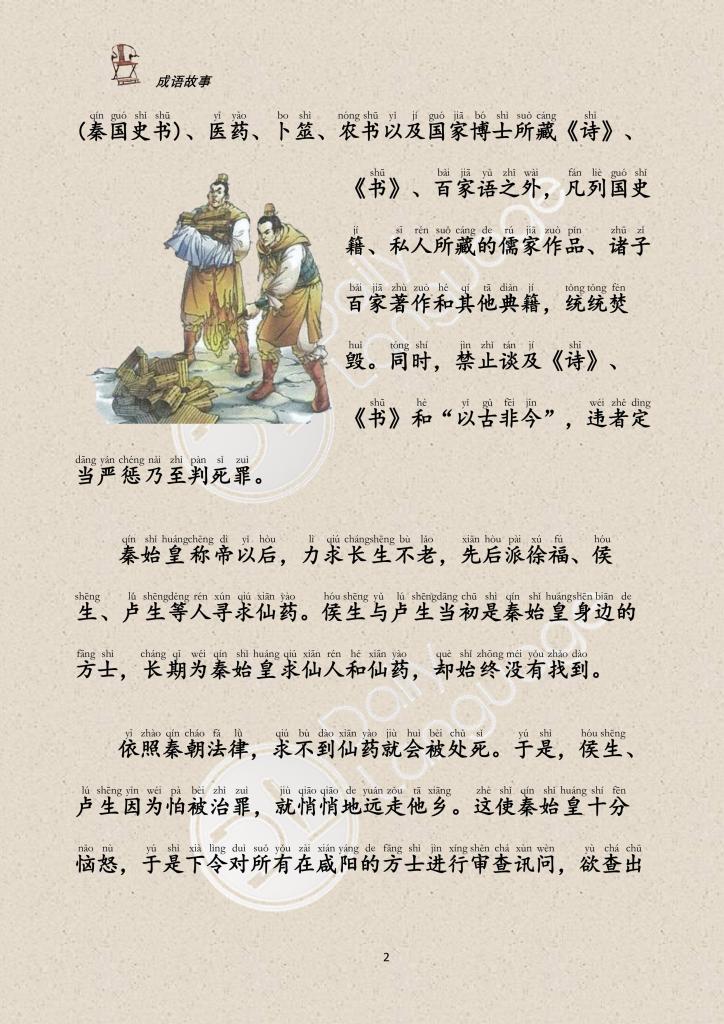
After the First Emperor of Qin unified the six kingdoms, he searched for the magic of immortality. Hou Sheng and Lu Sheng, two Buddhist scholars, searched for immortal people and immortal medicine for the emperor for a long time, but they could not find them.

According to the law of the Qin Dynasty, failure to find the fairy medicine was punishable by death. Hou Sheng and Lu Sheng were afraid of being punished, so they secretly fled.

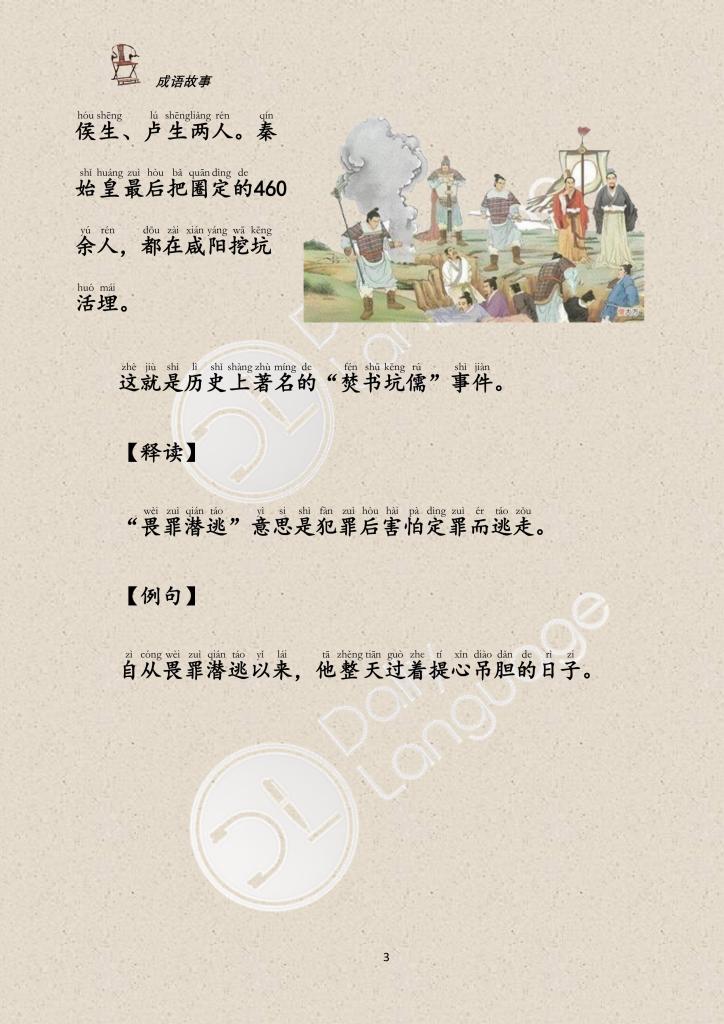
Qin Shi Huang was very angry and ordered the execution of hundreds of Confucian scholars who had been involved in the affair. This is the famous burning of books and burying scholars.

畏罪潜逃

[wèi zuì qián táo],意思是犯罪后害怕定罪而逃走。

出自《吕不韦与秦王政的批判》。

例句

找了半天,却没有找到,我以为它真是“畏罪潜逃”了。

老板畏罪潜逃后,公司就人去楼空,铁门深锁,使得员工们都丧失了赖以维生的工作。

这家伙畏罪潜逃,今天自己送上门来,岂不是飞蛾投火。

Reading The Paragraphs!

Meaning of Words
 

词语华文解释英文解释
举措指言行举动;措施。
例句:虽然政府发布了一系列举措,但还未能根除就业歧视。
measure
大排指很大的规模。
例句:这天早晨,为了欢送我们,连队大排宴席。
large
分封指君主将部分土地及相应的人口等分出来给宗室或功臣等。
例句:国王将这几块土地分封给几位效忠自己的骑士。
enfeoffment
严惩意思是严格或从严惩处。
例句:违法者将受到严惩
punish severely
乃至意思是以至于。
例句:这些小说的流行使狄更斯成为全国乃至全世界著名的文学家。
and even
长生不老指生命不老不死、永生不灭。
例句:传说中吸血鬼会长生不老、永葆青春。
living forever
始终意思是自始至终,有始有终。
例句:她始终关注慈善工作。
from beginning to end
远走他乡意思是远离开自己的家乡去别的地方。
例句:他再也没有理由呆在农场了,随即决定尽快远走他乡
travel in distant parts
圈定指画圈,比喻确定一个范围。
例句:考古队圈定了一个范围,准备先勘探地势。
delineation

成语——破镜重圆

Meaning of the Idiom

po jing chong yuan(a broken mirror joined together)

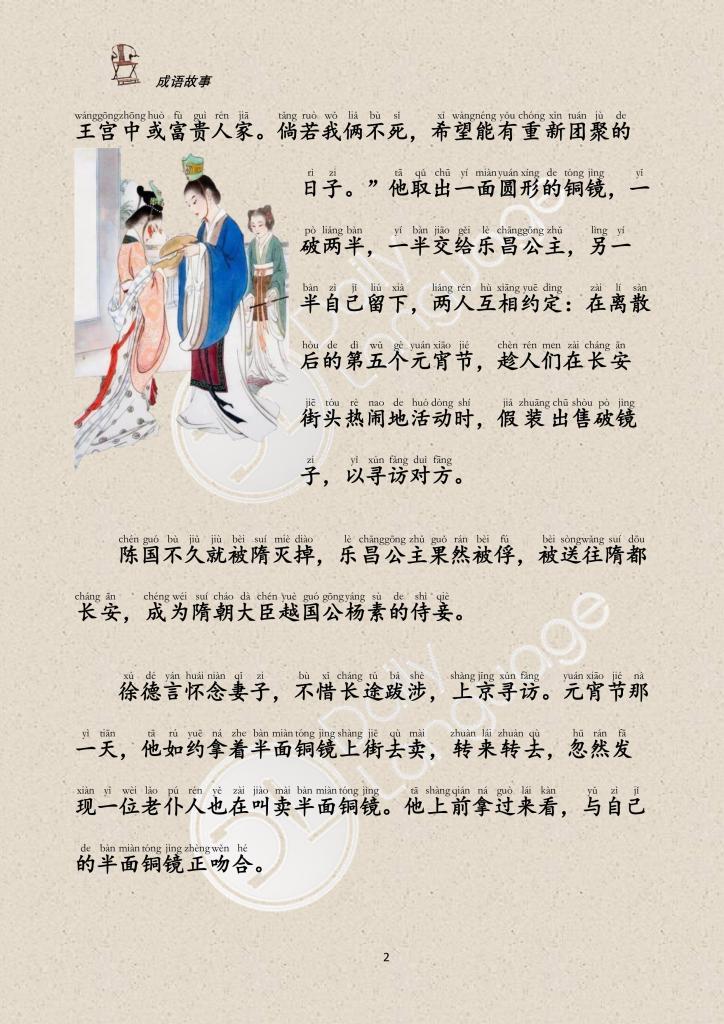
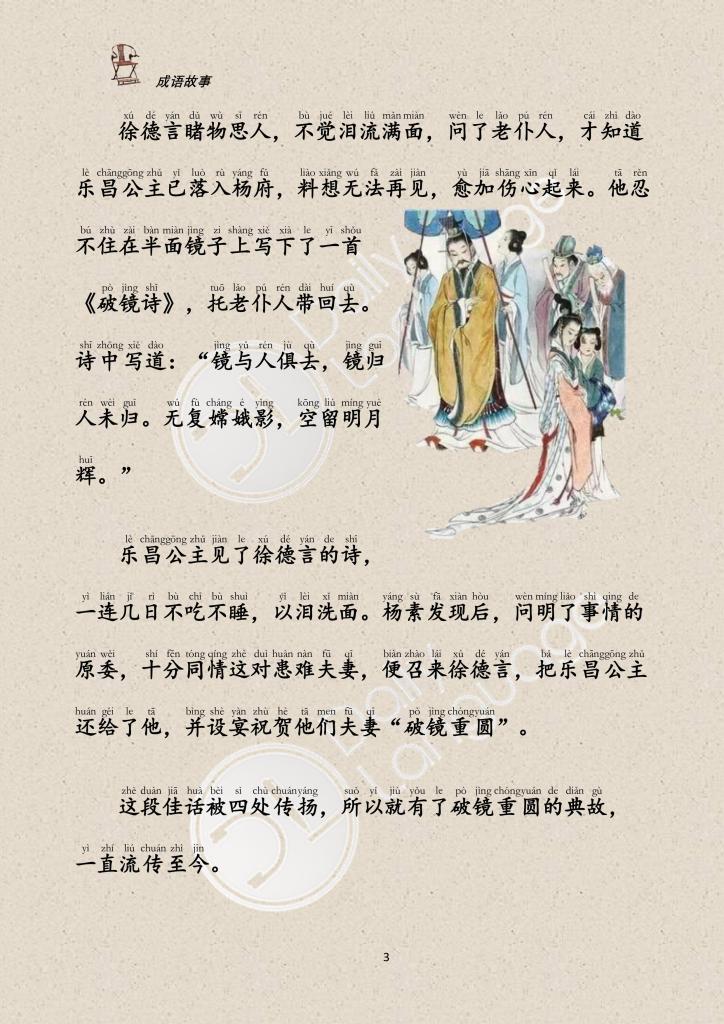
In the Northern and Southern Dynasties when the State of Chenwas facing its demise, Xu Deyan, husband of the princess, broke a bronze mirror into halves.

Each of them kept a half as tokens in case they were separated.

Soon afterwards, they did lose touch with each other, but the two halves of the mirror enabled them to be reunited.

This idiom is used to refer to the reunion of a couple after they lose touch or break up.

破镜重圆

[pò jìng chóng yuán],比喻夫妻失散或决裂后重新团聚与和好。

出自唐·孟棨《本事诗·情感》。

例句

他的父母已离婚多年,最终还是破镜重圆了。

这对夫妻经十年离散,今天得以破镜重圆,不禁悲喜交集,抱头痛哭。

人世间的破镜重圆,大概都是一言难尽。

Reading The Paragraphs!

Meaning of Words


词语华文解释英文解释
寻欢作乐意思是寻求欢快,设法取乐;形容追求享乐。
例句:自从搬到新的住所,他们每晚都外出寻欢作乐
pursue pleasure
预感指事情未发生,就感觉出它的结果好坏。
例句:我有个不祥的预感:我们迷路了。
presentiment
寻访指访求寻找。
例句:传统的西班牙食品美味可口,其特色菜肴值得寻访
 look for
长途跋涉指远距离的翻山渡水,形容路途遥远,行路辛苦。
例句:我们是经过长途跋涉回家的。
trek
如约指按照约定行事。
例句:他没能如约参加我们的晚宴。
according to appointment
吻合指完全符合。
例句:他们每个人对事情的描述都不吻合
be identical
睹物思人意思是看见离别的人留下的东西就想起了这个人。
例句:夫妻俩睹物思人,想起了远在他乡的儿子。
Seeing the thing, one thinks of the person
以泪洗面拿眼泪来洗脸。形容极度忧伤悲痛,终日流泪。
例句:自从爱人离世,她就终日以泪洗面
wash face with tears
原委指事情从头到尾的经过。
例句:我倒吸了口气,接着把事情的原委都告诉了她。
the whole story

成语——恶贯满盈

Meaning of the Idiom

e guan man ying(a full record of crimes and misdeeds)

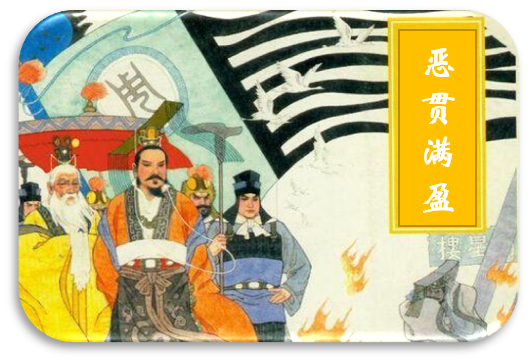
At the end of the Shang Dynasty, King Zhou of Shang was very cruel.

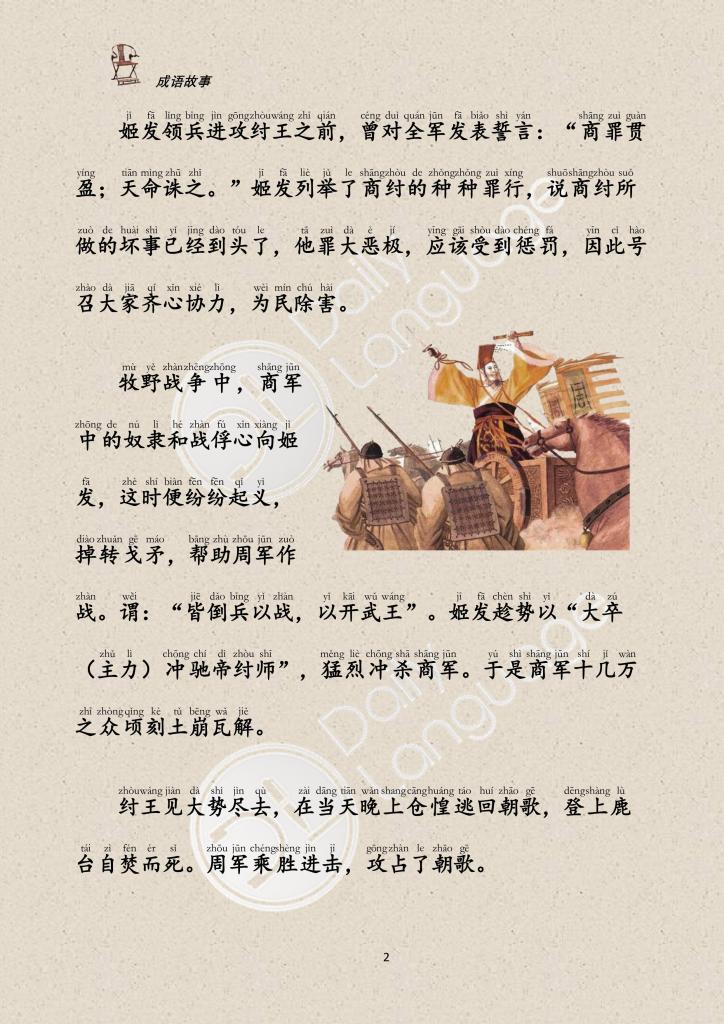
There was a vassal named Ji Chang, who stood for benevolence against the tyranny of King Zhou, and he had him arrested. Later, his son Ji Fa joined forces with the vassals to fight against King Zhou. The army crossed the Yellow River and marched to the commercial capital, where it met the king’s army at Muye. The popularity of Ji Fa led to a great deal of support from the people, who hated King Zhou’s army, resulting in a great defeat for Zhou, who burned himself to death and the Shang Dynasty fell.

Before Ji Fa led the army against King Zhou, Ji Fa made an oath to the whole army, listing Zhou’s crimes, saying that the evil he had done had come to an end, and that he should be punished for his crimes. Call on everyone to work together for the sake of the people.

恶贯满盈

[è guàn mǎn yíng],意为罪恶之多,犹如穿线已穿满一根绳子;形容罪恶极多,已到末日。

出自《尚书·泰誓》。

例句

他年轻时即已恶贯满盈

在小镇上横行多年,他已恶贯满盈,达到不可容忍的地步。

大法官同意了新泽西有史以来最恶贯满盈的连环凶手被判处死刑。

Reading The Paragraphs!

Meaning of Words
 

词语华文解释英文解释
暴虐无道意思是残暴狠毒,丧尽道义。
例句:连续两代国王都暴虐无道,这一王朝很快就被政变推翻了。
full of iniquities
愤慨指愤恨,气愤不平。
例句:我对他们的卑劣行径感到愤慨
indignation
业绩指的是完成的事业和建立的功劳。
例句:他批评公司近期业绩不佳。
performance
礼贤下士形容重视人才。
例句:历史上,有所作为的君主大多能做到礼贤下士,这才会吸引治国人才为国效力。
respect for the wise
列举意思是一个一个地罗列出来。
例句:小明列举了十种解决办法。
list
罪大恶极形容人的罪恶很大。
例句:他们是罪大恶极,死有余辜的罪人。
flagitious
齐心协力形容思想认识一致,为了一个目标而共同努力。
例句:我们一定要齐心协力把工作做好。
make concerted effort
趁势意思是利用有利的形势、时机。
例句:他越过对方后卫,趁势把球踢入球门。
take advantage of a favourable situation
土崩瓦解原义是如土之崩坠、瓦之破碎;比喻彻底崩溃、不可收拾。
例句:这个大家庭在贫困的压力下终于土崩瓦解了。
disintegration
仓皇是仓促,慌张的意思。
例句:几声枪响后,仓皇的人群向四面逃去。
In a hurry
肃清意思是指清除;消灭干净。
例句:政府试图肃清反叛运动,结果失败了。
eliminate

成语——覆水难收

Meaning of the Idiom

fu shui nan shou(It is no use crying over spilled milk.)

Jiang Ziya was born in the Shang Dynasty. He was proficient in the art of war, and King Zhou was cruel and wicked. He had to retreat to a relatively remote place.

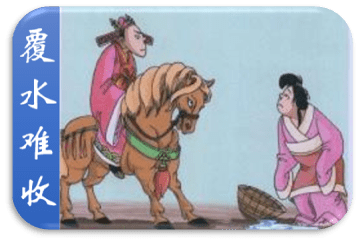
Jiang Ziya’s wife is surnamed Ma. She saw that Jiang Ziya was getting older and older, but he had not made any achievements. She did not want to live with him. Jiang Ziya tried to persuade her patiently at first, but Ma felt that Jiang Ziya was cheating her and refused to believe it anyway. Finally, Ma finally resolutely left Jiang Ziya. Jiang Ziya had no choice but to let her away.

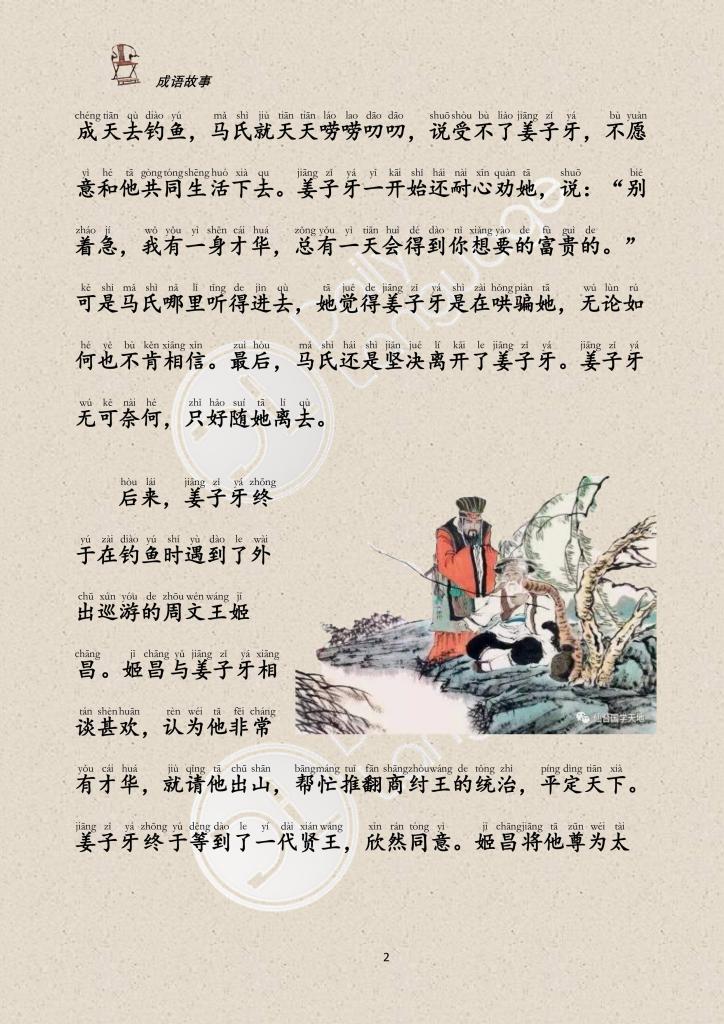
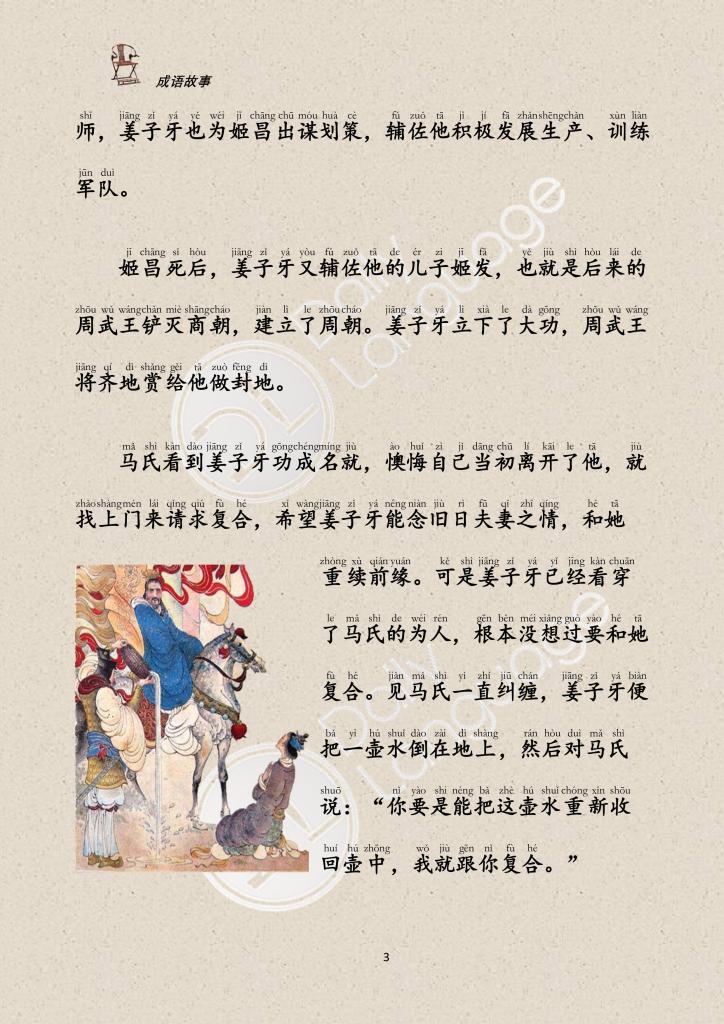
Later, Jiang Ziya finally met Ji Chang, King of Zhou, who was on a cruise. Ji Chang thought him very talented and asked him to leave the mountain. Later, Jiang Ziya made great achievements and King of Zhou awarded him the land of Qi. Ma saw Jiang Ziya success, regret that he had left him, she came to ask for compound. But Jiang Ziya has seen through Ma’s personality, never want to get back together with her. Seeing Ma’s persistence, Jiang poured a pot of water on the ground and said to Ma: “If you can put the water back in the pot, I will get back together with you.”

Hearing this, Ma quickly fell to the ground to fetch water, but the water had already penetrated into the soil, where to get back. Ma struggled for a long time, but only pulled up some mud. At this time, Jiang said to her coldly, “What is done cannot be undone. Do you understand that my relationship with you is the same as that of this pot of water? Since it has been poured out, it is impossible to turn back.”

覆水难收

[fù shuǐ nán shōu],意思倒在地上的水难以收回,比喻事情已成定局,难以挽回。

出自《后汉书·何进传》。

例句

事已如此,覆水难收,你也不必过分悲痛。

这辞呈一旦送出去,也就覆水难收了,能不谨慎吗?

看来这事已经是覆水难收,结局只能如此。

Reading The Paragraphs!

Meaning of Words
 

词语华文解释英文解释
富有才学比喻人极有才华。
例句:这位老先生研究了很多历史典籍,富有才学,写了不少专著。
Rich in talent and learning
谋略指通过对眼前和长远的问题思考而制定的解决对策和方案。
例句:邱吉尔非常有谋略,很早就确定了对欧洲各国的外交方针。
stratagem
残暴昏庸指残忍凶恶,同时还昏头昏脑,毫无才干。
例句:这些孤儿被贩卖为奴隶,如果遇到残暴昏庸的主人,真是会生不如死。
Cruel and senseless
纵然意思是即使。
例句:纵然任务艰巨,我们也要及时完成。
even if
安邦之志意思是安定国家的志向。
例句:李白一直心怀安邦之志,但却一生都没有机会施展。
Ambition of statecraft
施展指显示本领,发挥才能。
例句:父亲在工作中找到了施展抱负的途径。
put to good use
哄骗是指用假话或手段骗人。
例句:这些人一直哄骗我去买他们那些毫无价值的存货。
cheat
相谈甚欢意思是交谈的非常愉快。
例句:虽然只是初次相见,但这两个人却相谈甚欢,一直聊了一个下午。
take happily with each other
欣然意思是非常愉快的,自然的(指表情上的)高兴的样子。
例句:我把座位让给她时,她欣然接受了。
joyfully
辅佐意思是协助,多指政治上,如协助君主治理国家。
例句:他辅佐总统数十年,工作涉及所有的政策,而不仅仅限于新闻发布。
assist
铲灭指铲除;消灭。
例句:这位警探觉得已经是合适的机会去铲灭整个贩毒组织了。
destroy
功成名就指功绩与名利都得到了。
例句:经过多年的努力工作之后,她终于在这一领域功成名就了。
achieve success and win recognition

成语——抛砖引玉

Meaning of the Idiom

pao zhuan yin yu(throw out a minnow to catch a whale)

During the Tang dynasty, there lived a man named Zhao Gu, who was a very talented poet. Zhao Gu’s poems were so well-written that even famous poets of his time enjoyed reading them.

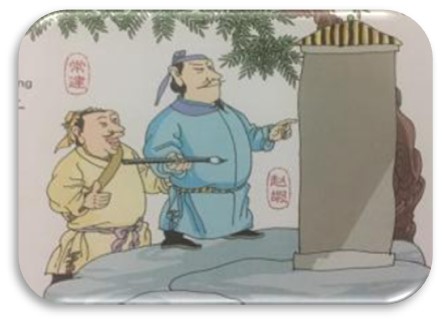
At that time, in a place called Wu, there lived a man named Chang Jian, who also liked to write poems. Chang Jian greatly admired Zhao Gu’s literary talent, and longed to know him personally. One day, Chang Jian heard that Zhao Gu would be travelling to Wu. He knew that Zhao Gu would definitely go visit Ling Yan Temple during his trip, because this was a very famous place which everyone who came to Wu went to see. So Chang Jian went first to the temple, and on the wall which was set aside for guests’ comments and ideas, wrote two lines of poem.

When Zhao Gu saw the two lines of poetry on the temple wall, he could not help adding another two lines, because Chinese poems are always composed of at least four lines. And so Chang Jian achieved his goal. He said, “My poem is a brick, and Zhao Gu’s poem is jade, I layed a brick, and attracted jade!”

This idiom is now a polite expression often used when giving an opinion or delivering a speech. It means that what one is offering is somehow lacking, and one is in hopes that others will, seeing it, offer something that is better.

抛砖引玉

[pāo zhuān yǐn yù],指抛出砖头,引回白玉;比喻用自己粗浅的东西(多指意见、文章),引出好的、珍贵的东西。

出自宋·释道原《景德传灯录·卷十·赵州东院从稔禅师》。

例句

我刚才是抛砖引玉,希望大家发表自己的高见。

以上只是个人的了一孔之见,权当抛砖引玉

他在会议上先提出几点见解,抛砖引玉,希望大家发表更好的建议。

Reading The Paragraphs!

Meaning of Words
 

词语华文解释英文解释
佳句指诗文中精彩的语句或美妙的诗文。
例句:作者饱含创作激情以及深厚的文学功底,使得文章中佳句不断。
beautiful line (in a poem)
博得指换来;取得。
例句:她的眼泪博得观众的无限同情。
gain
规矩指一定的标准、成规。
例句:她不知道新学校的规矩,闹出了很多笑话。
rules
赋诗意思是写诗;作诗。
例句:他生长在书香门第,下棋,赋诗,还有作画,很自然地在他的生活里占了很多的时间。
write poem
反驳意思是指提出反对的理由辩驳。
例句:姐姐总是认为闯红灯没什么,这次出了车祸,我们用事实反驳了她。
refutation
交情指互相交往而产生的情谊。
例句:他不顾多年的交情,拒绝在朋友困难的时候帮助对方。
friendship
推断意思是根据事实或前提推论。
例句:根据血型和外貌特征,他推断这两个孩子是那对夫妇的。
Inference
遗墨意思是名人留下的文字或作品。
例句:他访遍名山大川,就是想寻找这位隐士的遗墨
painting
别致意思是别出心裁,新奇有致之意。
例句:你这枚胸针看起来很别致
Unique
细品意思是仔细的品味。
例句:他细品了这杯红酒,立刻说出了是哪一年的葡萄酿造。
Taste carefully
语意意思是话语所包含的意义及情味。
例句:这篇文章用词晦涩难懂,语意不明。
semantics
未尽意思是还没有到尽头。
例句:虽然晚会结束了,但宾客们还意犹未尽,不愿离去。
unfinished
一时兴起指突发奇想,突然间的兴致所致。
例句:我不是一时兴起跑去泡咖啡的。
on the spur of the moment
兴致盎(àng)然指对某种事物兴趣十分浓厚。
例句:一群游客正兴致盎然地参观这座几百年前建造的城堡。
in high spirits

成语——呕心沥血

Meaning of the Idiom

ou xin li xue(to vomit one’s heart and shed one’s blood)

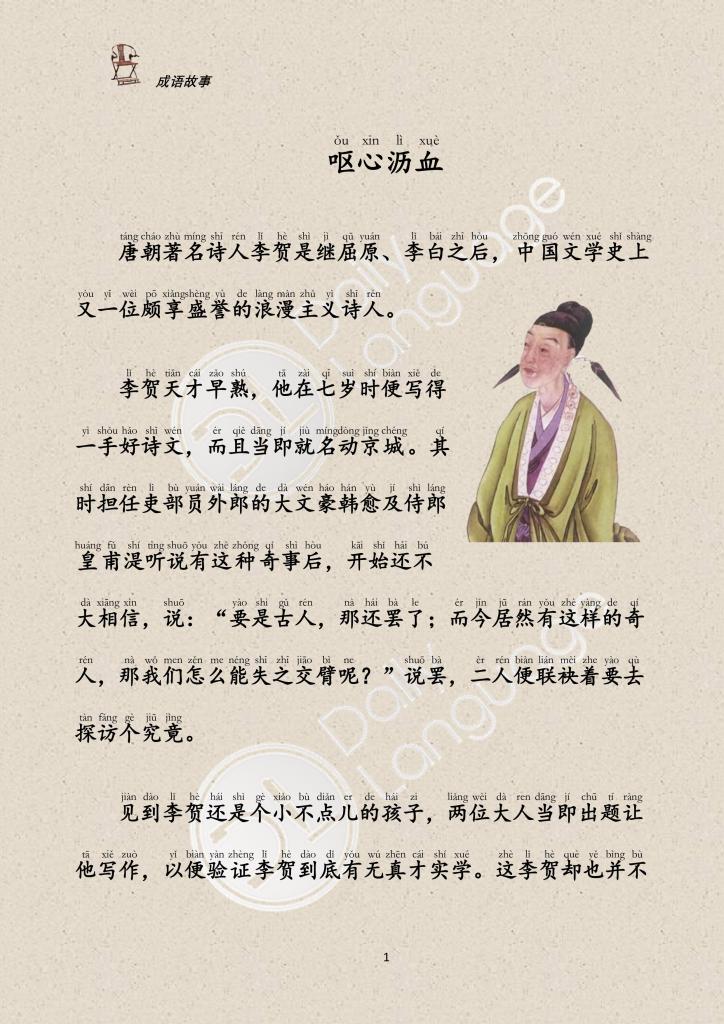
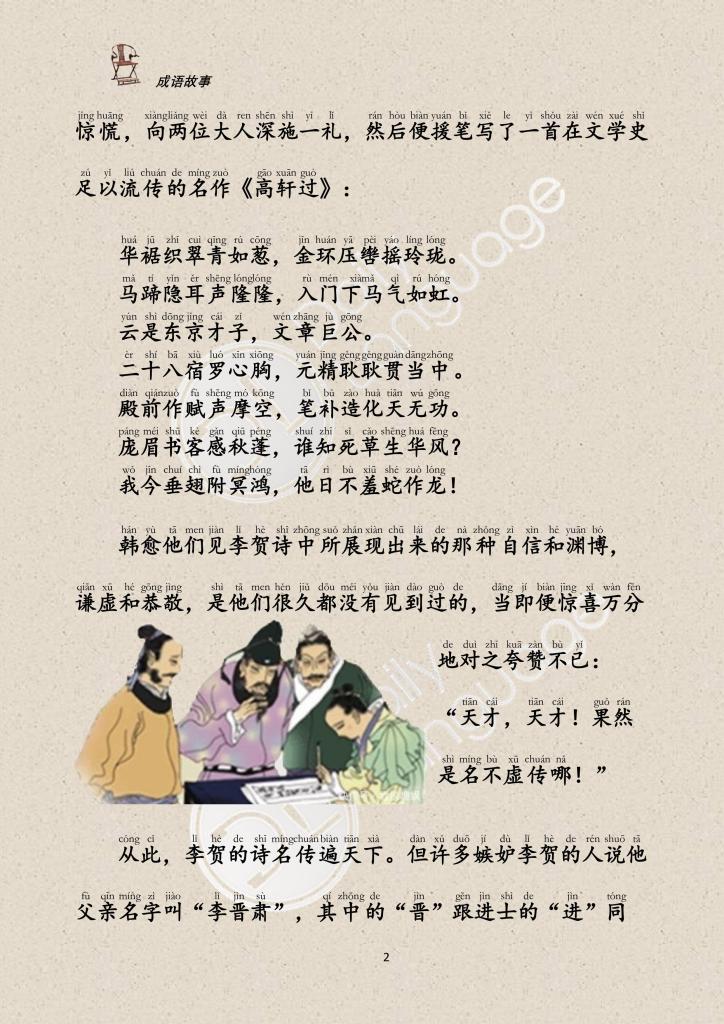
Li He was a famous poet in the Tang Dynasty.

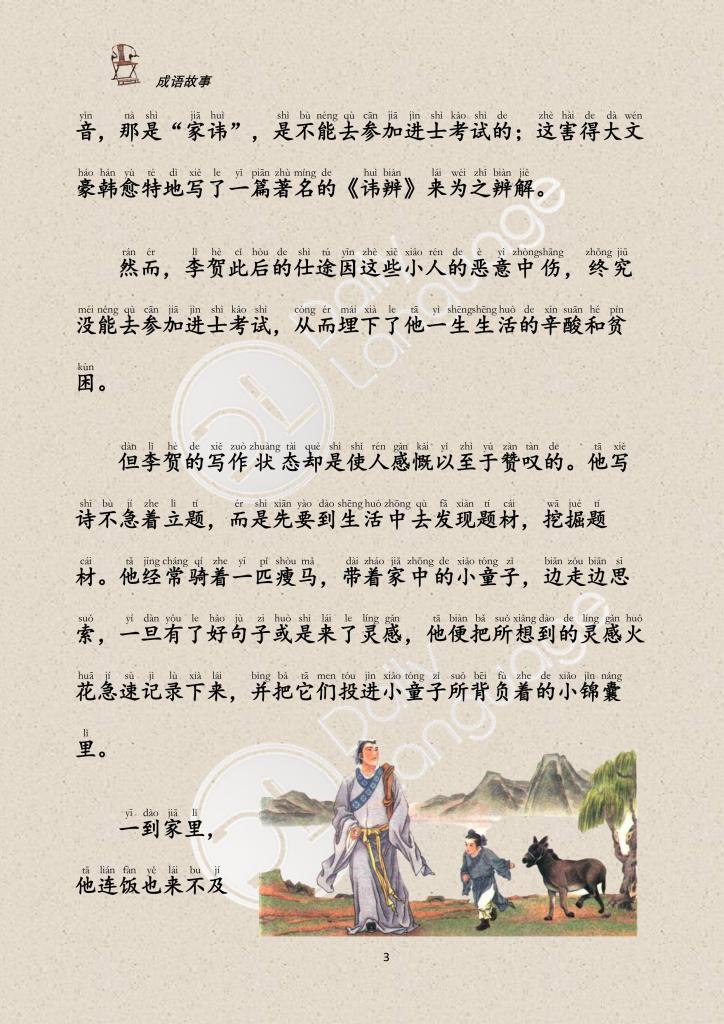
It is said that Li He did not set up a topic first when composing poems, but paid attention to discovering materials in life. Every time he goes out, he always rides a skinny horse, takes a little boy with him, and carries a kit on his back. He thinks while walking, and when he recites a good sentence, he writes a scroll on the horse and puts it in the kit.

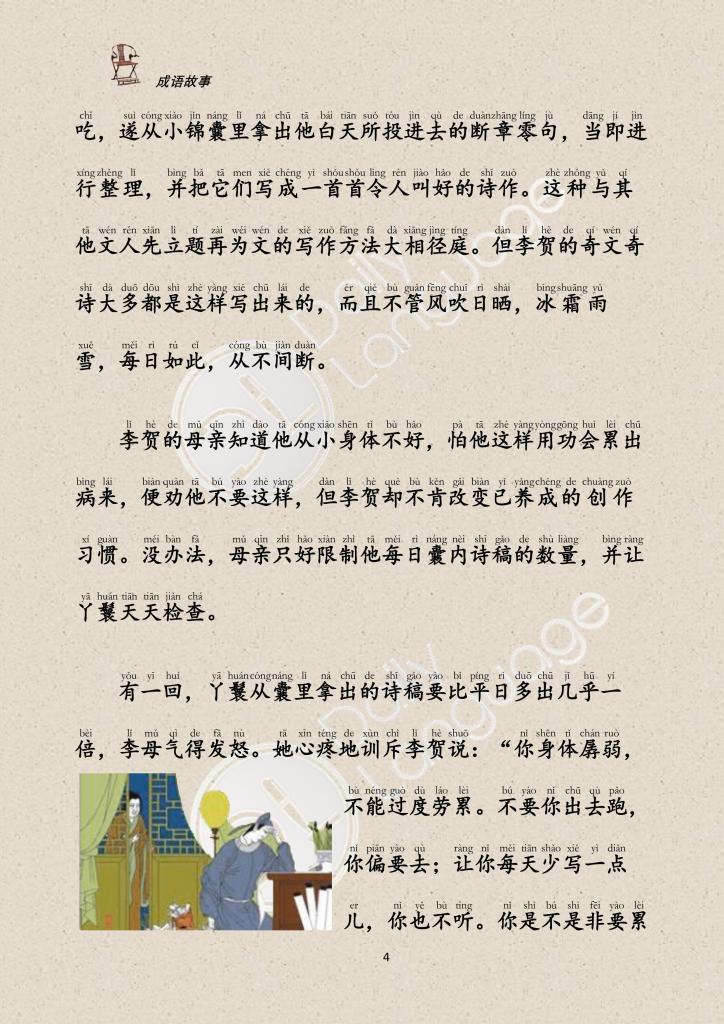
His mother waited for him to go home, checked all his pockets and found that he had written a lot, and often complained to him pitifully: “Don’t tell me you have to vomit all your hard work before you give up!”

Li He wrote poems too hard, which damaged his health. He died at the age of 27, but he left many poems with unique artistic style for later generations, which added splendor to the Chinese poetry world.

呕心沥血

[ǒu xīn lì xuè],形容苦思冥想,费尽心血(呕:吐;沥:一滴一滴)。

出自唐代李商隐《李贺小传》。

例句

如果没有他呕心沥血地工作,就不会有此刻的成绩。

他日复一日呕心沥血地从事着音乐创作。

作为家长,我们为了自己的子女呕心沥血,创造条件,却又不求回报,这也永远不是一种牺牲,相反,我们认为这是一种本能,一种责任。

Reading The Paragraphs!

Meaning of Words


词语华文解释英文解释
盛誉表示极高的荣誉或声誉。
例句:他们中间有许多是国际科学界享有盛誉的科学家。
great fame
早熟指人的生理心理成熟较早。
例句:他从小就明显地又叛逆又早熟
precocious
失之交臂形容当面错过。
例句:我们总是与生命中许多机会失之交臂
just miss the opportunity
联袂(mèi)意思是手拉着手,比喻一同(来 ,去等)衣袖相联;比喻携手同行。
例句:今晚的演出听说会有两位名角联袂登台献艺。
together
真才实学意思是真正的才能和学识。后常用于形容人富有才能及学识。
例句:他这个人我看透了,没有什么真才实学
true skill and genuine knowledge
展现指明显地表现出。
例句:她的表演展现了精湛的技艺。
reveal
名不虚传原义是传出的名声与实际相符合,不是虚假的;确实很好,不是空有虚名,真实。
例句:尼亚加拉瀑布果然是名不虚传的一个奇景。
deserve one’s reputation
中伤意思是诬陷或恶意造谣,旨在毁坏人的名誉。
例句:他们背地里用很恶毒地语言中伤了他。
slander
仕途意思是做官的途径、做官的道路。
例句:他既能耐得住寒窗苦读的寂寞,又能经得起仕途上的重重挫折。
official career
大相径庭比喻彼此相差很远,大不相同。
例句:如果你的现实模型与真实的世界大相径庭,那么你很难模拟出正确的结果。
Very different
孱弱意思是瘦小虚弱;缺乏权威和能力。
例句:他已经很孱弱的身体受到高烧的折磨。
delicate (in health)
故我意思是自己仍象从前一样。
例句:公司的经营状况一直不好,换了几个经理后,依然故我,没有一点好转。
unchanged
由盛转衰意思是从兴盛繁荣转向衰败后退。
例句:去年全球银行业的境遇是由盛转衰的实例之一。
changing from flourish to decadence
无能为力意思是用不上力量,帮不上忙,指没有能力或力不能及。
例句:对于她的病情,除了盼望情况好转,他们无能为力
helplessness
抒发意思是指表达;倾吐。
例句:一个真正的艺术家是尽情抒发自己的胸怀。
express
诡异意思是指很反常,很令人惊讶、奇怪,感到迷惑的事。
例句:这部电影里有很多诡异的场景。
Strange
毕生即一生、终生、今生今世或全部的人生。
例句:她的毕生愿望就是成为名作家。
Lifetime

成语——刻舟求剑

Meaning of the Idiom

ke zhou qiu jian(to mark the boat in order to find the lost sword)

One day, a man of the State of Chu was crossing a river by boat. Due to carelessness, his sword which hung at his side fell into the water. Not in the least worried, he slowly took out a small knife and cut a mark on the side of the boat.

Someone on the boat asked him:

“Why don’t you jump into the water at once to fish for your sword? What’s the use of making this mark on the side of the boat?”

He pointed to the mark on the side of the boat, saying unhurriedly:

“There is no need to worry. My sword fell into the river at this marked place. As soon as the boat reaches the dock and pulls in to shore, I will jump down from here to retrieve my sword.”

No one understood why he did this, and they stopped asking him.

As soon as the ship reached the shore, the Chu man went into the water at the place marked on the ship to retrieve the fallen sword. The Chu people fished for a long time, but never saw the shadow of the sword. He was very surprised and said to himself, “Isn’t this where my sword fell? I made a mark here. How can I not find it now?”

When he said this, the men burst out laughing and said, “How can you find your sword when the ship is still moving and your sword is under the water and will not move with the ship?”

刻舟求剑

 [ěr yú wǒ zhà],比喻死守教条,拘泥成法,固执不变通的人。

出自《吕氏春秋·察今》。

例句

今非昔比,你老是想用老方法解决新问题,和刻舟求剑有何不同?

从事研究工作,眼界要宽,勇于尝试新的方式方法,切忌刻舟求剑

信息时代情况在不断发生变化,我们不能用刻舟求剑的方法来解决新问题。

Reading The Paragraphs!

Meaning of Words
 

词语华文解释英文解释
惋惜表示对某事感到同情、可惜。
例句:这次比赛没能晋级,球迷都为他们感到惋惜
feel sorry (for sb. or about sth.)
胸有成竹指画竹前竹子的完美形象已在胸中;比喻处理事情之前已有完整的谋划打算。
例句:对于这部电影的拍摄思路,这位著名导演早已胸有成竹
have a well-thought-out plan
自言自语指自己对自己说话。
例句:看他思考这道难题,一会儿对窗外凝视,一会儿在纸上作答,时不时的还自言自语,真让人好笑。
talk to oneself