成语——纸上谈兵

Meaning of the Idiom

zhi shang tan bing(to win a war with words

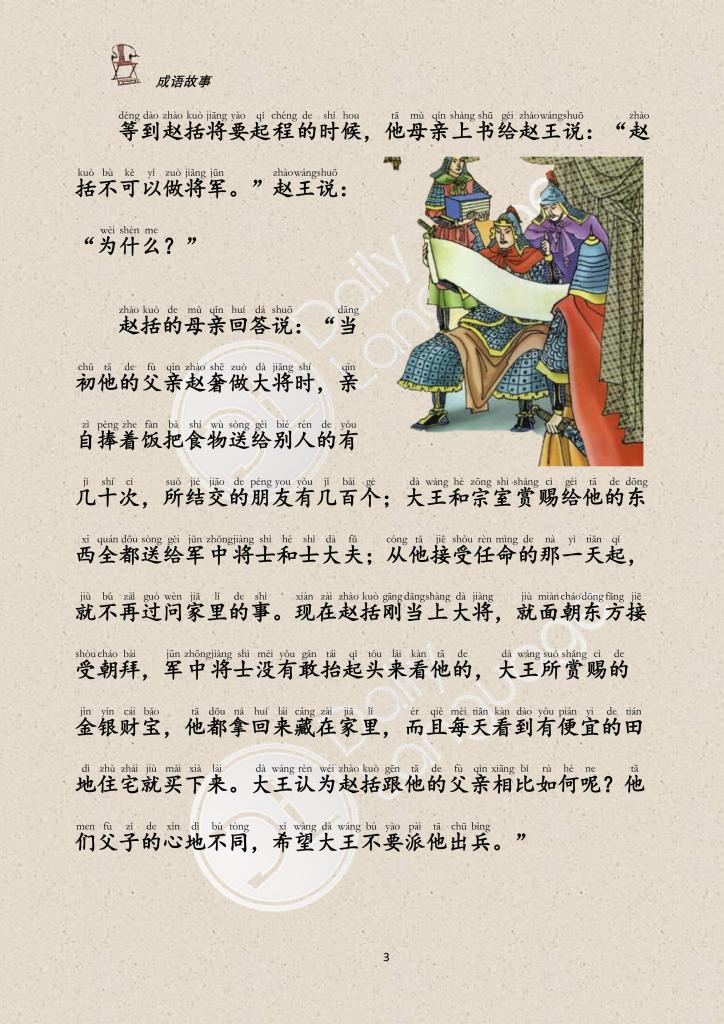
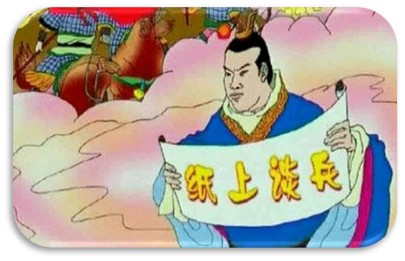
In the Warring States Period, the State of Zhao had a famous general called Zhao She, whose son, Zhao Kuo, was very fond of reading books on military science and discussing strategy.

He could recite military texts by heart, and when discussing warfare he spoke so clearly and logically that it seemed that even his father was not his match.

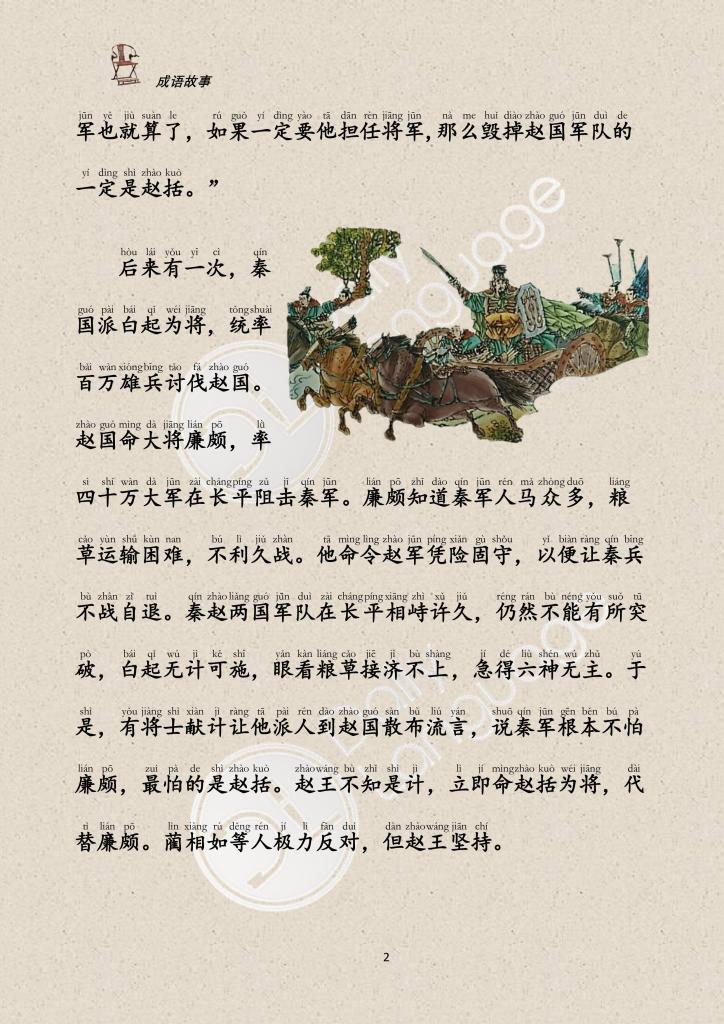
When the State of Qin attacked the State of Zhao, the ruler of Zhao ordered Zhao Kuo to lead 400,000 men to resist the attack. But since Zhao Kuo had no practical experience of battle, he was defeated and lost his life.

纸上谈兵

zhǐ shàng tán bīng,意思是指在纸面上谈论打仗。比喻空谈理论,不能解决实际问题。也比喻空谈不能成为现实。

出自《史记·廉颇蔺相如列传》。

例句

人们都十分讨厌那些只会纸上谈兵,而不能解决实际问题的人。

纸上谈兵学不到真本事,闭门造车结不出好硕果。

我们应该将行动纳入决策当中,否则就是纸上谈兵

Reading The Paragraphs!

Meaning of Words


词语华文解释英文解释
头头是道多形容说话做事很有条理。
例句:他对汽车很在行,各种功能原理讲的头头是道
(what one says)be clear and logical.
驳(bó)倒指成功地否定了对方的意见。
例句:诸葛亮回头看了一眼提问的那个谋士,觉得不先驳倒他,就无法服众。
confute
生死攸(yōu)关攸:所。意思是指生死存亡的关键。
例句:这是千百名战士生死攸关的大事,一定不能含混。
a matter of life and death
纸上谈兵意思是指在纸面上谈论打仗。比喻空谈理论,不能解决实际问题。也比喻空谈不能成为现实。
例句:有些学者只会纸上谈兵,他们的理论在实际中却毫无价值。
to win a war with words
讨伐指出兵征伐。 
例句:纣王无道,各诸侯国纷纷起兵讨伐
crusade against
凭险固守意思是依靠险要地势来把守而不让敌人通过。
例句:这处山隘位置非常重要,只要我们凭险固守,援军一到就可以击退敌兵。
to guard by depending the strategic place
不战自退意思是还没有正面交战,就自己退走了。
例句:正当大家摩拳擦掌准备决战时,敌军却不战自退了。
retreat without fighting
相峙 [zhì]许久指双方互相对峙,持续了很长时间。
例句:两名搏击手你来我往、相峙许久,最终不分胜负。
be locked in a stalemate a long time
无计可施意思是没有办法可用。
例句:如果每家每户都锁好门窗,那闯空门的小偷就无计可施了。
not able to carry out any plan
接济意思是以财物等资助他人。
例句:我们应该接济贫困的人。
give material assistance to
六神无主意思是形容惊恐万分而毫无主张。
例句:孩子发烧了,独自照顾他的父亲六神无主,不知所措。
in a state of utter stupefaction
撤换意思为撤去原有的,换上其他的。
例句:这些广告已经过期,该撤换了。
replace
佯(yáng)装意思是假装。
例句:妈妈问放在桌上的零钱去哪里了?我和弟弟佯装不知。
pretend

成语——背水一战

Meaning of the Idiom

bei shui yi zhan(To fight with one’s back to the river)

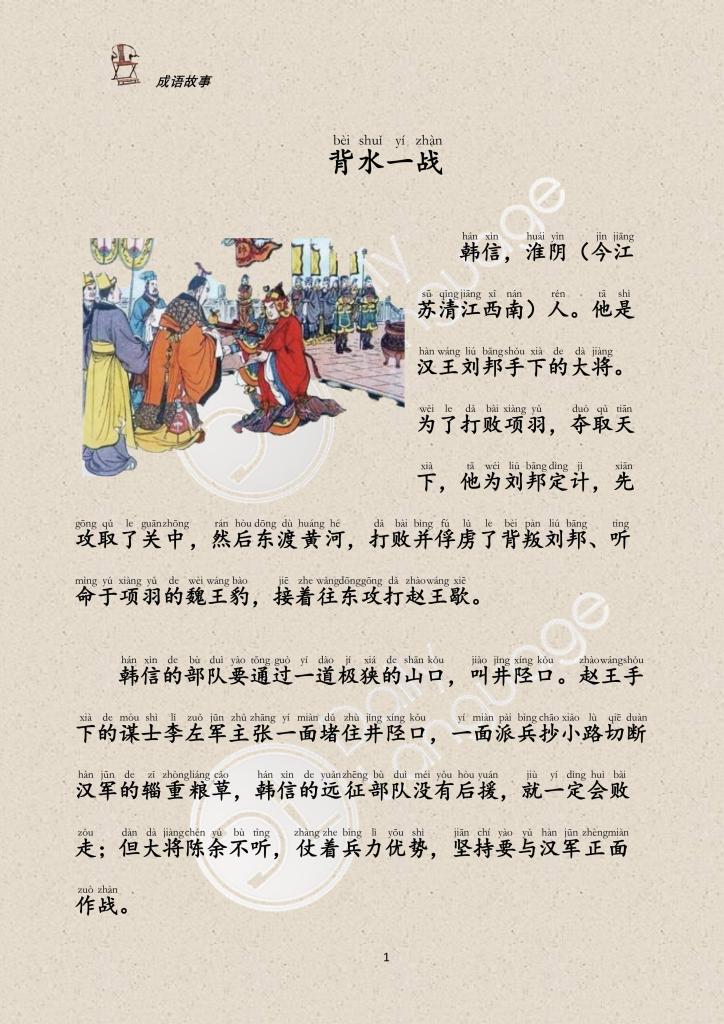
In 204 B.C., there is a war between the state of Han and Zhao in JingXing.

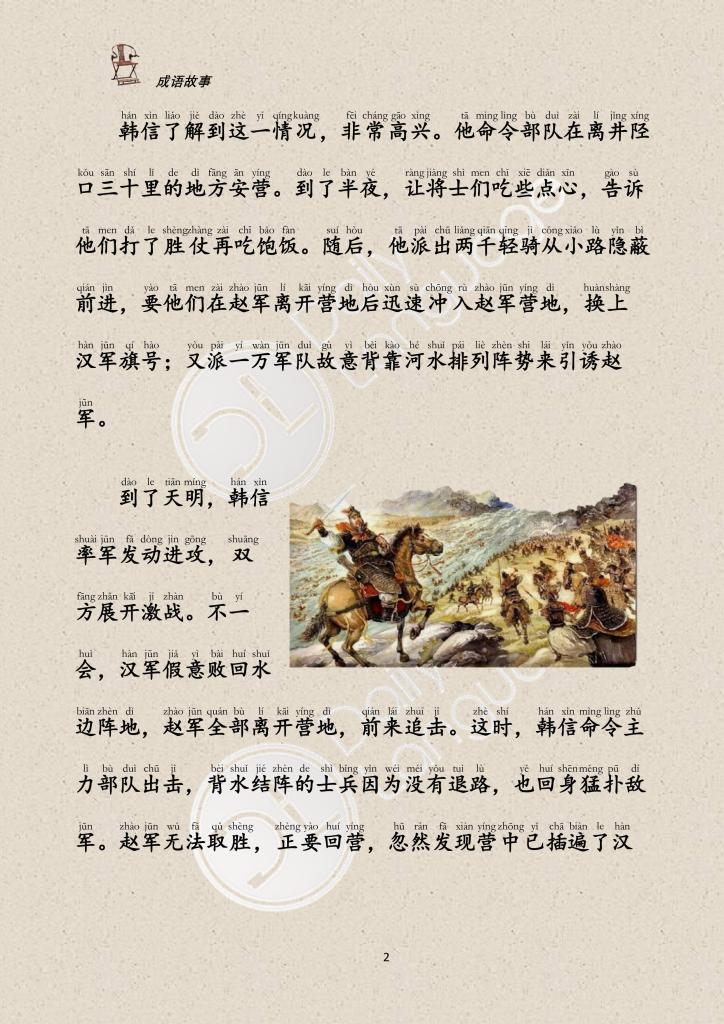
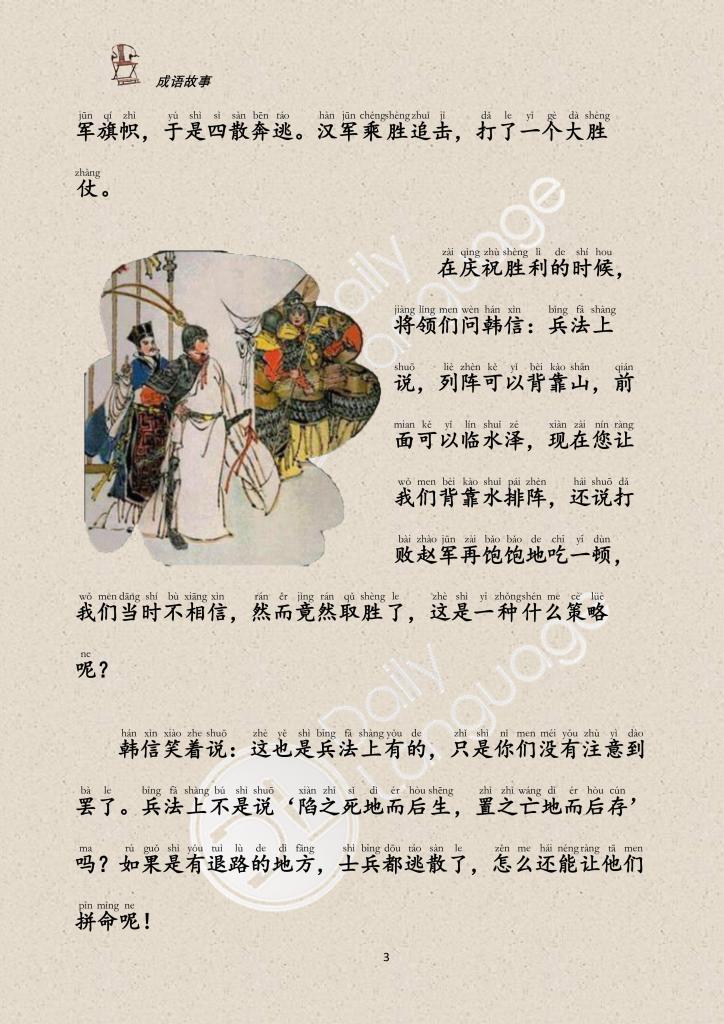
Han Xin, a general of the Han army, arranged his soldiers to fight with their backs to the river.

The soldiers found no way to escape too fight bravely.

As a result, the Han army won the battle.

背水一战

意思是背后临近河水摆阵;或布下的阵势。后来指处于绝境之中,为求出路而决一死战。

出自《史记·淮阴侯列传》。

例句

为了成功,你必须有“背水一战”的准备。

预选赛出现的全部希望就在这最后一搏,队员们决心背水一战

虽然局势极为危险,但为了死里求生,只好背水一战了。

Reading The Paragraphs!

Meaning of Words


词语华文解释英文解释
抄小路意思是选择比较近的小路。
例句:为了追上校车,小明抄小路跑到了车站。
take a shortcut pavement
辎(zī)重指行军时由运输部队携带的军械、粮草、被服等物资。
例句:载满士兵的汽车一辆辆通过路口,最后过去的是辎重车队。
supplies and gear of an army
后援援军。亦泛指在后面的支援力量。
例句:父母是我们强有力的后援
backup
轻骑(jì)指装备轻便而行动快速的骑兵。
例句:飞将军李广,一次仅带了百名轻骑去迎击匈奴,利用智慧迷惑了敌人,全身而退。
light cavalry
隐蔽意思是指借助别的东西遮盖掩藏。
例句:狙击手隐蔽在丛林中,准备在危急时刻解救人质。
hide
策略指可以实现目标的方案集合。
例句:教练制定了以防御为主的策略,应对这次比赛。
strategy

成语——杯弓蛇影

Meaning of the Idiom

bei gong she ying(Mistaking the Reflection of a Bow in the Cup for a Snake

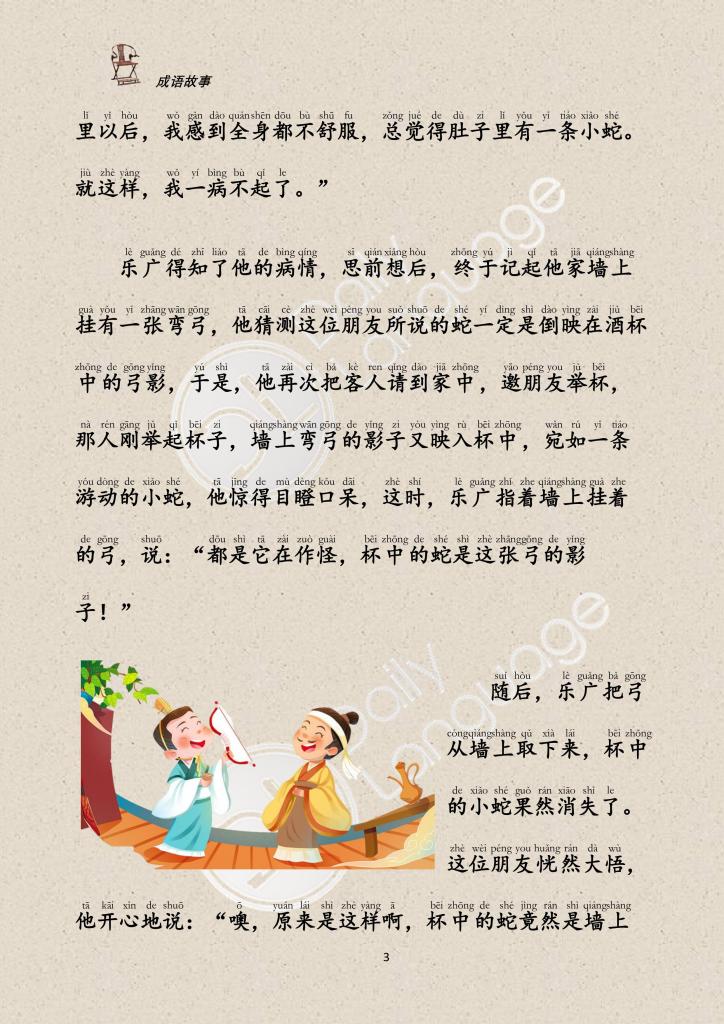
Yue Guang was very hospitable. One day he invited a friend to have a drink in his hall.

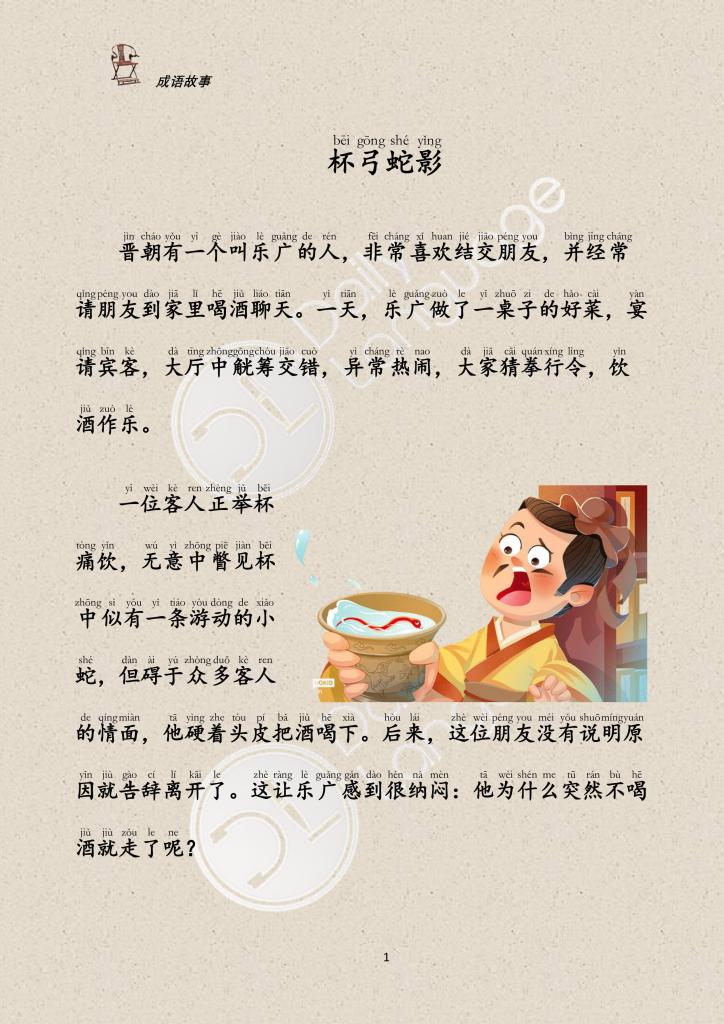
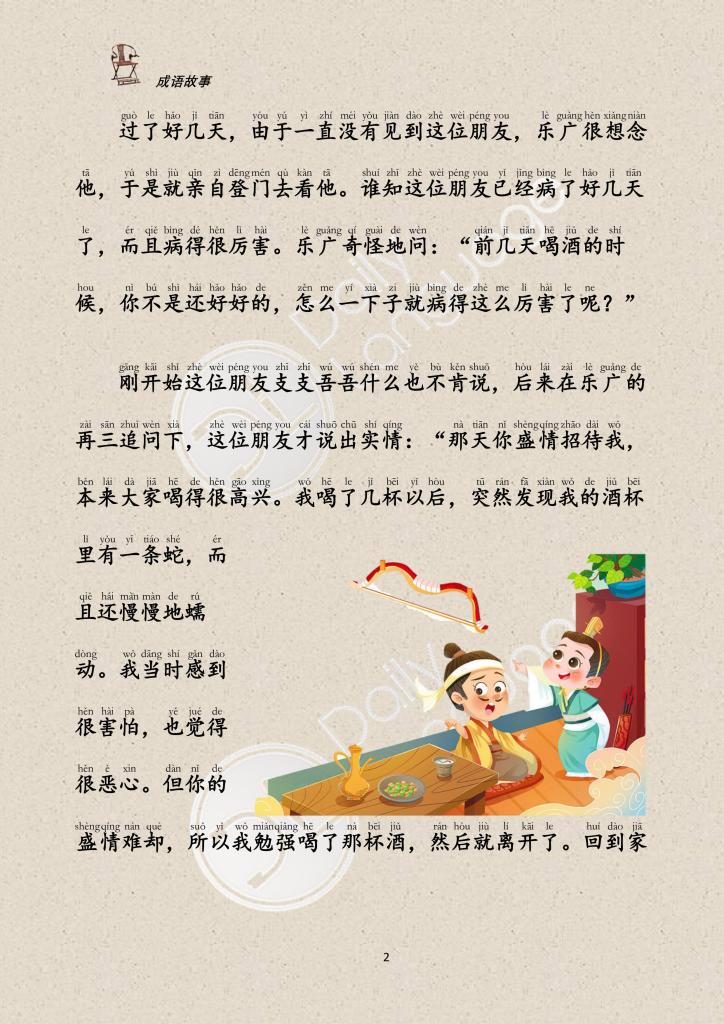
While drinking, his friend thought he caught a glimpse of a small snake swimming around in his cup. Though disgusted, he swallowed the wine down, but the thought of the snake nauseated him. As soon as he got home, he fell ill.

After a few days, Yue Guang heard about his friend’s illness and its cause. He thought that there couldn’t be a snake in the wine cup. So he went to inspect the place where they had the drink and eventually found the cause: on the wall of the hall hung a colourful bow, the shadow of which happened to throw exactly at the place where his friend had put his wine cup.

Yue Guang hurried to his friend’s home and told him about this. As soon as his friend came to understand that it was not a snake but the reflection of a bow in his cup, he got over his illness at once.

杯弓蛇影

bēi gōng shé yǐng ,原义是将映在酒杯里的弓影误认为蛇,后比喻因疑神疑鬼而引起恐惧。

出自《风俗通义·怪神》。

例句

他胆子很小,常常杯弓蛇影,自己吓自己。

大伙儿看了都没事,只有他杯弓蛇影地吓了一身汗。

做了亏心事的人,就会整天杯弓蛇影,心神不宁。

Reading The Paragraphs!

Meaning of Words


词语华文解释英文解释
宴请意思是设宴招待。
例句:新闻发布会后,大使还宴请了所有出席的嘉宾。
fete; entertain
觥筹(gōng chóu)交错觥:古代的一种酒器;筹:行酒令的筹码。觥筹交错表示酒杯和酒筹杂乱地放着,形容许多人聚会喝酒时的热闹场景。
例句:婚礼后的酒会上,宾客们觥筹交错,并纷纷祝贺新人。
toast each other
猜拳行令意思是划拳行酒令。形容宴饮欢畅。
例句:宴会刚开始,这一桌的客人就开始猜拳行令、大声喧哗,让周围的宾客不胜其扰。
play drinker’s wager game
瞥见意思是很快地看了一下,也指无意中看到某事。
例句:小明路过邻居家,无意中瞥见有个陌生人在院子里鬼鬼祟祟。
to glimpse at
碍于指被某种原因阻挡而不能做某事。
例句:虽然小明知道小文也喜欢自己,但碍于周围都是同学,他不敢向小文表白。
for fear of hurting somebody’s feelings
情面意思是私人间的情分和面子。
例句:他这个人非常有原则,即使批评朋友也毫不留情面
feeling
硬着头皮意思是勉强去做难度较大的事情。
例句:爸爸说过,无论什么困难的事,只要硬着头皮去做,就闯过去了。
forced myself to do it
纳闷意思是因为疑惑而发闷。
例句:小雨不明白师傅的意思,又不敢问,只能在心里纳闷
puzzled; wonder
支支吾吾指说话时言语遮遮掩掩,含混躲闪。
例句:在妈妈询问下,小明一直支支吾吾,不敢把学校发生的事说出来。
falter; hesitate in speaking
再三追问指反复不停、多次的询问。
例句:经过妈妈的再三追问,小明才说出学校里发生的事情。
repeatedly ask
盛情难却意思指浓厚的情意难以推辞。
例句:朋友们再三要为我饯行,因盛情难却,我只好接受。
be hard to turn down the warm-hearted offer
勉强意思是能力不够的情况下还尽力做;或做非自愿的事,也有将就或凑合的意思。
例句:虽然最近身体一直不好,但这项工作我勉强还能坚持下来。
reluctantly
一病不起意思是得病后就再也起不了床;比喻得病后病情一天天恶化,终至死亡。
例句:在创作完成后,画家却终因积劳成疾,一病不起
to take to one’s bed and never leave it again
目瞪口呆形容因吃惊或害怕而瞪大眼睛、说不出话的样子。
例句:福尔摩斯刚讲出凶手的名字,所有在场的人全都目瞪口呆,愣在那里。
stunned
恍然大悟意思是对某一事物突然明白、突然醒悟。
例句:听了小明的解释,爸爸这才恍然大悟
suddenly be enlightened
疑窦顿开意思是所有的疑问突然得到了解释和答案。
例句:读完了信,小明疑窦顿开,终于明白了小文的良苦用心。
all the questions were suddenly answered

成语——指鹿为马

Meaning of the Idiom

zhi lu wei ma(calling a stag a horse

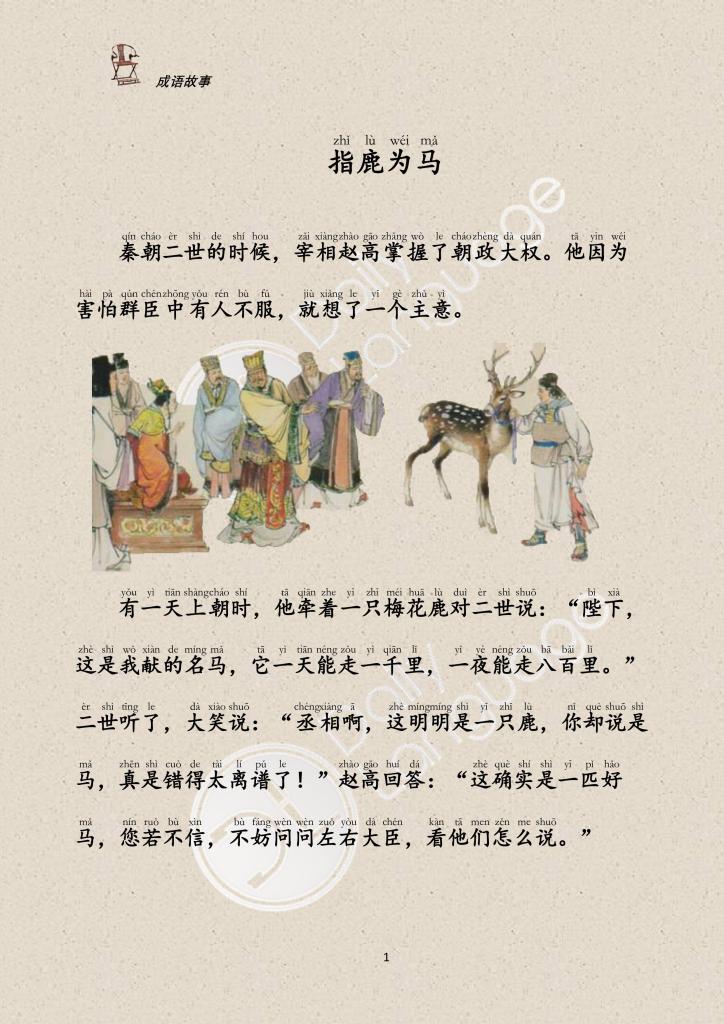
In Qin dynasty, there was a powerful and evil counselor named Zhao Gao.

Zhao Gao wanted to rebel, but he didn’t know how many people in the court would stand by his side.

So he worked out a way to test the people.

He presented a deer as a tribute to the emperor in front of the court, and said that it was a swift horse.

The emperor not accepting his statement said, “This is obviously a deer.”

Then, Zhao Gao took this opportunity to ask the court, “Is this a deer or a horse?”

In the court, those who didn’t dare to go against Zhao Gao agreed with him and said that it was a horse, those who dared to go against Zhao Gao said that it was a deer. Later, Zhao Gao remembered the counselors who didn’t agree with him and persecuted them to solidify his power. This story is still popular even today.

People use this idiom to describe someone who calls white black。

指鹿为马

zhǐ lù wéi mǎ,意思是指着鹿,说是马;比喻故意颠倒黑白,混淆是非。

出自《史记·秦始皇本纪》。

例句

在正义与真理面前,指鹿为马、颠倒黑白的人终究是要受到惩罚的。

这件事情的真相,就在有心人指鹿为马地误导下真假莫辨了。

这个嫌疑犯一直指鹿为马,企图掩饰罪证、推卸刑责。

Reading The Paragraphs!

Meaning of Words


词语华文解释英文解释
离谱意思是形容事物的发展脱离了规律性。比喻一个人在说话、办事等方面不遵循习惯和规则。
例句:他的这个玩笑开的太离谱了,让朋友们都无法理解。
far away from what is normal
不妨表示可以这样做,没有什么妨碍。
例句:这次演出正在挑选演员,你不妨去试试看。
might as well
阿谀奉承(ē yú fèng chéng)意为迎合别人,竭力向人讨好。
例句:这几个围着你整天阿谀奉承的人,根本不是真正的朋友。
flattery; greasiness
摸了底指了解底细、内情。
例句:这次测验让老师对大家的水平摸了底,后面的复习就有方向了。
know the real situation
加官进爵指官职提升。
例句:新部长一上任,就立刻对自己的部下加官进爵,引起了民众的不满。
be promoted in rank
把持意思是指拿,握;比喻揽权专断,不让别人参与。
例句:家里的钱都是被儿子把持,根本不给父母用。
hold; control
混淆(xiáo)是非意思是故意把正确的说成错误的,把错误的说成正确的。
例句:他不仅不承认自己的错误,还试图混淆是非,把过错推给别人。
confuse right and wrong

成语——熟能生巧

Meaning of the Idiom

shu neng sheng qiao(Practice makes perfect.)

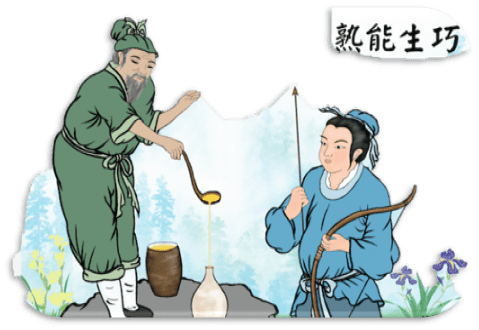
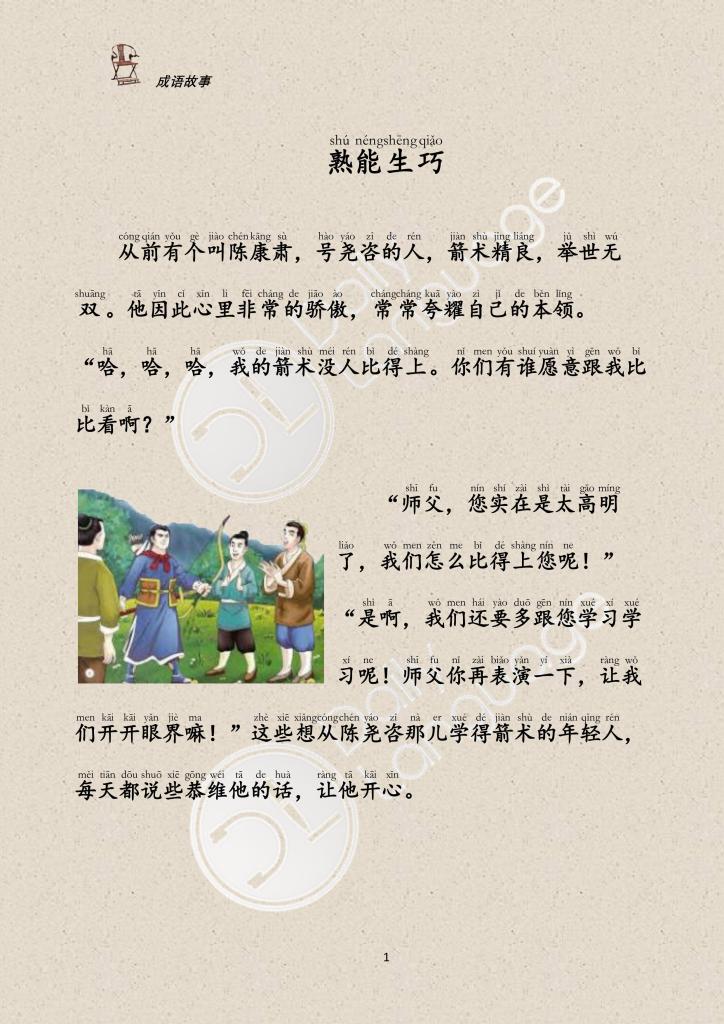
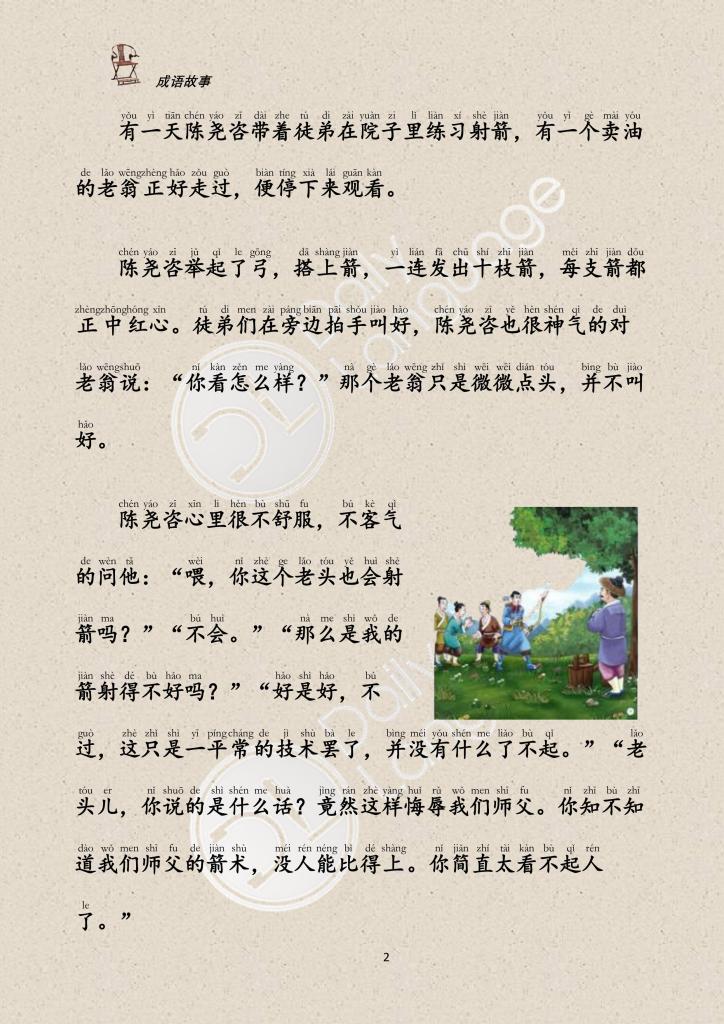
Chen Yaozi, Duke Kang Su was unsurpassed in archery, and he had a very high opinion of himself.

One day, when he was shooting arrows in his own garden, an old oil peddler happened to pass by. The old man laid down his shoulder pole with its load, stood to one side, watched askance for a long while and didn’t go away.

When the old man saw him hit the target every time, he didn’t cheer, but only nodded slightly. Duke Kang Su asked:

“Do you know archery too? Isn’t my skill excellent?”

The old man said:

“This is nothing, only skillful technique.”

Duke Kang Su was angry and rebuked him loudly:

“How dare you belittle my archery skill?”

The old man replied unhurriedly:

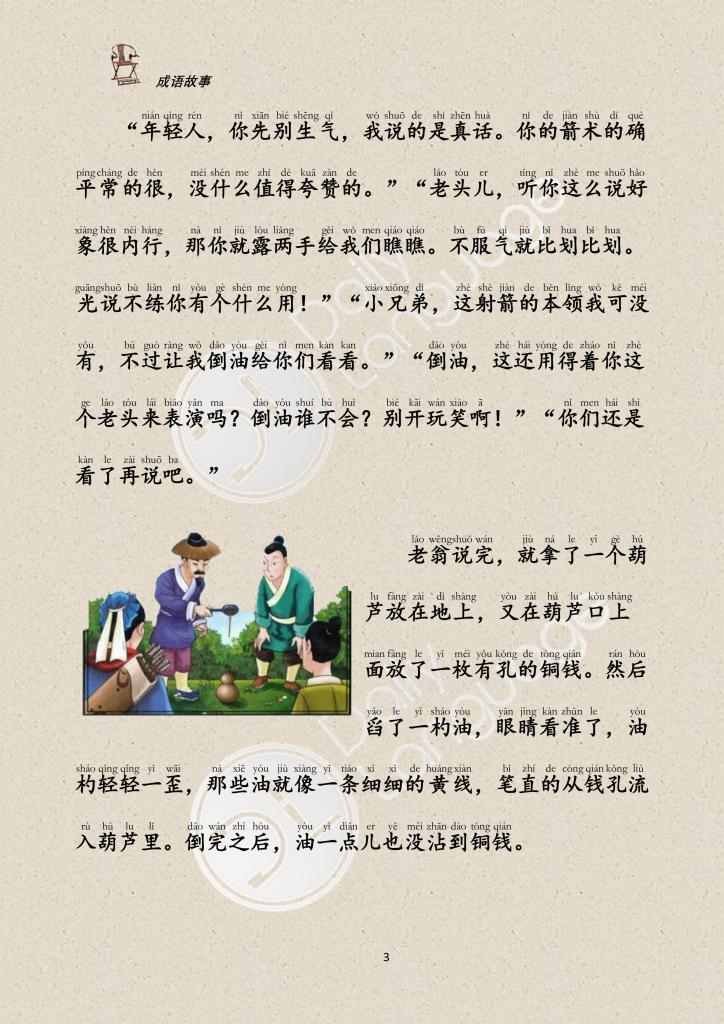
“I know this from pouring oil.”

As he spoke, he put a bottle gourd on the ground, and a copper coin with a hole in its centre on the mouth of the bottle gourd. Then he slowly poured oil into the bottle gourd with a ladle. The oil, like a thin string, went straight into the bottle gourd through the hole in the copper coin without staining the coin at all.

The old man smiled and said:

“This is nothing either, only skillful technique.”

熟能生巧

shú néng shēng qiǎo,意思是熟练了就能产生巧办法、好办法。

出自《镜花缘》。

例句

要想掌握技术,只有勤学苦练,才能熟能生巧

吹制这个玻璃花瓶需要高超的技巧,这位师傅已经做了十几年。俗话说熟能生巧,只见他一套流畅的动作后,花瓶制成了 。

奶奶说熟能生巧,果不其然,经过一遍遍的尝试,我终于做出了美味佳肴。

Reading The Paragraphs!

Meaning of Words


词语华文解释英文解释
精良意思是精致优良;十分完善。
例句:这部小说字体清晰,印制精良,可以作为收藏版了。
excellent
举世无双指世界上再没有第二个这样的人或物,形容极其罕见稀有;无与伦比。
例句:圆明园位于北京西郊,是一座举世无双的大型皇家园林。
have no equal in the world
夸耀意思是指向人炫耀自己的长处、优势、功劳等,属于贬义词。
例句:她很谦逊,从不夸耀自己。
flaunt
恭维指出于讨好对方的目的而去称赞、颂扬。
例句:他们当面恭维你,可是转过背去又在说你的坏话呢!
flatter
光说不练意思是指只会说而不干实事。
例句:他是个光说不练的人。
all talk, no action
窍门比喻解决问题的好办法。
例句:告诉你一个小窍门,这样会使做这件事方便得多。
key(to a problem); know-how
得心应手意思是心手相应,运用自如,多形容技艺纯熟。
例句:这把斧子他用了很久,砍起树来得心应手的。
handy with facility / with facility
琢磨原指琢和打磨玉石。现比喻反复思考;研究。
例句:他话中的意思,我当然可以琢磨出来!
ponder

成语——愚公移山

Meaning of the Idiom

yu gong yi shan(Yu Gong Moves Away the Mountains)

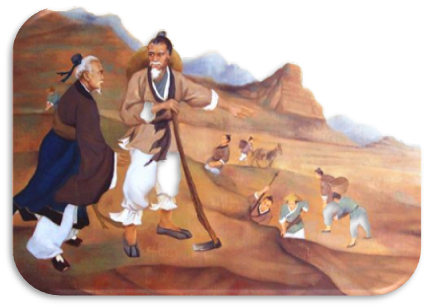
In ancient times, there was an old man named Yu Gong. He was nearly 90 years old. There were two mountains in front of his house. One was the Taihang Mountain, the other the Wangwu Mountain. It was very inconvenient for people to come and go.

One day, Yu Gong said to the whole family:

“These two mountains block the doorway of our house. It is very inconvenient for us to come and go. Let our whole family exert efforts to move away these two mountains. How about it?”

Upon hearing this, all his sons and grandsons said:

“You are right. Let us start tomorrow!”

But his wife felt it too difficult to move the mountains. She said:

“Do you know how high these two mountains are? How can you move such big mountains? Where can you put all the stones and earth?”

Everybody said:

“So long as we work hard together, we can certainly move away these two mountains. We can carry the stones and earth of the mountains to the sea.”

The following day, Yu Gong led the whole family and started to move the mountains. His neighbour was a widow with a son, only 7 or 8 years old. When he heard of this, he also came to help happily. They worked nonstop every day, fearing neither heat in summer nor cold in winter, neither wind nor rain.

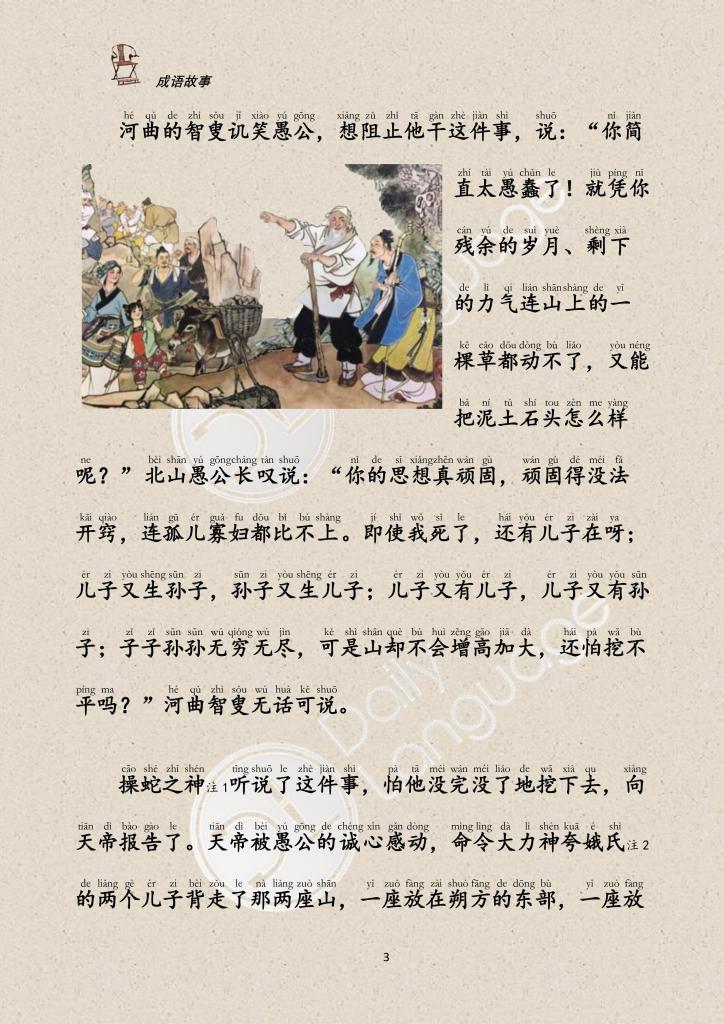
When a shrewd old man named Zhi Sou saw Yu Gong’s family moving the mountains, he thought it ridiculous and said to Yu Gong:

“You are so old that you can hardly walk. Can you move the mountains?”

Yu Gong replied:

“You are not even as clever as a child. Though I am about to die, I have sons. When my sons die, there are still grandsons. Generation after generation, my offspring are endless. But with more and more stones being removed, smaller and smaller will the mountains become. Not a grain of earth or a piece of stone will grow on the mountains. If we work without stop every day, why can’t we move away the mountains?”

Zhi Sou, who thought himself clever, had nothing more to say.

Yu Gong led his family digging the mountains continually from early morning till late night. They finally moved God, who sent two celestials to the world to move away these two mountains.

愚公移山

yú gōng yí shān,说明了要克服困难就必须坚持不懈的道理。

出自《列子·汤问》。

例句

科学家们以愚公移山的精神去改造沙漠,让它变成绿洲。

在学习上,我们要发扬愚公移山的精神。

只要有愚公移山的精神,就什么困难都能克服。

Reading The Paragraphs!

Meaning of Words


词语华文解释英文解释
方圆是指定半径范围内的面积 。
例句:方圆几十里的土地,处处是繁茂的麦草。
circumference
阻塞(sè)指有障碍而不能通过,无法畅通。
例句:这条小河被很多垃圾阻塞,小船无法通过。
block
险峻意思是陡峭险恶的山势。
例句:这里的山势险峻,攀岩的难度很高。
steep
讥笑指冷言冷语地嘲笑。
例句:别人有缺点,我们应该热情帮助,不要讥笑他们。
sneer
愚蠢形容人笨,愚昧无知。
例句:这种危及生命的行为是十分愚蠢的。
stupid
残余意思指残存;也指残存的人或事物。
例句:一场残酷的战争后,这支军队仅有残余的几百名士兵。
remnant
长叹指深长地叹息。
例句:想起他这十几年的遭遇,父亲不禁喟然长叹
deep sigh
顽固指思想保守,不愿接受新鲜事物。
例句:这个顽固的老人,怎么也不肯搬离这所摇摇欲坠的小木屋。
obstinate; stubborn
无穷无尽意思是没有止境。
例句:他喜爱读书,因为从中可得到无穷无尽的知识。
endless
无话可说没有什么话可以说,在某些场合下包含一种无奈,郁闷的情感。
例句:他是个很内向的人,即使在朋友面前,也总是显得无话可说
speechless
没完没了意思是无穷尽。
例句:这个演讲内容枯燥又冗长,简直没完没了
endless
诚心意思为诚恳的心意。
例句:相信他这次的道歉是诚心实意的。
sincerely; earnestly
阻隔是两地之间隔绝,难以往来。
例句:即使有万水千山的阻隔,也不能挡住他回乡的愿望。
barrier

成语——夜郎自大

Meaning of the Idiom

ye lang zi da(The state of Ye Lang/self-conceited)

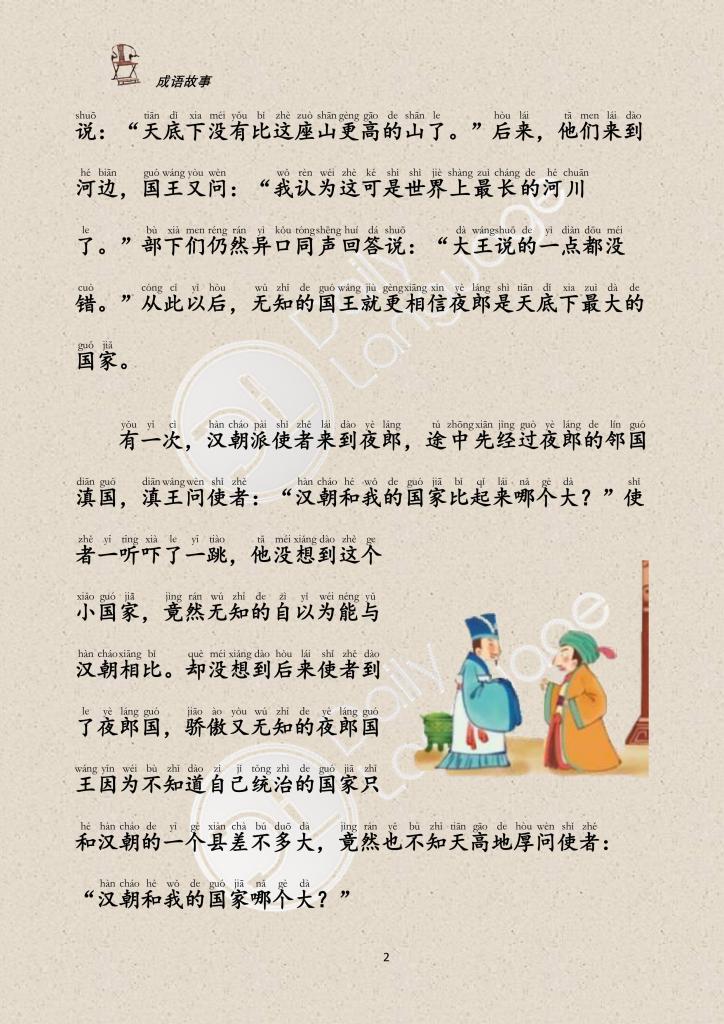
During the Han Dynasty, in the southwest there was a small country called Yelang, and although it was an independent nation, its territory was small, there weren’t many citizens, and its products were pitifully few. Because it was the largest kingdom in the near area, the Yelang king who’d never left his own country thought the country he ruled was the biggest on earth.

One day, the king of Yelang was on a national border inspection tour with his troops, when he pointed in front of him [to neighboring country] and said, “Which country is bigger?” In order to serve their own interests and make the king happy, the troops said, “Of course Yelang is bigger!” They walked along, and the king once again lifted up his head, gazed at the big mountain in the distance and asked: “Is there a taller mountain than this anywhere on earth?” And his men answered: “No, there’s no mountain taller than this one on earth.” After a while, they reached the river side, and the king asked again: “I think this is the world’s longest river.” And all his men said in unison “The king speaks truly.” After this, the ignorant king believed even more firmly that Yelang was the world’s biggest country.

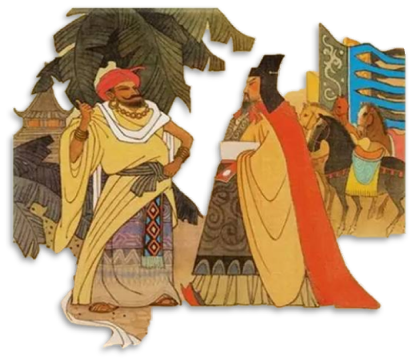
Then one day, the Han Dynasty dispatched an envoy to Yelang, and on the way they passed the neighboring country of Dian, and the King of Dian asked the emissary: “If you compared the Han Dynasty and my Kingdom, which one would be bigger?” The emissary listened in astonishment, as he’d never have thought this small a country thought it could compare itself to the Han Dynasty. But he really never could have suspected that when he got to Yelang, the prideful and ignorant king who didn’t know that the kingdom he ruled was about the size of one Han county, would ask with an exaggerated opinion of his own worth, “Which is bigger: the Han Dynasty or my country?”

夜郎自大

yè láng zì dà,比喻妄自尊大,即骄傲无知的肤浅自负或自大行为。

出自《史记·西南夷列传》。

例句

他只是拿了一次奖,就夜郎自大,认为没有甚麽人比得上他。

他觉得自己很了不起,那种夜郎自大的作风最叫人讨厌。

我们要进步,就绝不能夜郎自大,故步自封。

Reading The Paragraphs!

Meaning of Words


词语华文解释英文解释
巡视意思是指巡行视察。
例句:老师走进考场,就开始四处巡视
go on an inspection tour
迎合意思是猜测别人的心意以便投其所好。
例句:除了小文表达了自己的想法,其他人都只迎合了老板的意见。
cater
异口同声意思是不同的人同时说同样的话。形容意见一致。
例句:老师刚讲出问题,同学们就异口同声地回答了出来。
speak with [in] one voice
无知意思是缺乏知识和重要常识。
例句:他这个人不仅自己无知,还总觉得是别人的问题。
ignorance
不知天高地厚不知道天有多高,地有多深。形容骄狂无知。
例句:这个年轻人不知天高地厚,擅自就决定了这件事。
not to know the immensity of heaven and earth

成语——卧薪尝胆

Meaning of the Idiom

wo xin chang dan(To sleep on brushwood and taste gall)

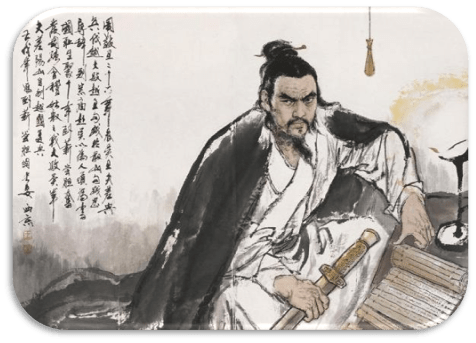
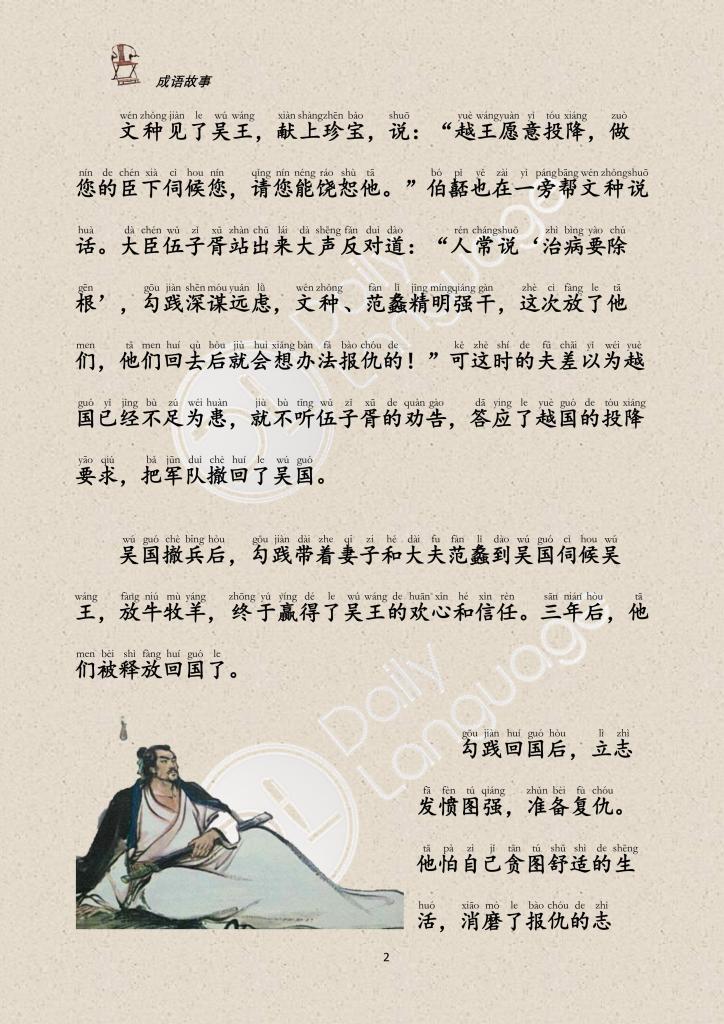
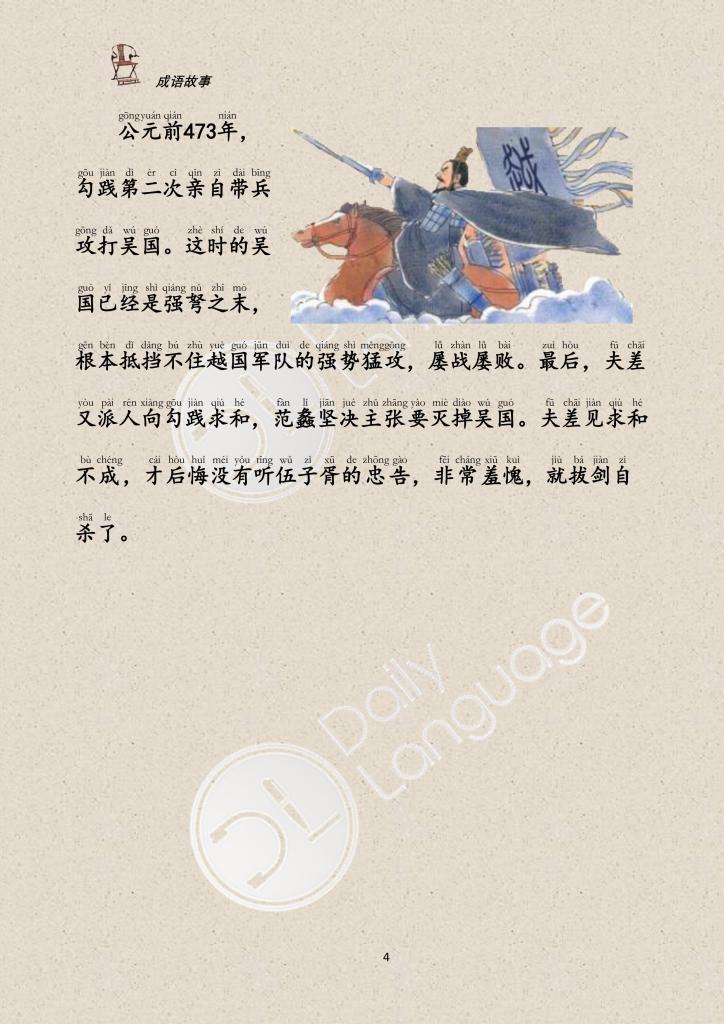
During the Spring and Autumn period (770-476BC), the State of Wu launched an attack against the State of Yue. The King of Wu was seriously wounded and soon died. His son Fu Chai became the new King. Fu was determined to get revenge. He drilled his army rigidly until it was a perfect fighting force. Three years later, he led his army against the State of Yue and caught its king Gou Jian. Fu took him to the State of Wu.

In order to avenge his father’s death, Fu let him live in a shabby stone house by his father’s tomb and ordered him to raise horses for him. Gou pretended to be loyal to Fu but he never forgot his humiliation. Many years later, he was set free. Gou secretly accumulated a military force after he went back to his own state. In order to make himself tougher he slept on firewood and ate a gall-bladder before having dinner and going to bed every night. At the same time he administered his state carefully, developing agriculture and educating the people. After a few years, his country became strong. Then Gou seized a favorable opportunity to wipe out the State of Wu.

Later, people use it to describe one who endures self-imposed hardships to strengthen one’s resolve to realize one’s ambition.

卧薪尝胆

wò xīn cháng dǎn,意思是形容一个人忍辱负重,发愤图强。

出自《旧五代史·汉书·隐帝纪》,《史记˙越王勾践世家》。

例句

自从上次比赛失利,在过去的一年中我们卧薪尝胆、刻苦训练,团队实力转弱为强,终于在这次的全国竞赛中成为冠军。

勾贱卧薪尝胆的故事告诉我们,有志者事竟成。

做为学生要想出类拔萃,考入理想大学,必须有卧薪尝胆的刻苦精神,才能梦想成真。

Reading The Paragraphs!

Meaning of Words


词语华文解释英文解释
嘱咐意思是告诉对方记住应该怎样,不应该怎样。
例句:妈妈已经嘱咐书店老板,要他等新书到货就保留一本给我。
enjoin
牢记意思是牢牢记住,不忘记。
例句:母亲临终的话,他一直都牢记在心里。
remember well
贿赂指给予对方金钱或其它利益,希望获得更大利益的行为。
例句:他们用贵重的礼物贿赂他,希望能获得这份合约。
bribe
深谋远虑意思指计划得很周密,考虑得很长远。
例句:总理深谋远虑,很早就制定了环境保护的法规。
forethought
精明强干指机灵聪明,办事能力强。
例句:他这个人精明强干,这些事交给他办一定没问题。
clever and capable
不足为患意思是不足以成为问题。
例句:这场比赛下来他们已经失去冠军资格,对我们而言已不足为患
not a threat
发奋图强意思是下定决心,努力追求进步,一般情况下与“奋发图强”通用。
例句:自从那次的实验失败以后,科学家没有灰心,继续发奋图强的开展研究。 
rise in great vigor
消磨常指消耗;磨灭;消遣,打发时光;犹琢磨。
例句:假期里我有更多的时间来看书消磨时间。
wear down
耻辱指声誉上所受的损害。
例句:去欺负小孩子,你不觉得耻辱吗?
shame
兵精粮足意思是兵士精壮,粮草充足。形容军力强盛,战备充分。
例句:这位将军仗着自己兵精粮足,守着城池不出战。
have a large army of veterans and ample supplies
盲目比喻无意义、无目的的一种状态。
例句:在没有得到足够的证据前,不要盲目的相信任何结论。
blind
力图极力谋求;竭力打算的意思。
例句:球赛已经接近尾声,但落后一方仍旧力图扭转战局。
try hard to
称霸因具有更大的势力、权威而占据统治地位。
例句:美国作为二战后最强大的国家,称霸世界数十年。
to dominate
强弩(nǔ)之末为强弩所发的弓箭已达射程的最远处,比喻强大的力量已经衰竭。
例句:经过两个小时的竞赛,看对方已经是强弩之末,我们应该再坚持下去,就一定会胜利。
an arrow at the end of its flight
屡战屡败(lǚ zhàn lǚ bài)意思是多次打仗多次失败。
例句:这位将军根本没有战斗力,几场战役下来,屡战屡败
can’t win for losing

成语——东施效颦

Meaning of the Idiom

dong shi xiao pin(Mere copycat)

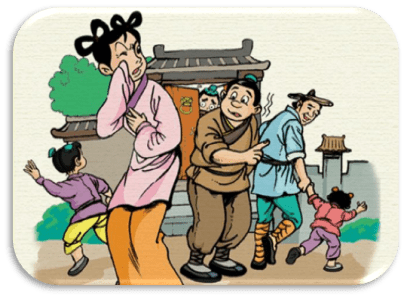
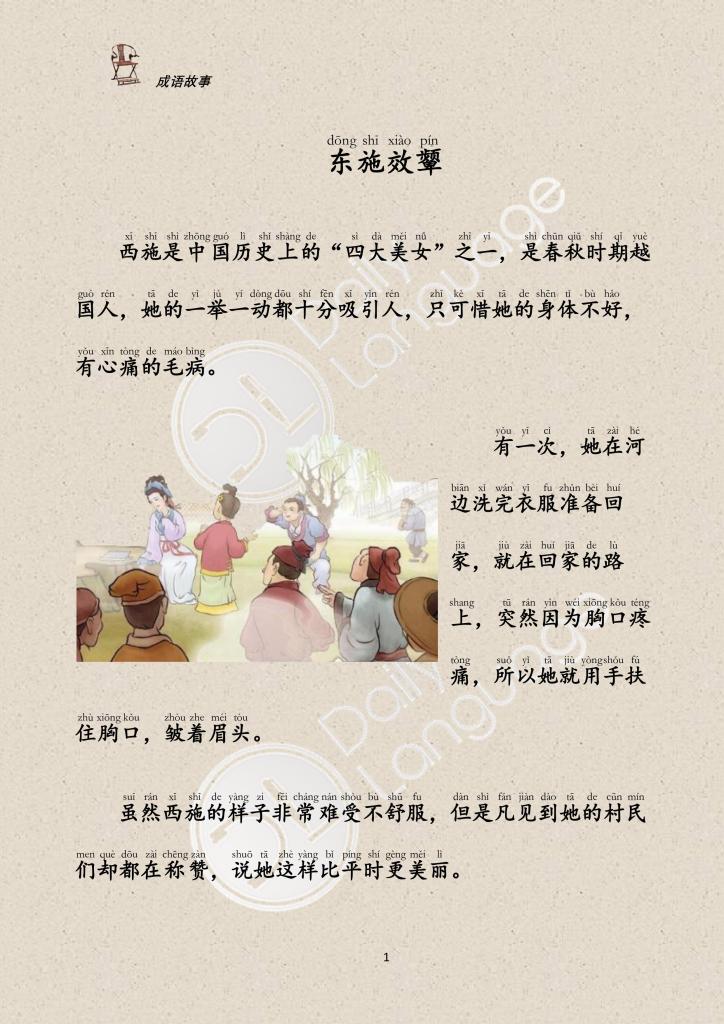
In the Spring and Autumn Period (770-476 BC), there was a beauty in the State of Yue called Xishi.

She often suffered from pains in her chest, and so she would often walk around doubled over and with her brows knitted.

There was an ugly girl in the village called Dongshi who envied Xishi.

Striving to emulate Xishi, she imitated her stoop, knitting her brows at the same time.

She thought that this made her elegant, but in fact, it only made her more ugly.

Later, this idiom came to be used to indicate improper imitation that produces the reverse effect.

东施效颦

dōng shī xiào pín,比喻模仿别人,不但模仿不好,反而出丑。有时也作自谦之词,表示自己根底差,学别人的长处没有学到家。

出自《庄子·天运》。

例句

凡事一经效仿,总不大妙,多少带点儿东施效颦的嫌疑。

你别再模仿这些歌星了,小心有人会取笑你东施效颦,不知自丑。

一个人如果不考虑自己的条件而东施效颦,只会弄巧成拙。

Reading The Paragraphs!

Meaning of Words


词语华文解释英文解释
一举一动指人的每一个动作。
例句:为了学习到小文每个舞蹈动作,小雨注视着她的一举一动
every movement[action; move]
夸赞指赞美;称赞。
例句:看样子校长是从心里在夸赞她们,不是随便说一说的。
praise
刻意意思是故意、特意、用上全部心思。
例句:她并不刻意修饰,可是仍然显得清纯靓丽。
deliberately
装腔作势意思是故意装出一种腔调,做出一种姿势,用来比喻故意做作。
例句:这个人尽管装腔作势的摆出一副专家的样子,但还是有人一眼看出其实他什么也不懂。
strike an attitude
厌恶是一种反感的情绪。
例句:她对这出戏剧不仅是不喜欢,甚至已经到了厌恶的程度。
hate; detest

成语——水滴石穿

Meaning of the Idiom

shui di shi chuan(Constant dripping wears away the stone)

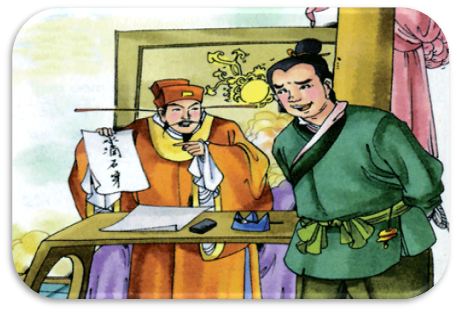
Long long ago, there was a person called Zhang Guaiya and he was a county leader. At that time the beadles always challenge their supervisor, even some of them insulted the generals. Guaiya wanted to make an change to chastise their doings.

One day, when Guaiya was perambulating, he saw a beadle coming out from the warehouse in a hurry. Guaiya asked him to stop and found there was a coin in his headband. After looking into, the beadle refuse to admit that he had stolen the money from the warehouse.

Guaiya sent the beadle to his office and wanted to punish him. But the beadle said angrily: “there is nothing to stole a coin, and why you punish me. You only can beat me but can not kill me.”

Guaiya heard that, saying without hesitate. “If you save one coin a day, you will get one thousand coins after one thousand days. The rope can make the wood broken, and the water can make the stone a hole.”

After judging that, Guaiya put away the pen and command the executioner to cut off the beadle’s head to display to the public.

The meaning is that the water keeps dropping and it can make a hole on the stone after a long time.

水滴石穿

shuǐ dī shí chuān,意思是指水滴不断地滴,可以滴穿石头;比喻坚持不懈,集细微的力量也能成就难能的功劳 。

出自东汉·班固《汉书·枚乘传》

例句

从事文物修缮的工作,要有水滴石穿耐心和心如发丝般的细心。

我们在学习上要有水滴石穿的精神,这样才能取得优异的成绩。

成功,需要我们用水滴石穿一样的意志磨练造就。

Reading The Paragraphs!

Meaning of Words


词语华文解释英文解释
社会风气指社会上或某个群体内,在一定时期和一定范围内竞相仿效和传播流行的观念、爱好、习惯、传统和行为。
例句:政府应该鼓励民众和谐相处,优化社会风气
general mood of society
歪风意思是不良风气。
例句:近期网络上流传一种炫富的歪风
unhealthy tendency
巡视意思是指巡行视察。
例句:侦探用一双锐利眼睛在嫌疑人的队列里巡视了一遍。
make an inspection tour of various places
慌慌张张形容举止慌乱,不稳重。
例句:眼看校门就要关闭了,他才慌慌张张的跑进去。
in a flurry
联想意思是由于某人或某种事物而想起其他相关的人或事物,或由某一概念而引起其他相关的概念。
例句:她盯着眼前的这只蝴蝶,不由的联想起自己在舞会上的美丽舞姿。
associate
判断意思是对思维对象存在、属性等的肯定或否定。
例句:球手需要在极短时间内判断出对方的发球方向。
judge
监守自盗意思是窃取公务上自己看管的财物。
例句:这名银行职员监守自盗,让银行损失了几十万元。
defalcate
审讯通常指法官或警察机关审理案件时,对与案情有关的当事人作详细的查问。
例句:一抓到嫌疑人,警察立即带他回警局审讯
trial
拷打 意思是指审问时为了强逼犯人招供而采用残酷的暴力手段折磨犯人。
例句:为了找到藏匿被绑孩子的地点,这名警员不惜拷打绑架犯逼他说出来。
torture
顶撞用强硬的话反驳别人(多指对长辈或上级)。
例句:小雨一点也不掩饰她的不满心情,当着许多人顶撞老师。
contradict
震怒意思是非常愤怒;盛怒。
例句:这次战役的失利使将军震怒,不惜一切也要重新夺回胜利。
be enraged
毫不犹豫形容人在处理事情上非常果断,没有片刻迟疑。
例句:眼看汽车就要撞到小孩,他毫不犹豫的冲出去把小孩推开了。
without hesitation
震慑意思是震惊使人恐惧。
例句:海军的护航有力的震慑了海盗的肆意抢劫行为。
frighten