jing gong zhi niao(a bird which has been hurt by an arrow — a badly frightened person)
In the Warring States Period, there was a man in the State of Wei called Geng Lei.
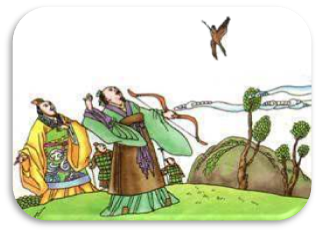
One day he said to the king: ‘I can shoot down birds by simply plucking my bowstring.’ When the king expressed doubt, geng Lei pointed his bow at a wild goose flying in the sky, twanged the bowstring, and the goose fell to the ground.
Geng Lei said, ‘This goose has been hurt in the past. Hearing the twang of the bowstring, it assumed that it was doomed. So it simply gave up trying to live.
This idiom means that if one has been frightened in the past one’s will may become paralysed in a similar situation.
The Owl always takes her sleep during the day. Then after sundown, when the rosy light fades from the sky and the shadows rise slowly through the wood, out she comes ruffling and blinking from the old hollow tree. Now her weird “hoo-hoo-hoo-oo-oo” echoes through the quiet wood, and she begins her hunt for the bugs and beetles, frogs and mice she likes so well to eat.
Now there was a certain old Owl who had become very cross and hard to please as she grew older, especially if anything disturbed her daily slumbers. One warm summer afternoon as she dozed away in her den in the old oak tree, a Grasshopper nearby began a joyous but very raspy song. Out popped the old Owl’s head from the opening in the tree that served her both for door and for window.
“Get away from here, sir,” she said to the Grasshopper. “Have you no manners? You should at least respect my age and leave me to sleep in quiet!”
But the Grasshopper answered saucily that he had as much right to his place in the sun as the Owl had to her place in the old oak. Then he struck up a louder and still more rasping tune.
The wise old Owl knew quite well that it would do no good to argue with the Grasshopper, nor with anybody else for that matter. Besides, her eyes were not sharp enough by day to permit her to punish the Grasshopper as he deserved. So she laid aside all hard words and spoke very kindly to him.
“Well sir,” she said, “if I must stay awake, I am going to settle right down to enjoy your singing. Now that I think of it, I have a wonderful wine here, sent me from Olympus, of which I am told Apollo drinks before he sings to the high gods. Please come up and taste this delicious drink with me. I know it will make you sing like Apollo himself.”
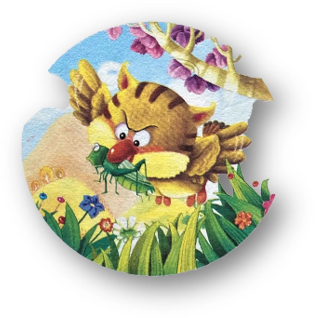
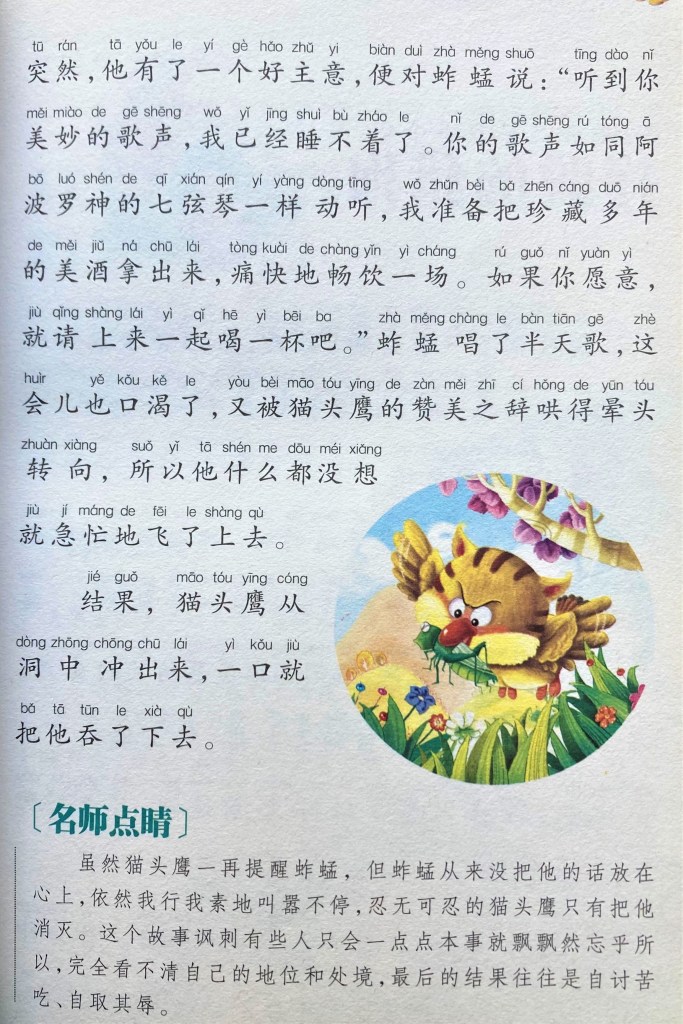
The foolish Grasshopper was taken in by the Owl’s flattering words. Up he jumped to the Owl’s den, but as soon as he was near enough so the old Owl could see him clearly, she pounced upon him and ate him up.
tui bi san she(Retreating about Thirty Miles as Condition For Peace)
During the Spring and Autumn Period (770-476 B.C.), Duke Xian of the State of Jin Killed the crown prince Sheng because he had heard slanders about Sheng and believed them. He also sent his men to arrest Chong Er, Shen Sheng and believed them. He also sent his men to arrest Chong Er, Shen Sheng’s brother. Hearing the news, Chong Er escaped from the state of Jin, remaining a fugitive for more than ten years.
After innumerable hardships, Chong Er arrived at the State of Chu at last. King Cheng of the State of Chu treated him with high respect as he would have treated the ruler of a state, believing that he would have a great achievements.
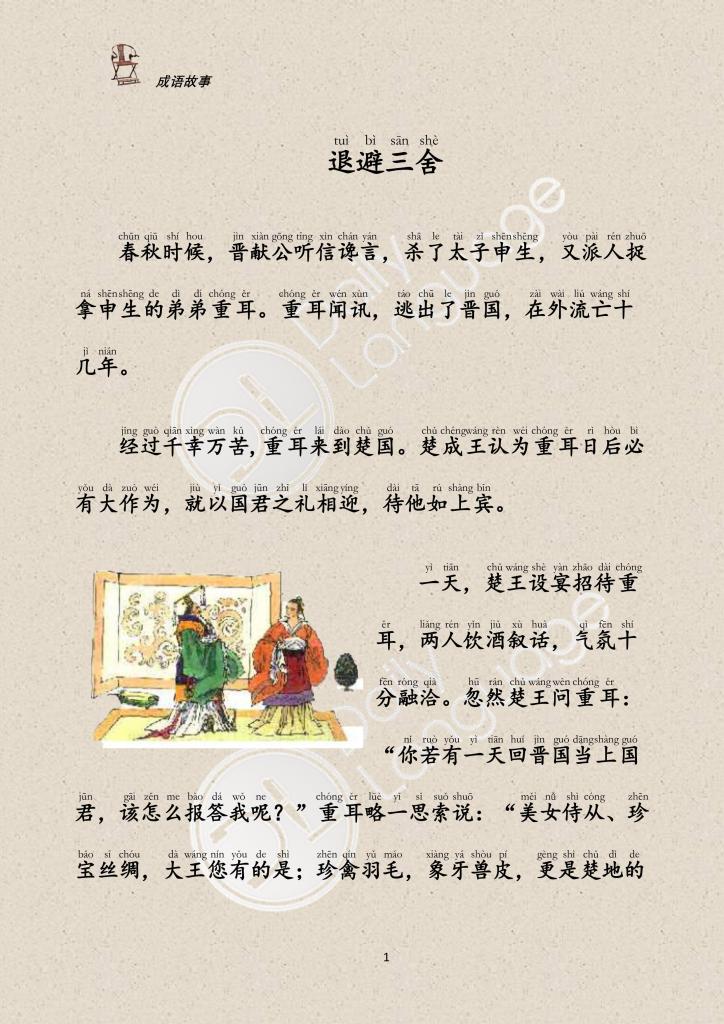
One day, King Cheng of the State of Chu gave a banquet in honor of Chong Er. Suddenly, amid the harmonious atmosphere of drinking and talking, King Cheng of the State of Chu asked Chong Er. “How will you repay me when you return to the State of Jin and become its ruler one day?” After thinking for a moment, Chong Er said, “You have plenty of beauties and attendants as well as jewelry and silk cloth, and the state of Chu abounds in rare brides and animals. What treasure can the State of Jin boast having to present to your majesty?” King Cheng of the State of Chu said, “You are too modest. Nevertheless, you still have to show your gratitude to me in one way or another, I presume?” Smiling, Chong Er answered, “If I should be fortunate enough to return to the State of Jin and become its ruler, the State of Jin would be friendly to the State of Chu. If, one day, there should be a war between the two states, I would definitely order my troops to retreat three SHE (one SHE is equivalent to thirty LI. The LI is a Chinese unit of length equivalent to 1/2 kilometer. And, therefore, three SHE is about thirty miles.) as a condition for peace. If, under that condition, you were still not reconciled, I would have to fight with you.”
Four years later, as might be expected, Chong Er returned to the State of Jin and became its ruler. He was none other than Duke Wen of the State of Jin famous in ancient Chinese history. Ruled by him, the State of Jin became increasingly powerful.
In the year 533 B.C., the Chu troops and the Jin troops confronted each other in a battle. Faithful to his promise, Duke Wen of the State of Jin ordered his troops to retreat about thirty miles. After retreating, the Jin troops were stationed at Chengpu. Seeing that the Jin troops were retreating, the Chu troops thought that the enemy troops were afraid, and began chasing them. Taking advantage of the Chu troops’ arrogance and their talking the Jin troops lightly, the Jin troops concentrated their forces and inflicted a crushing defeat on the Chu troops, thus winning the victory of the battle of Chengpu.
The idea of this set phrase is to give way to somebody in order to avoid a conflict.
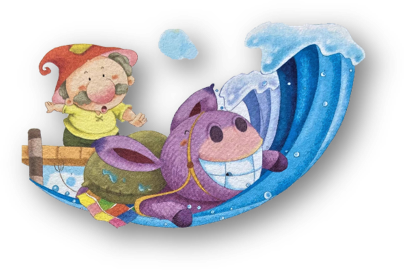
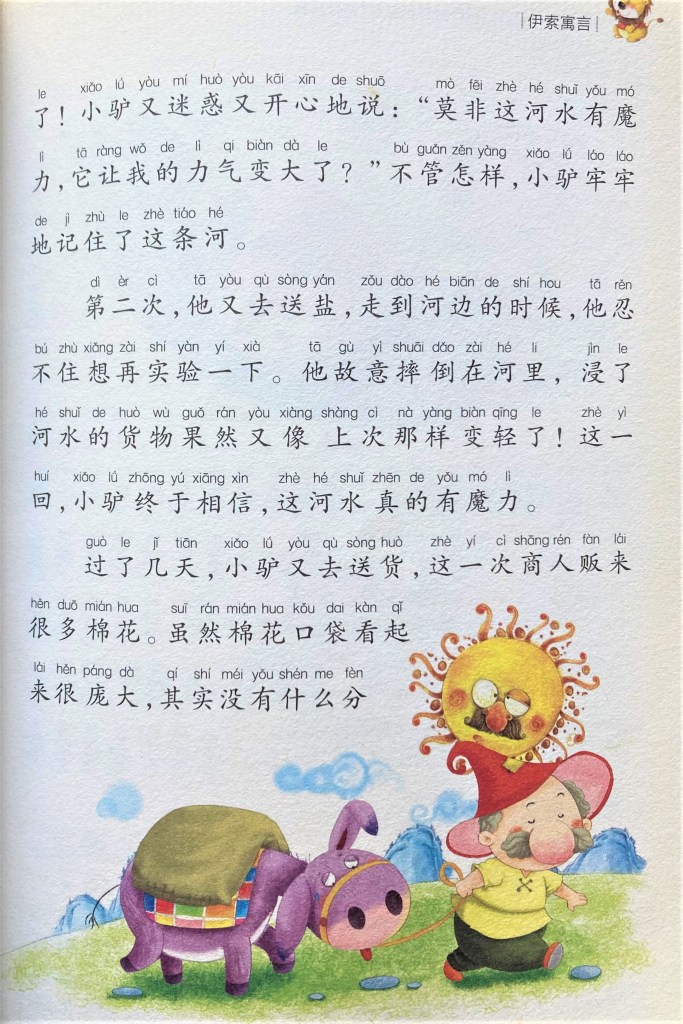
A certain huckster who kept an ass, hearing that salt was to be had cheap at the seaside, drove his ass there to buy some. Having loaded the beast as much as he could bear, he was driving him home, when, as they were passing a slippery ledge of rock, the ass fell into the stream below. The salt melted and the ass was relieved of his burden. Having gained the bank with ease, the ass pursued his journey onward, light in body and in spirit.
The huckster soon afterwards set off for the seashore for some more salt. He loaded the ass, if possible, more heavily than before. On their return, as they crossed the stream into which he had formerly fallen, the ass fell down on purpose and, by dissolving the salt, was again released from his load.
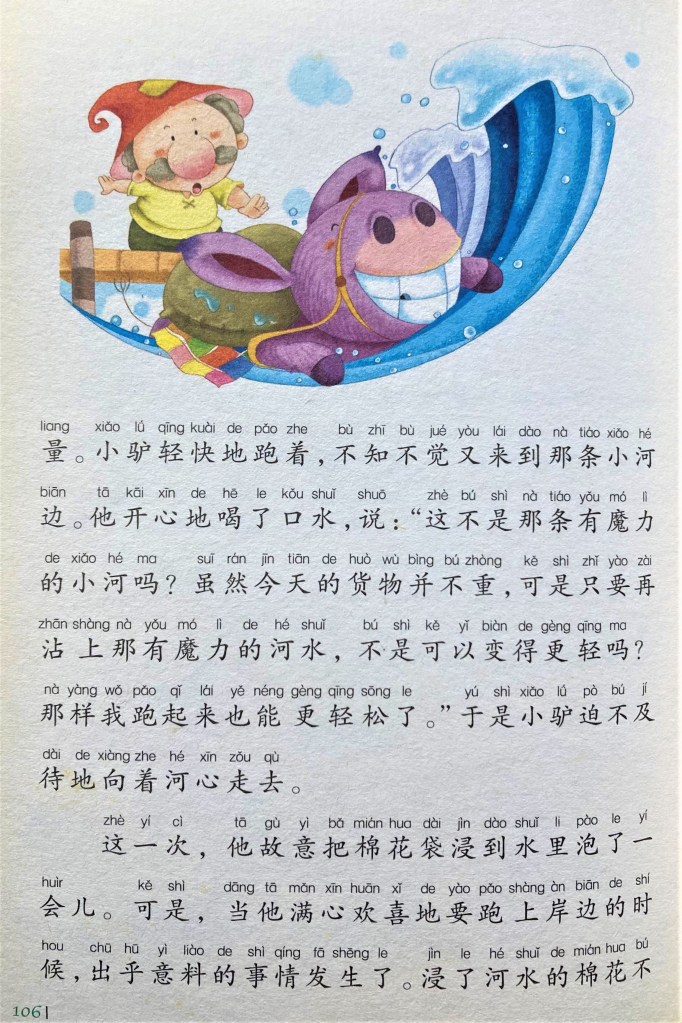
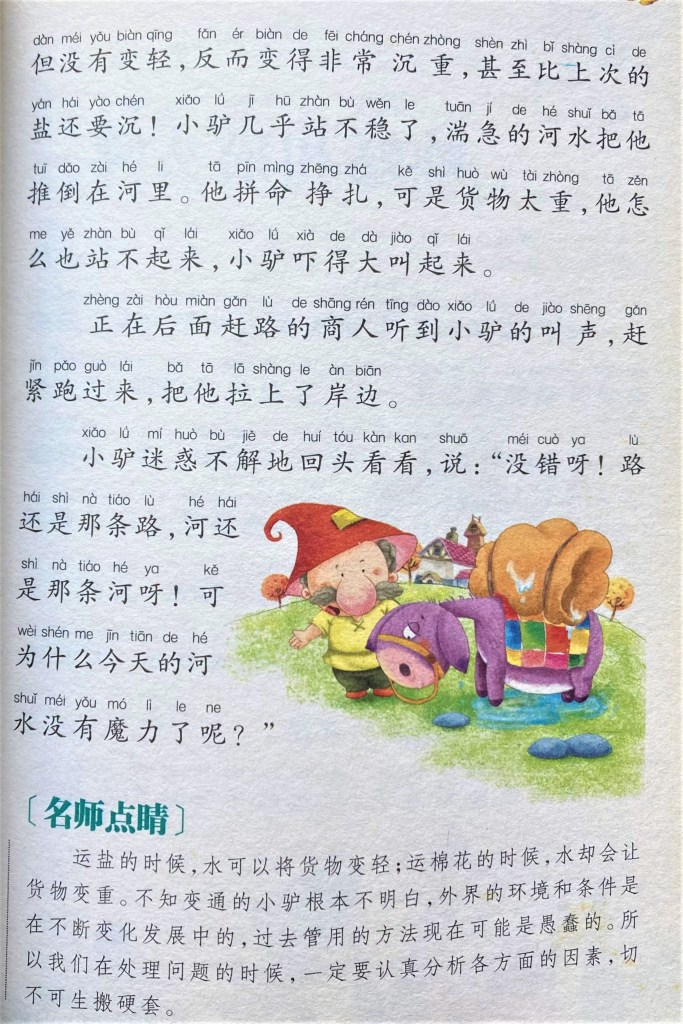
The master, provoked at the loss, and thinking how he might cure him of this trick, on his next journey to the coast freighted the beast with a load of sponges. When they arrived at the same stream as before, the ass was at his old tricks again and rolled himself into the water. He found to his cost that the sponges, becoming thoroughly wet, instead of lightening his burden, he had more than doubled its weight.
The same measures will not suit all circumstances and we may play the same trick once too often.
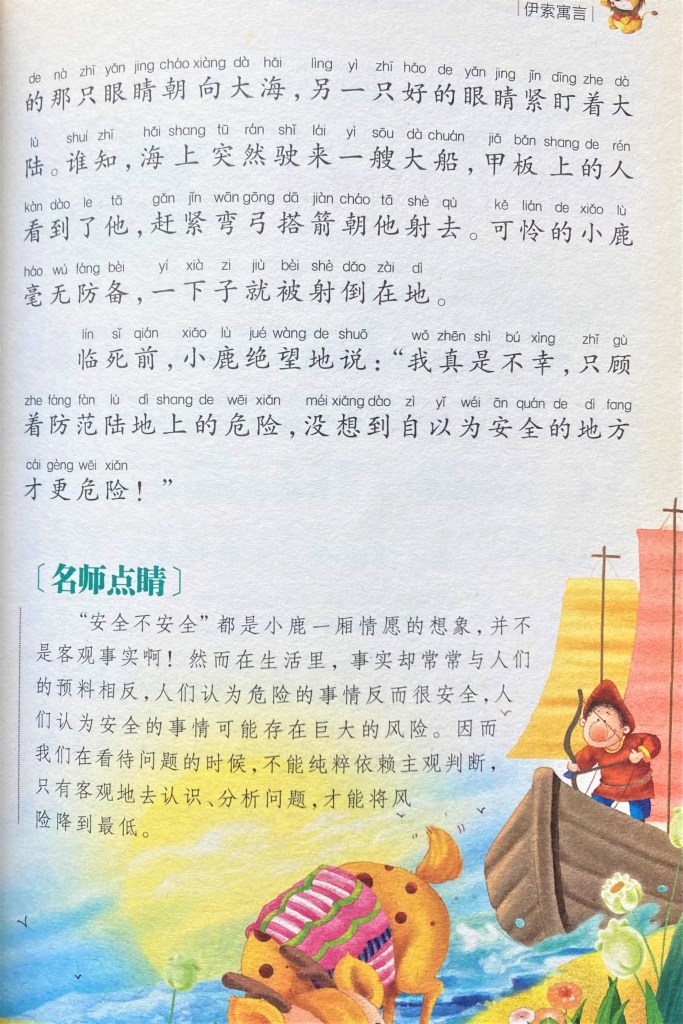
A doe that had but one eye used to graze near the sea. So that she might be more secure from attack, she kept her eye towards the land against the approach of the hunters and her blind side towards the sea, whence she feared no danger. But some sailors rowing by in a boat and seeing her aimed at her from the water and shot her. With her last gasp she sighed to herself: “Ill-fated creature that I am! I was safe on the land side whence I expected to be attacked, but find an enemy in the sea to which I most looked for protection.”
Our troubles often come from the quarter where we least expect them.
zhao san mu si(Three in the Morning and Four in the Evening)
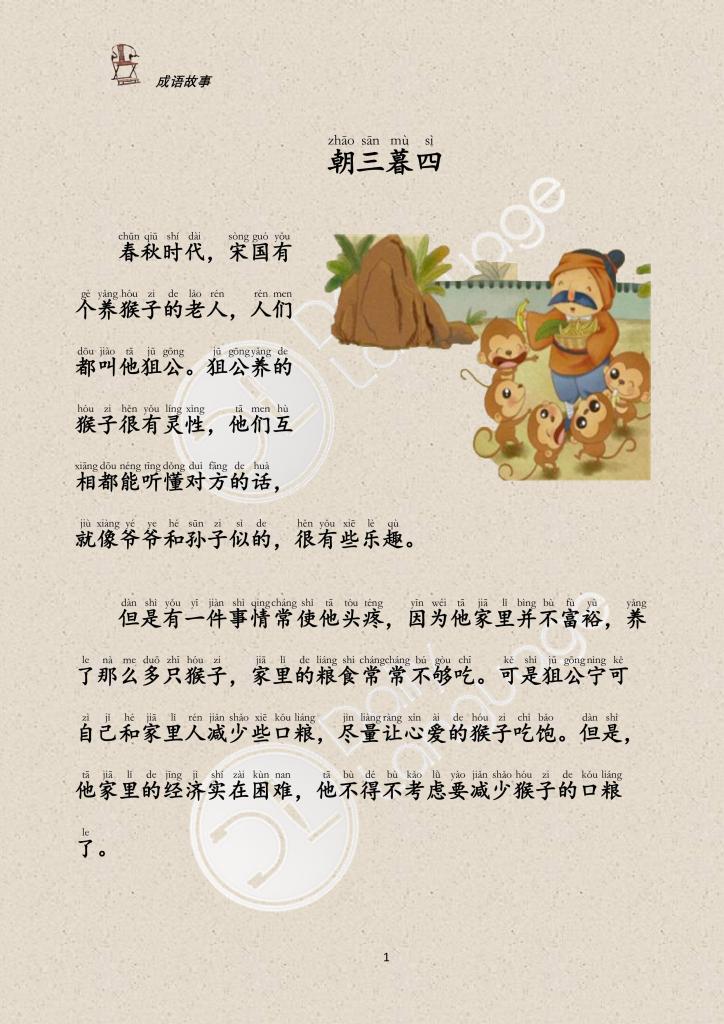
In the Spring and Autumn Period, a man in the state of Song raised monkedy. The monkeys could understand what he said.
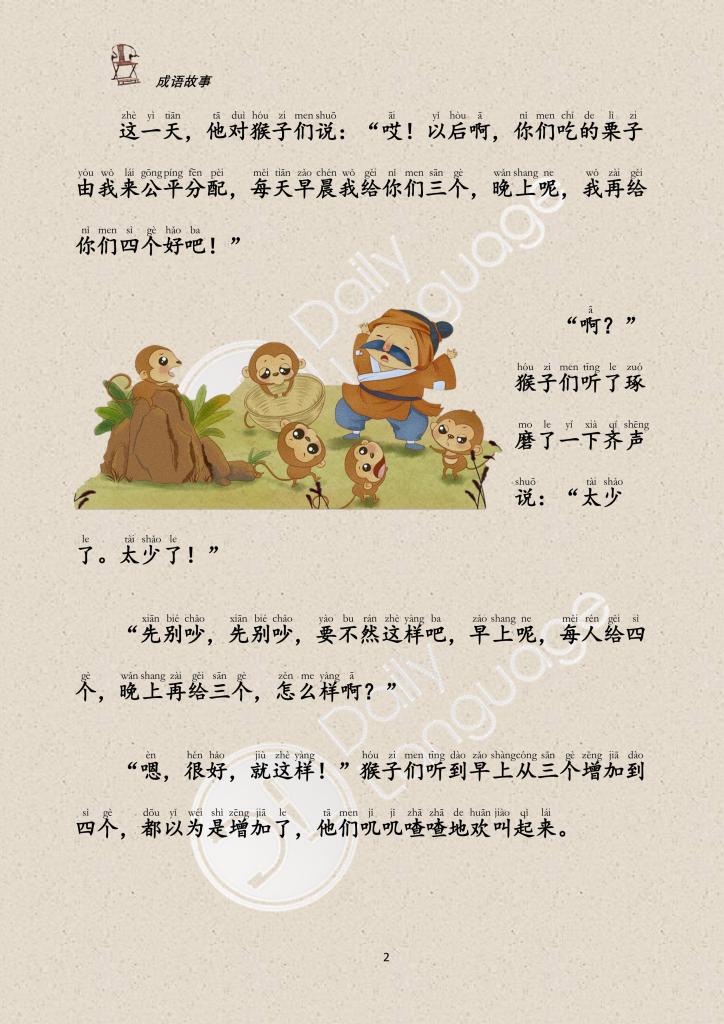
As the man became poor, he wanted to reduce the monkey’s food. He first suggested that he give them three acorns in the morning and four acorns in the evening. thereupon, the monkeys protested angrily. Then their owner said”How about fourn in the morning and three in the evening?” The monkeys were satisfied with that.
This idiom originally meant to befool others with tricks. Later it is used to mean to keep changing ones’ mind.
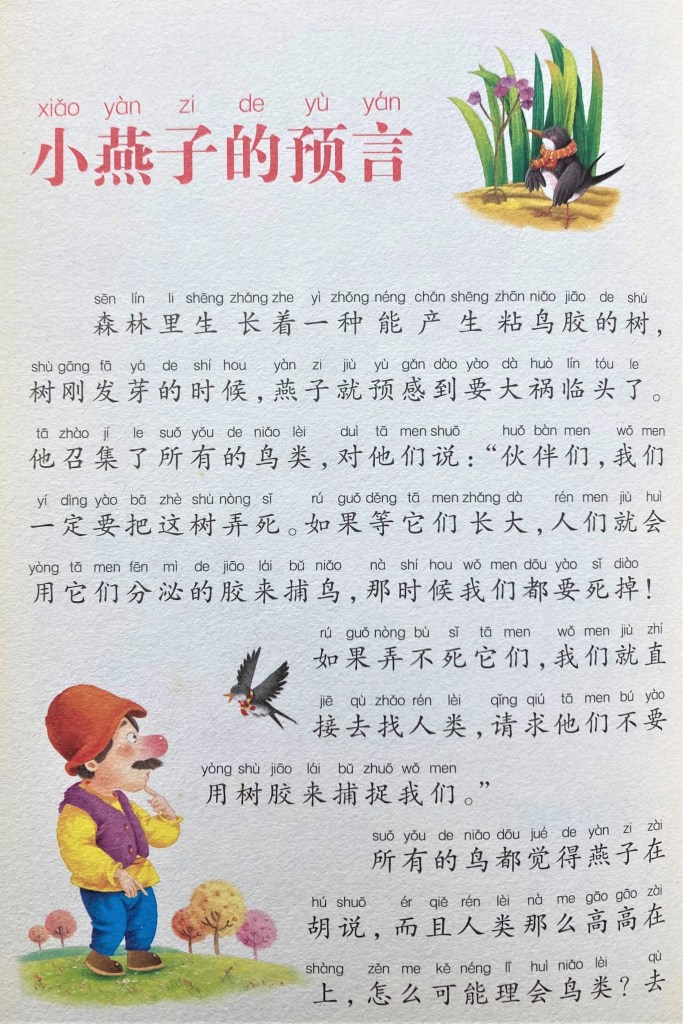
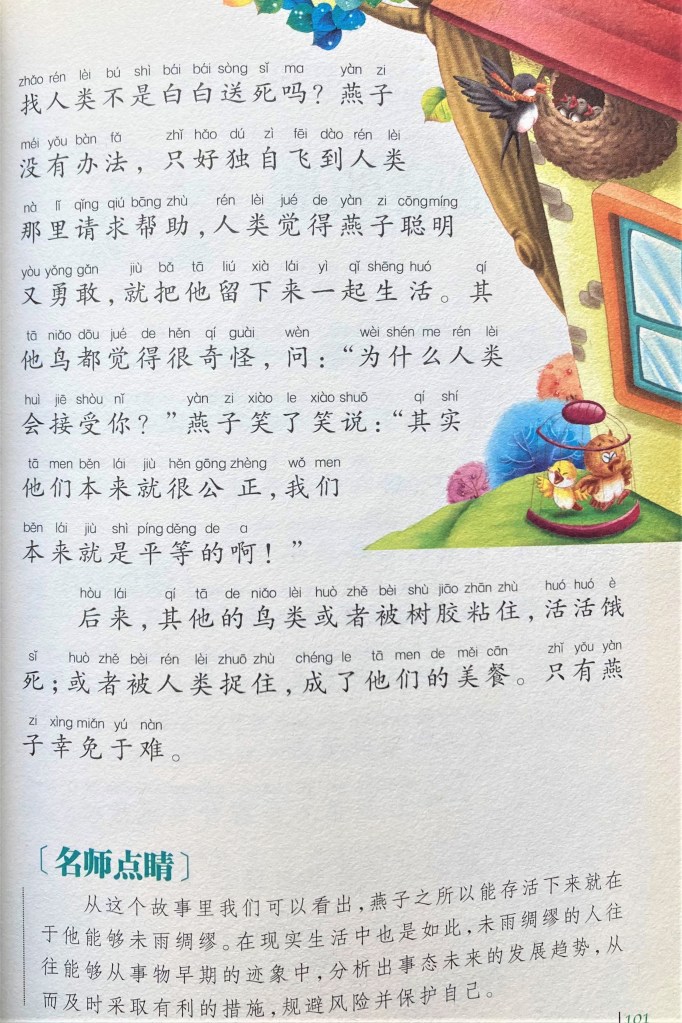
A kind of gum tree appeared in the forest, and the swallow foresaw disaster. He advised the other birds to ask humans for help, but none of them believed him.
The swallow had to fly to the humans to ask for help. The humans thought the swallow was smart and brave, so they asked him to stay and live with the humans.
Some of the other birds were glued to the tree and died, some became the food of man, only the swallow became man’s friend.
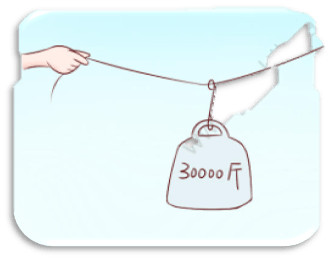
qian jun yi fa(to hang the weight of 15 tons by a single hair)
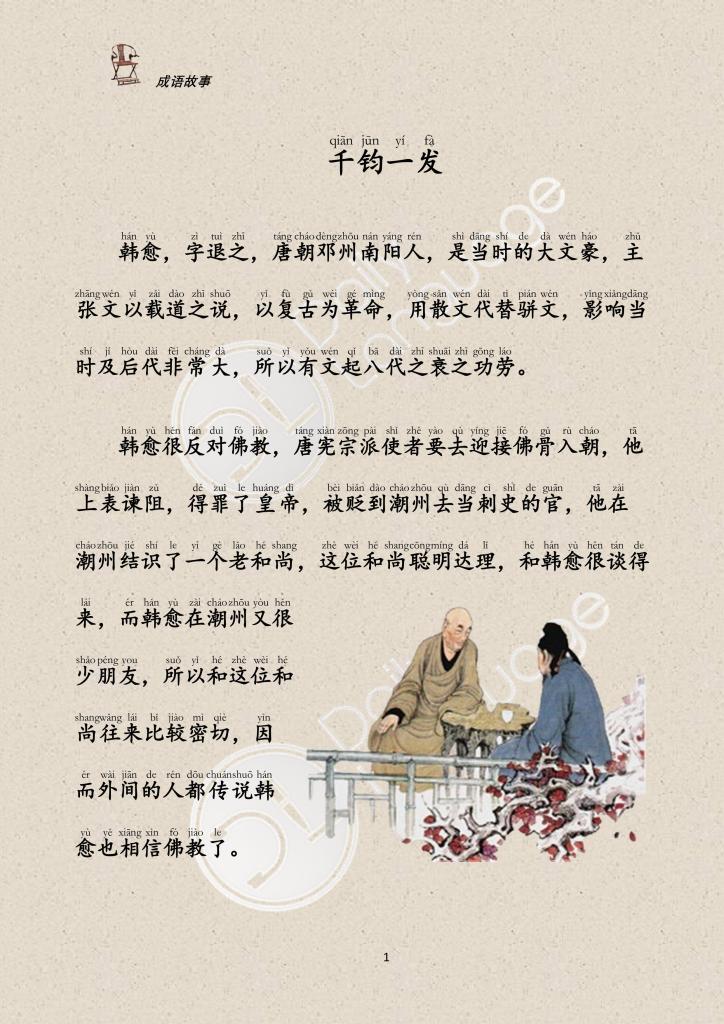
In Tang Dynasty, the famous scholar Han Yu was quite indignant at the ministers who believed in Buddhism and did not respect Confucianism.
In his letter to his friends, there is such a saying: “The situation in the country is like a dress that is already riddled with holes, something that is easily lost in a chaotic environment, and the greatest danger is like hanging the weight 15 tons thing by a single hair.











 Daily Language