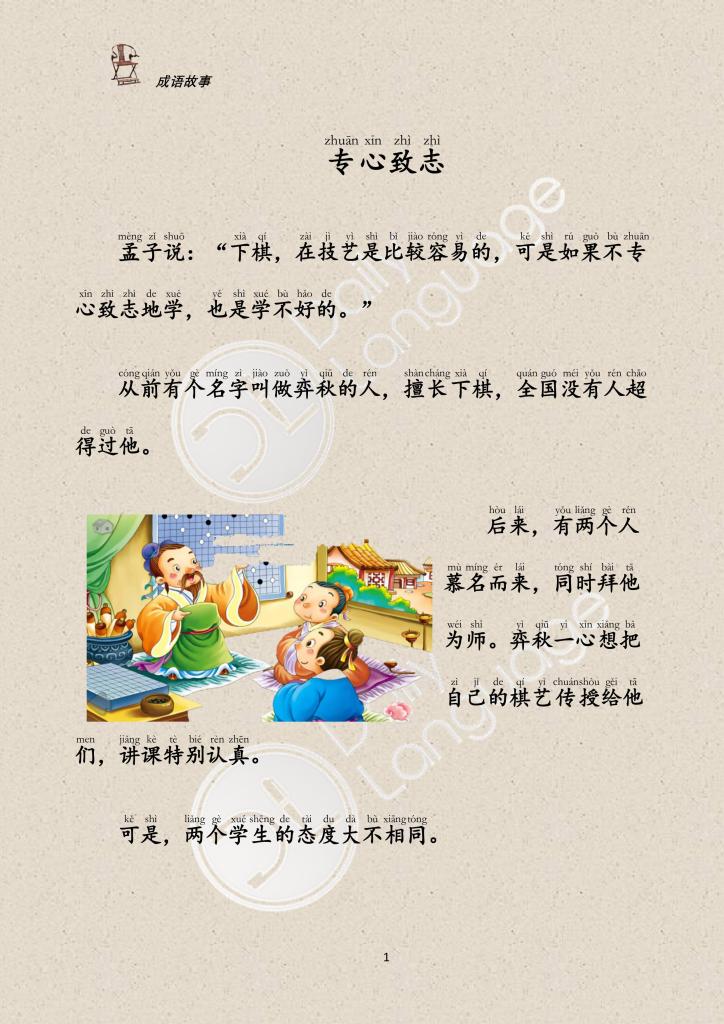
Yi Qiu was known as the most famous expert at chess throughout the land.
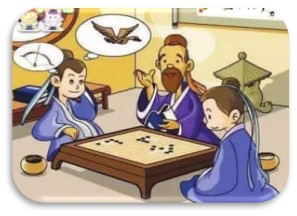
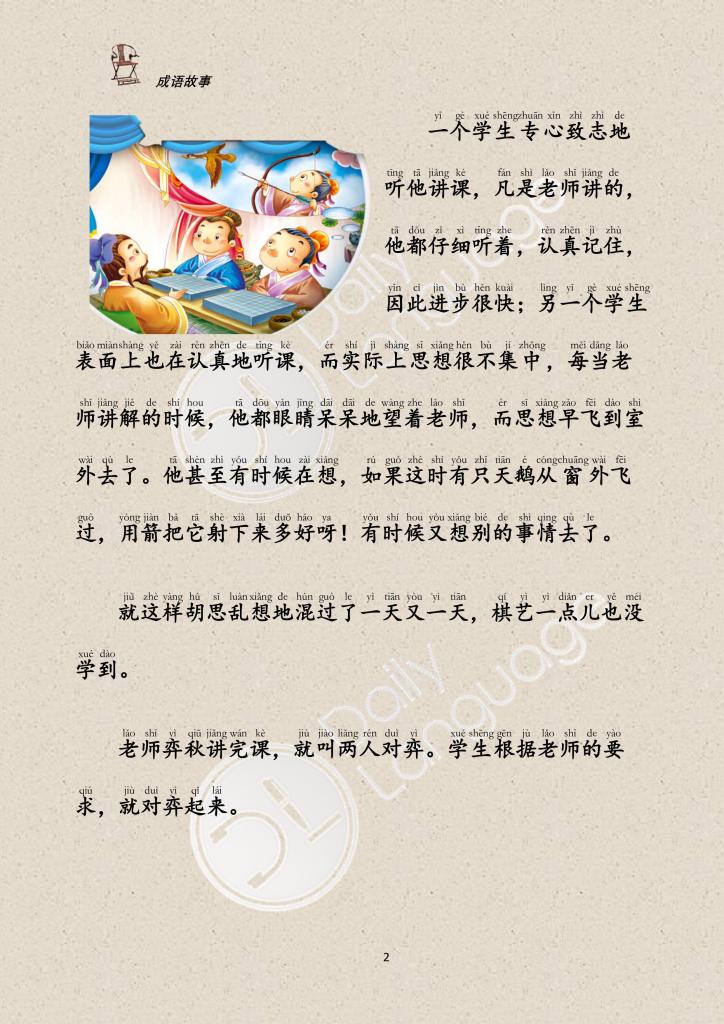
Once he gave lessons on chess to two men. One of them was completely absorbed in his teaching, listening attentively to Yi Qiu while the other, who seemed to be listening, had his mind on something else. In fact, he was having a fancy that a swan was flying towards him and he had in his hands a bow and an arrow, ready to shoot. As a result, though he was having the same lesson together with the first man, yet he turned out a much inferior pupil. If one does not give single-hearted devotion to it, no skills will be learned.
ru mu san fen(The ink has seeped into the wood three fen.)
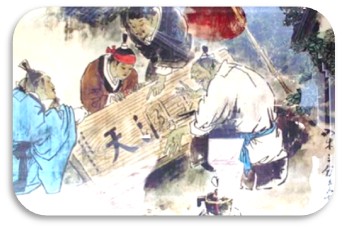
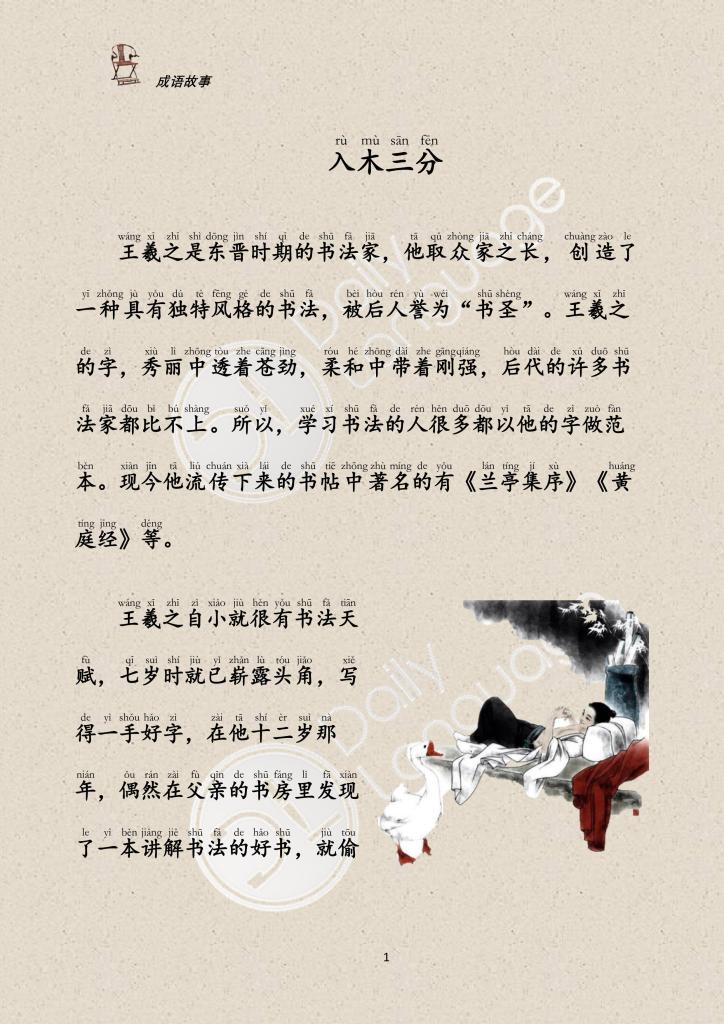
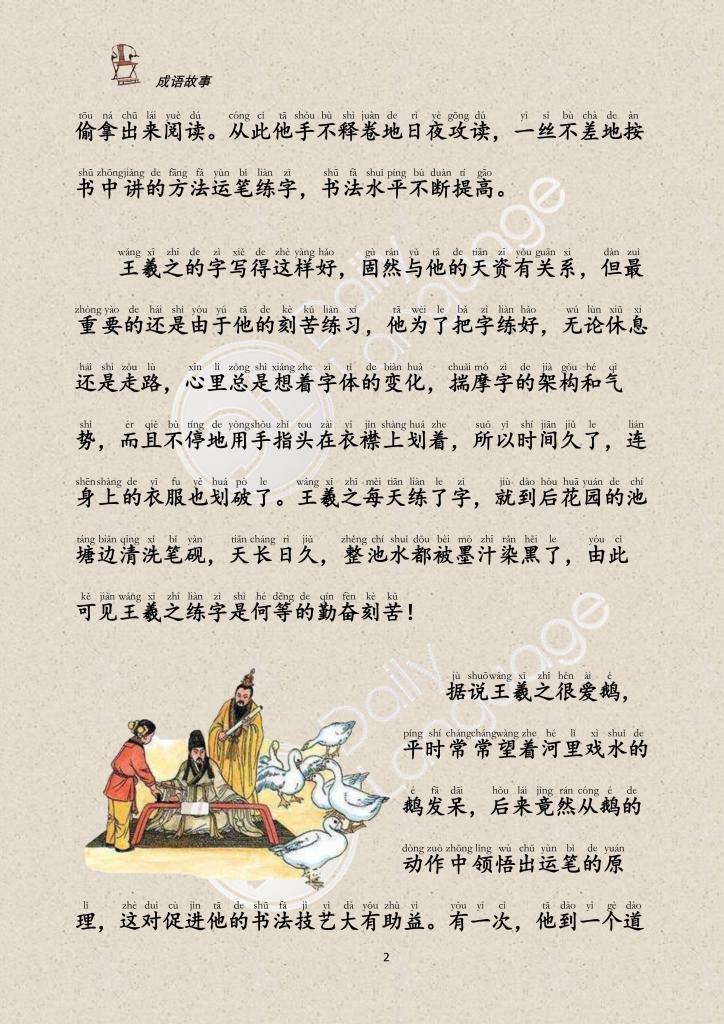
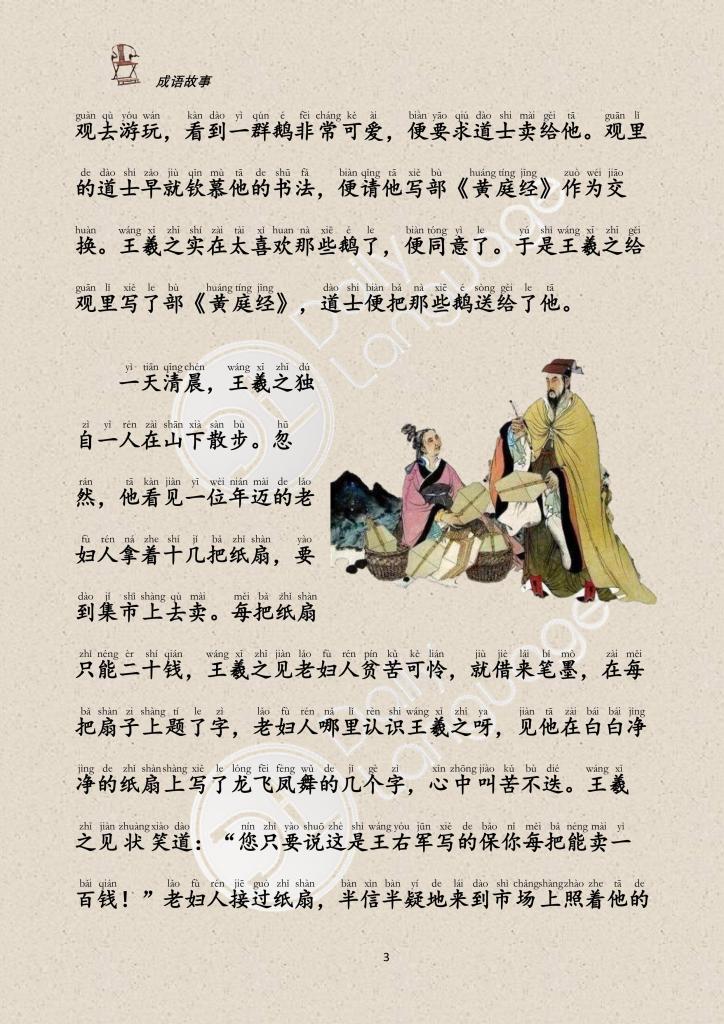
Wang Xi-zhi is one of the most famous calligraphers during the Eastern Jin Dynasty of China. When he was very young, he practiced his art every day and never stopped.
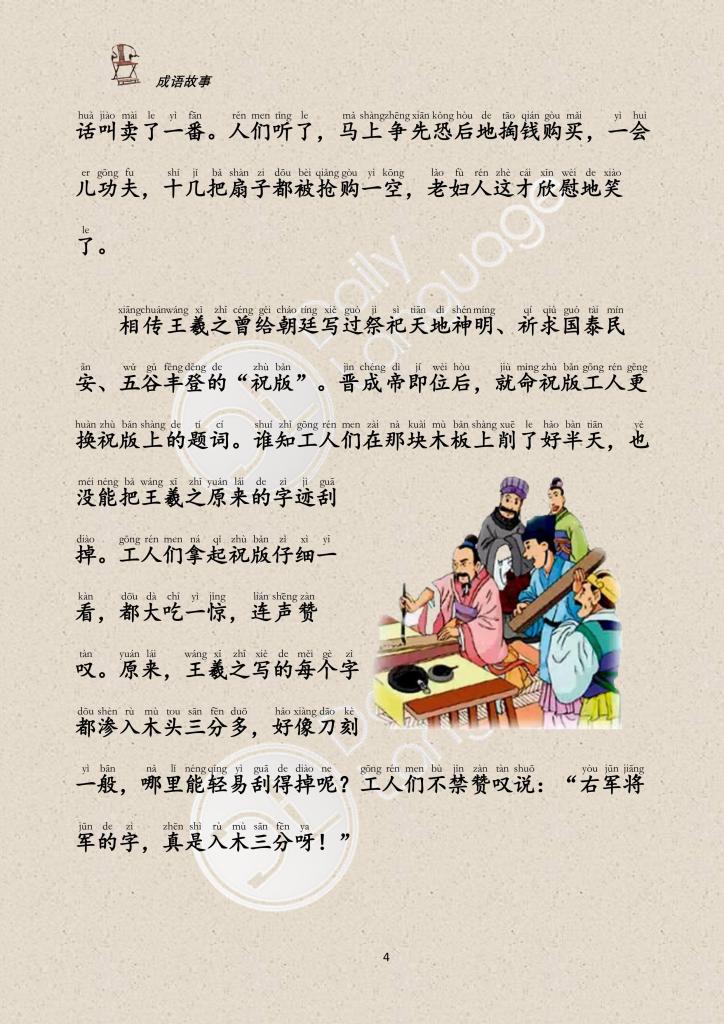
Later he absorbed the strong points of all the other schools of calligraphy, and developed his own unique style of writing. Because of his achievements, he has been honored as one of China’s sages of calligraphy. One time, Wang Xi-zhi sketched in wood for an engraver to cut. Then the engraver found the ink had penetrated one centimeter into the wood.
“Ru Mu San Fen” is got from this story, which means the calligraphy is penetrating.
Now it is often used to describe expressing sharp ideas or profound views.
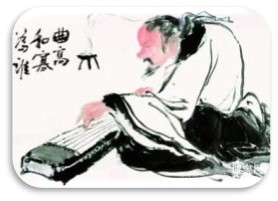
qu gao he gua(Songs of a highbrow type will find very few people to join in the chorus.)
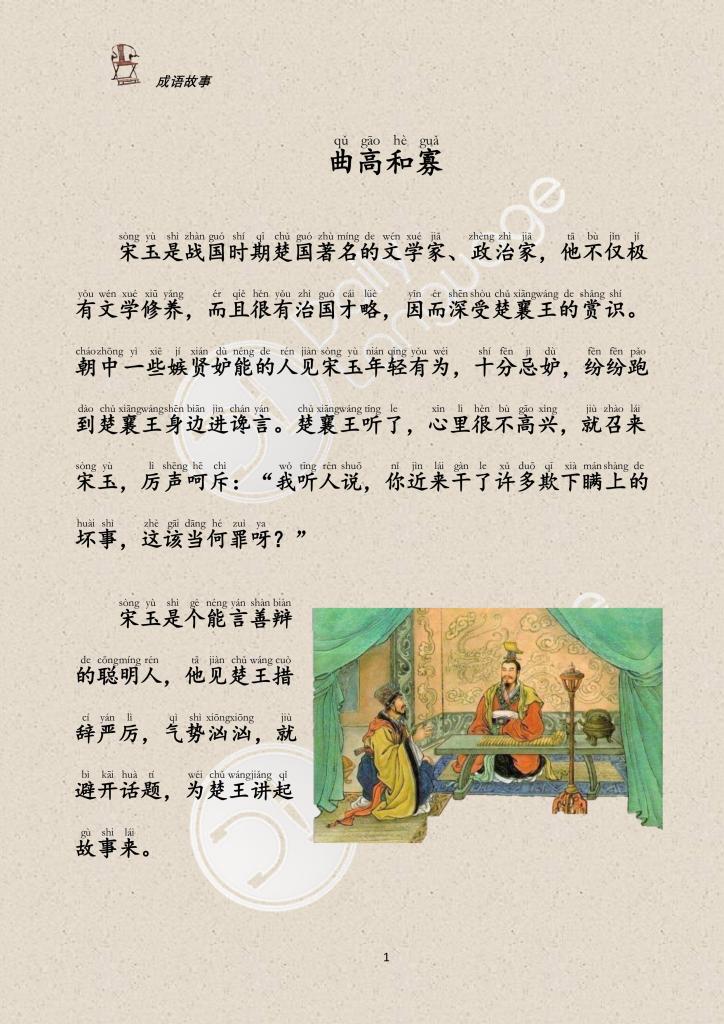
Long, long ago, the king of the State of Chu trusted Song Yu very much, but he often heard others say bad things against Song Yu.
One day, the king asked Song Yu:
“Have you ever done anything unfitting to your position? Otherwise, why do officials and people say bad things against you?”
Song Yu quickly kowtowed and said:
“Yes, it may be so. I hope Your Majesty will forgive my wrongdoings and allow me to finish what I have to say.”
Then he continued:
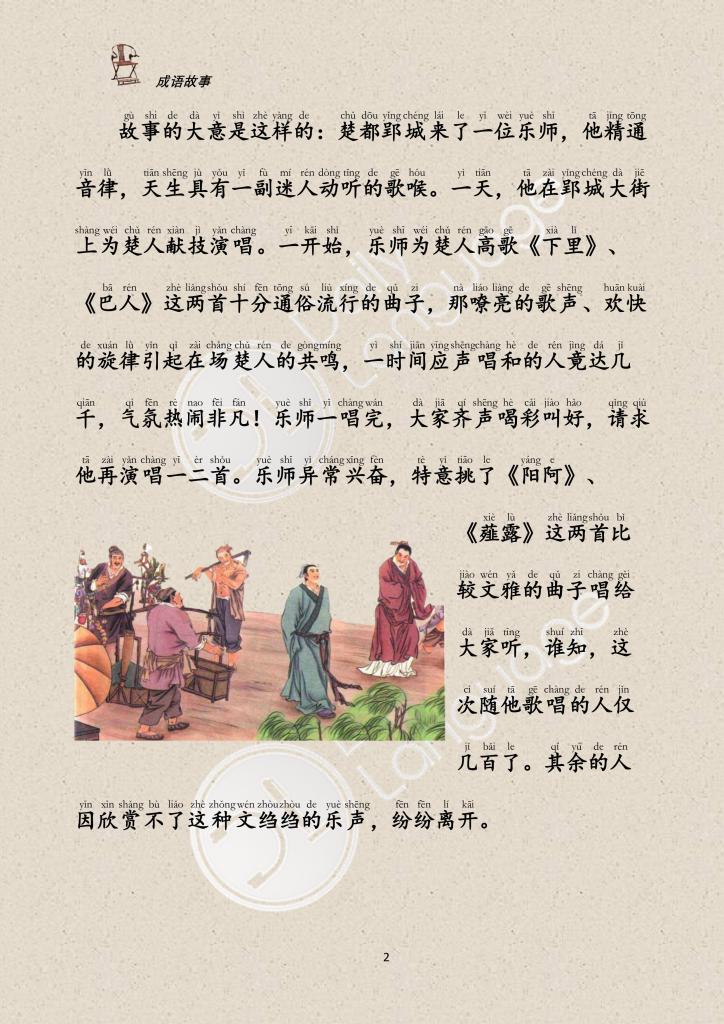
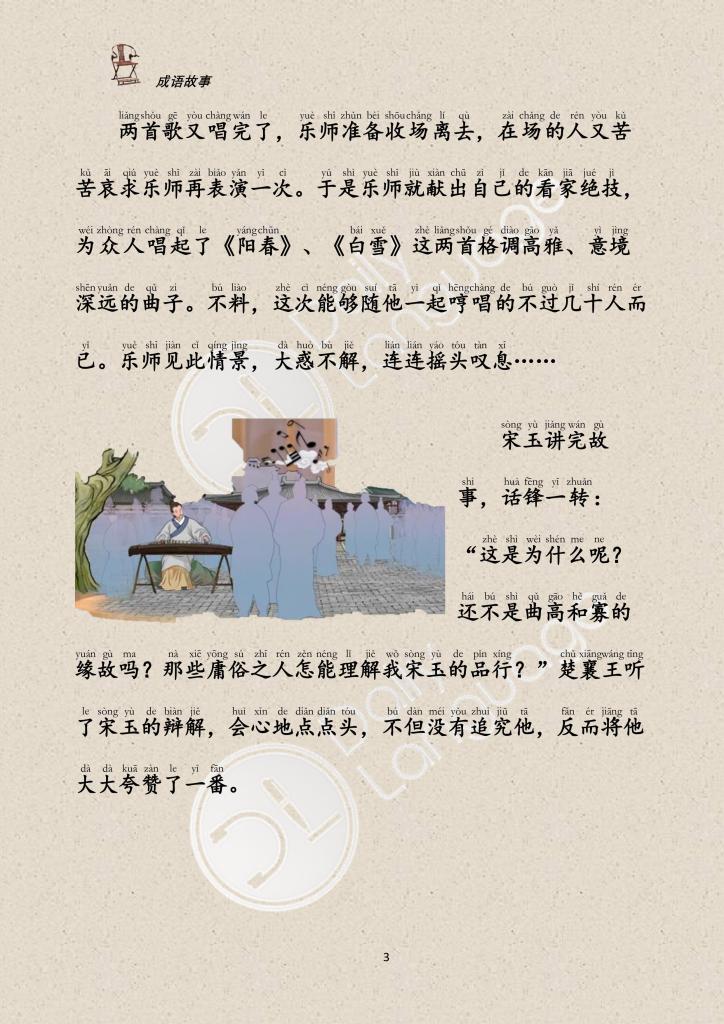
“I hear that there is a singer who often sings in the capital. In the beginning, he always sings the “Song of the Rustic Poor”, and several thousand people sing with him. When he sings the song “Picking Vetches at Yangling”, several hundred people sing with him; when he sings the song “Spring Snow”, only over ten people sing with him. Finally, when he sings an even more refined song, only very few people in the whole state can sing with him. Therefore, the more refined the song he sings, the fewer people can join him.”
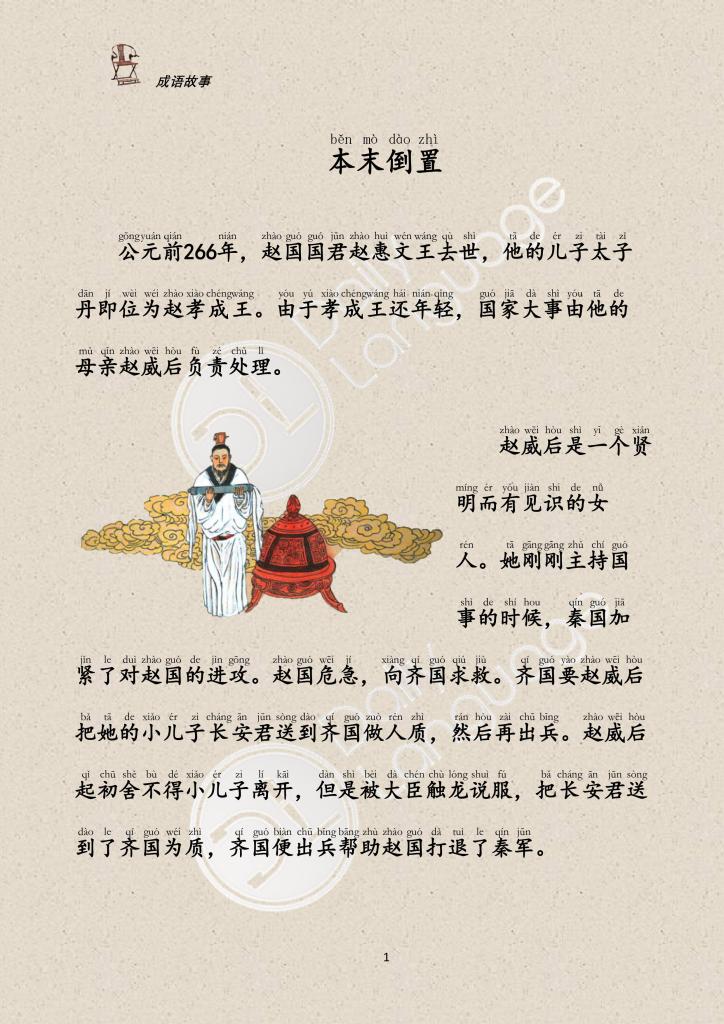
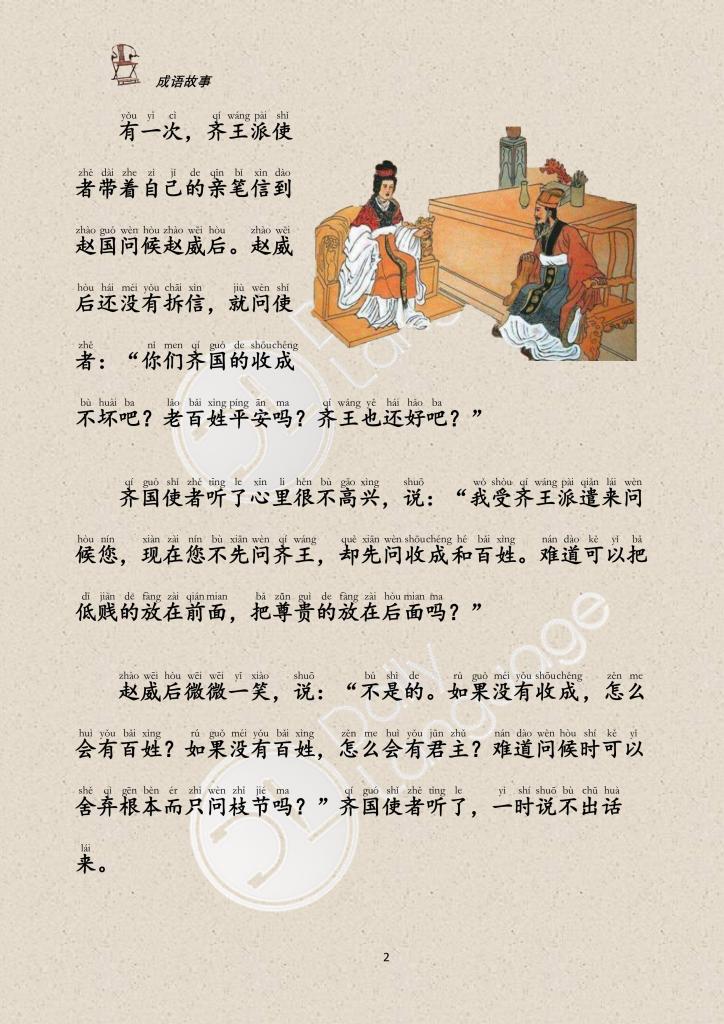
During the Spring and Autumn Period (770-476 BC), the king of Qi once sent an messenger to greet the mother of king of Zhao. The Queen of Zhao asked the messenger, “Is your harvest good this year? Are the people safe? Is the king safe and sound?”
Hearing this, the messenger was displeased and said, “You did not inquire about the king of Qi first, but about the harvest and the people. Shall we put the lowly first and the noble behind?”
The Queen of Zhao smiled and said, “No. If there is no harvest, how can there be people? If there are no people, how can there be a king? Is it possible to give up the basics and ask only trifles(putting the cart before the horse)?”
The messenger of the state of Qi was speechless for a moment.
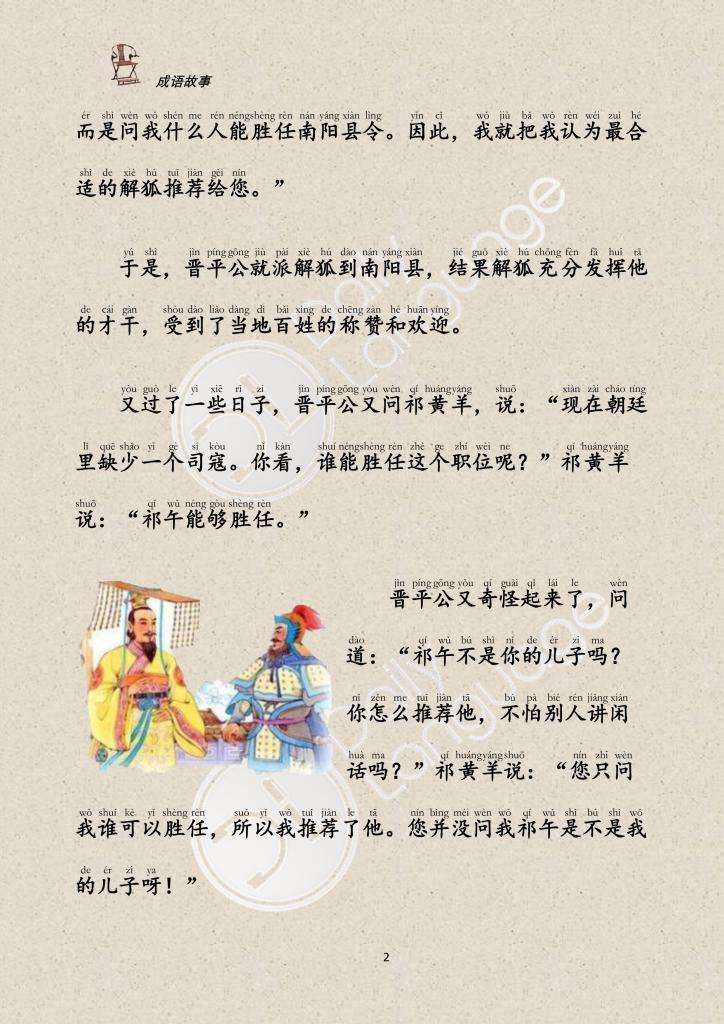
During the Spring and Autumn Period (770-476 BC), a very noble official caled Qi Huangyang lived in the State of Jin. One day, the king summoned him to court and asked, “Now that the magistrate position of Nanyang county is vacant, who do you think is suitable for the post?”
“Xie Hu is the right man for the job,” Qi replied without hesitation.
Surprised, the king asked, “Did you say Xie Hu? I thought he’s your enemy. Why did you recommend him to take such an important position?”
Smiling, Qi Huangyang said, “Your Majesty didn’t ask me my personal opinions o Xie Hu. You simply asked me who I thought would be competent for the position. Therefore I recommended Xie Hu.
The king followed Qi’s advice and made Xie Hu magistrate of Nanyang county. And sure enough, Xie Hu administered the county very well and won respect from local people and his colleagues.
Some days later, the king again asked Qi Huangyang for his opinions. This time, the king was trying to find a suitable candidate for a court judge position. Qi Huangyiang recommended Qi Wu for the job. Once again, the king was surprised again by the recommendation because Qi Wu was the son of Qi Huangyang. The king asked: “Who do you recommend your son? Aren’t you afraid people will gossip?”
Qi Huangyang replied, “Your Majesty, you asked me who was the most capable person for the position of a judge, and I think Qi Wu is.”
Although the king was a bit hesitant about making Qi Wu the judge, he nevertheless gave him the position. As it turned out, Qi Wu was an upright and talented judge, who people GREatly respected.
Qi Huangyang’s actions were praised by Confucius who said, “Qi Huangyang was right. He recommended people according to their abilities and talents, not because of personal sentiments, not because of fearing others’ gossip. Therefore, people like Qi Huangyang are referred to as people “without selfish motives”.
From Confucious’ comment came the idiom “Unselfish”. Anyone who handles affairs fairly and impartially can be described as “Unselfish; Perfectly impartial”.
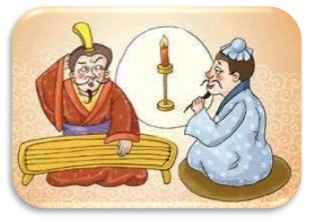
bei shui che xin(trying to put out a blazing cartload of faggots with a cup of water)
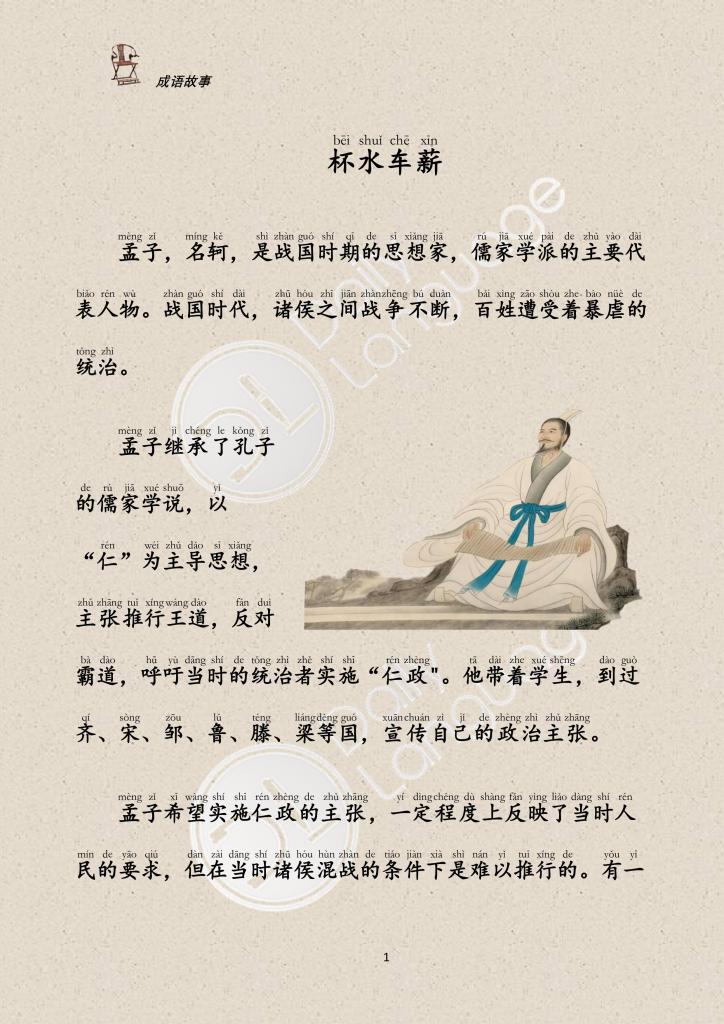
Mencius was a famous thinker in the Warring States Period. He recommended the political idea of governing the country by benevolence to the vassal states, but no one adopted it. His students asked him the same question.
Mencius replied:
It is no doubt that benevolence can overcome inhumanity, just as water can extinguish fire. But now some advocates of benevolence seem to use a small glass of water to save the flame of a wagon full of firewood. If any one thus thinks that water cannot extinguish fire, he is in the same class as a tyrannical person, and will lose what little benevolence he has had.
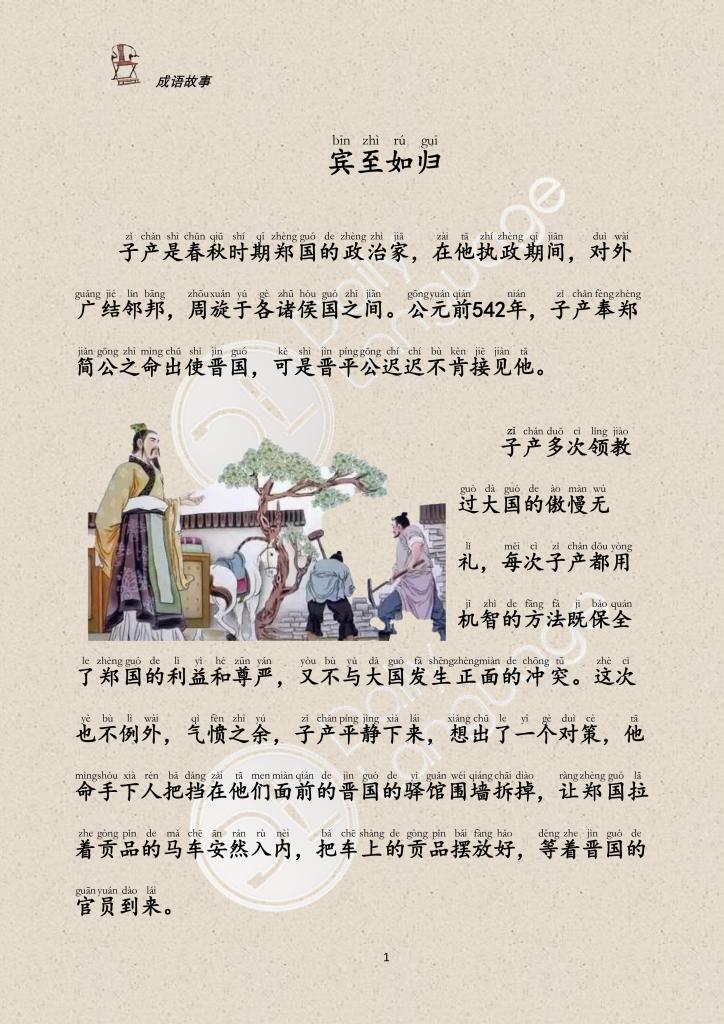
During the Spring and Autumn Period (775-476 BC), Zi Chan was sent on a diplomatic mission to the state of Jin on behalf of the State of Zheng. However, after a long time, Duke Wen refused to receive him.
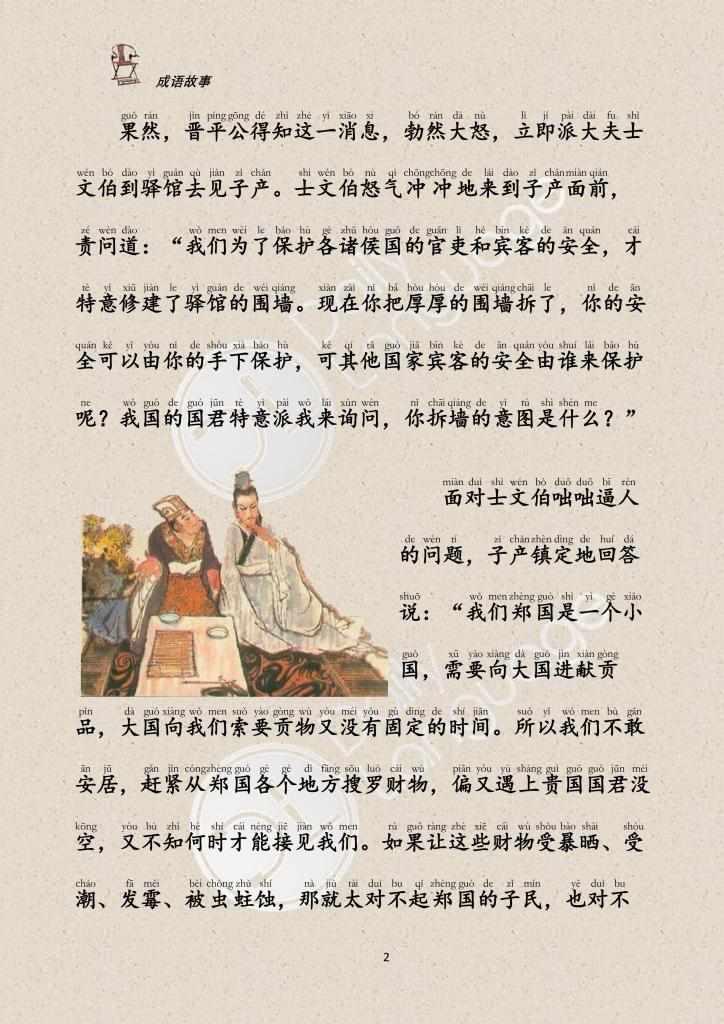
Zi Chan ordered his subordinates to tear down the walls of the inn, and The Duke of Wen sent his minister Shi Wenbo to inquire.
Zi Chan said: “I did this to protect the gifts brought to the state of Jin, in the past the Duke Wen treated the guests very warmly, let people feel at home, now I have not seen Duke Wen, afraid that the gifts will be stolen, so I can only tear down the wall to bring the carriage loaded with gifts in, if we can send gifts now, we are willing to repair the wall immediately.” ”
Shi Wenbo reported to Duke Wen, who immediately received Zi Chan and was very thoughtful in etiquette.
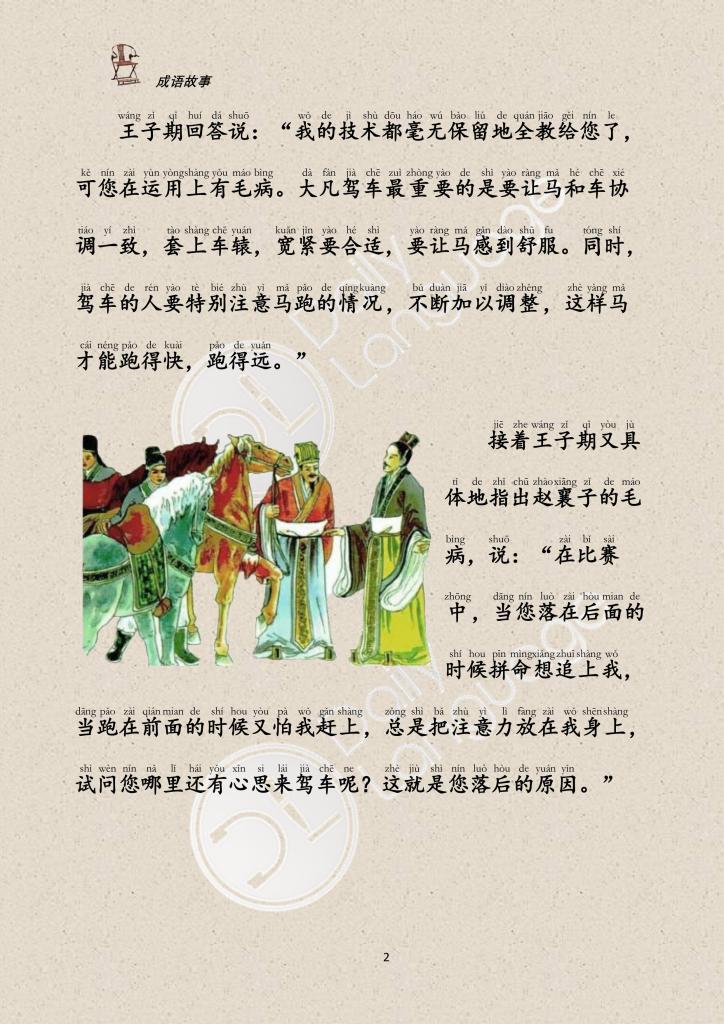
During the spring and autumn period,Zhao Xiangzi had been learning chariot driving from Wang Yuqi.
Before long, Zhao Xiangzi contested with Wang Yuqi. Zhao Xiangzi changed horses three times and lost three times. Then he reproached Wang Yuqi for not having taught him all the techniques.
Wang Yuqi said, “The most important thing in driving a chariot is to coordinate the body of the horse with the chariot and pay all your attention to controlling the horse. Now when you lagged behind, you just wanted to keep up with me. When you were in the lead, you were afraid of being caught up by me. In a driving contest, there is always someone who lags behind, and someone who is in the lead. If you pay all your attention on me, how could you control your hoarse well? This is the reason why you lost.”
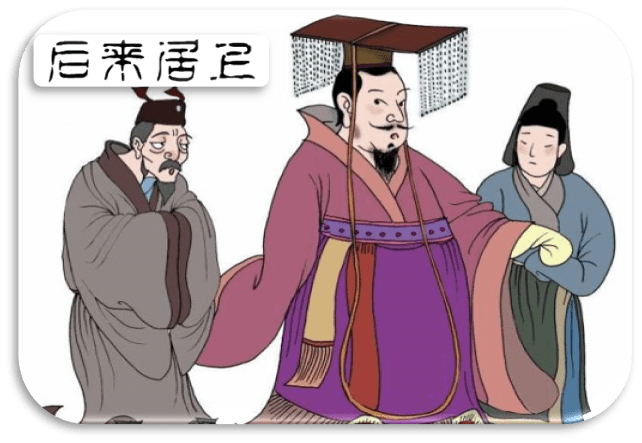
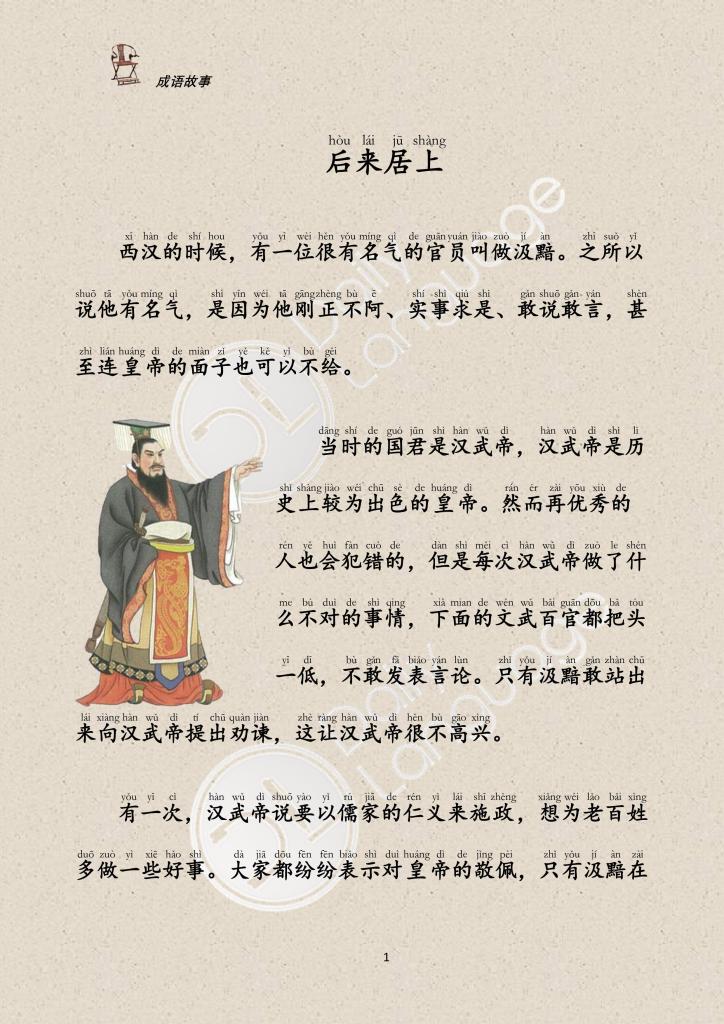
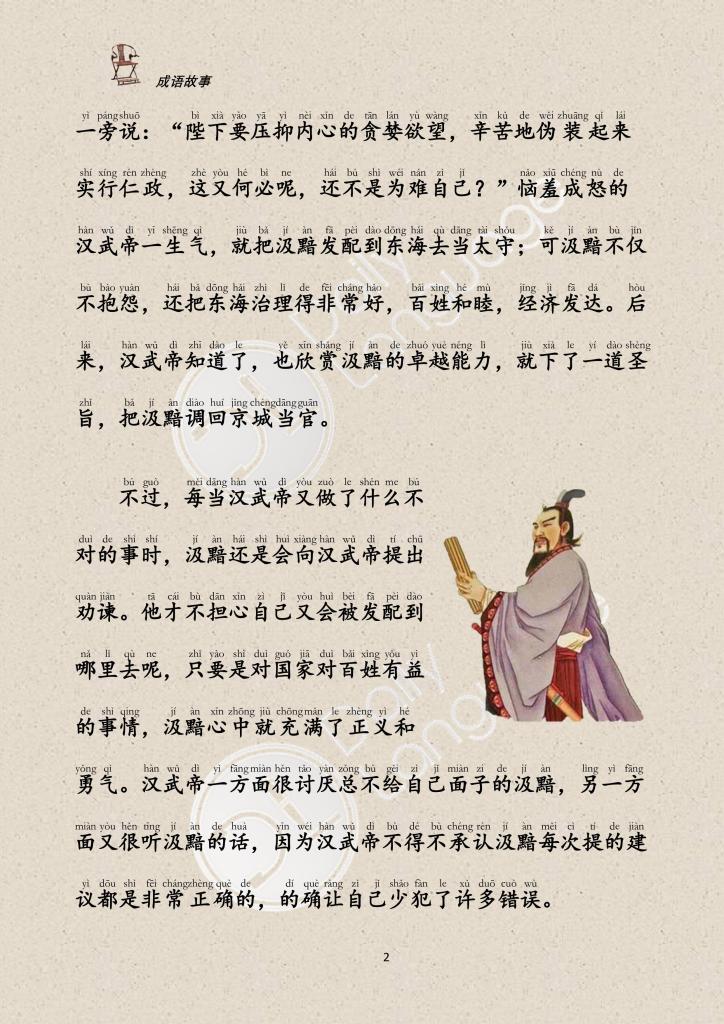
Ji An lived at the time of Emperor Wu of Han Dynasty (206 B.C.-A.D.24). He was respected because he was upright and just and spoke the truth. He did not care about trifles in his conduct and as an official. Because of this. Therefore, he was appointed to the post of managing the local officials.
Once, Emperor Wu said that he would implement the Confucian policy of benevolence and justice and do good things for the people. However, ji an interrupted the emperor, saying, “Why should you pretend to implement the policy of benevolence and benevolence when you are so greedy inwardly?”
Emperor Wu turned pale and left. Everyone was worried that Ji An would be punished.. When emperor Wu returned to the palace, he complained to his aides that Ji An was too rude and forthright.
From this time on, Ji An was never promoted again. His contemporaries, Gong Sun Hong and Zhang Tang, were promoted to very senior positions, but Ji An never got promoted.
One day, Ji An said to Emperor Wu, “You appoint officials in the same way as you arrange firewood. ‘Put the latest ones on them.’” Of course, Emperor Wu could tell this was a complaint. Then he turned to the others and said, “Everyone really can’t stop learning! You listen to him, it’s getting more and more strange!”
The idiom “later comes first” often means that the latter can outperform the former.
hu jia hu wei(the fox assuming the majesty of the tiger)
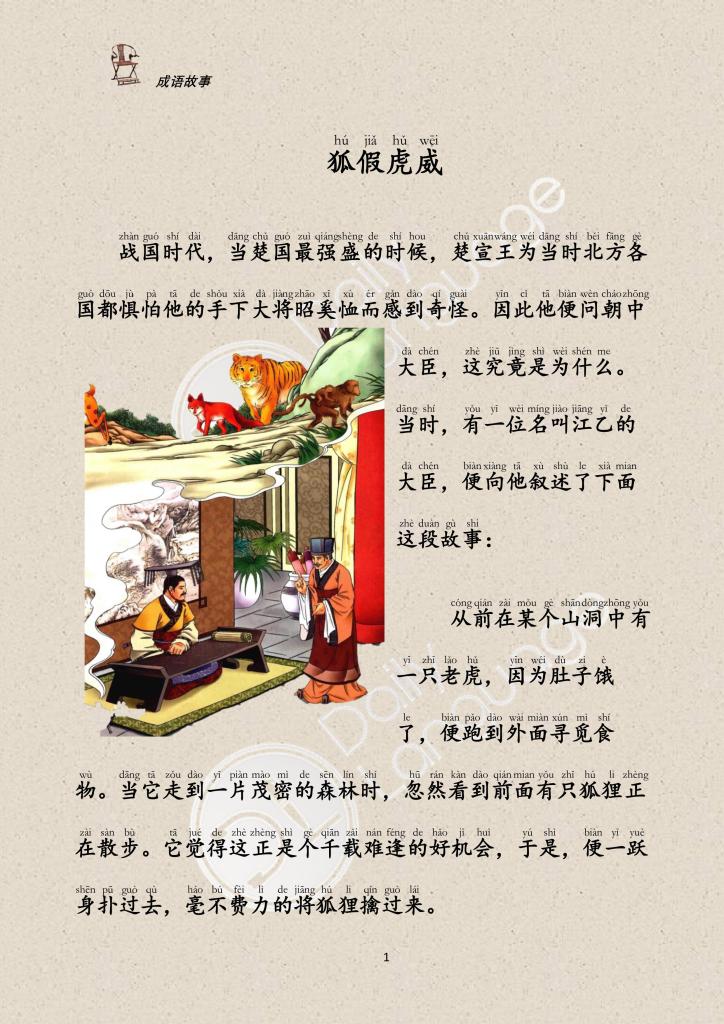
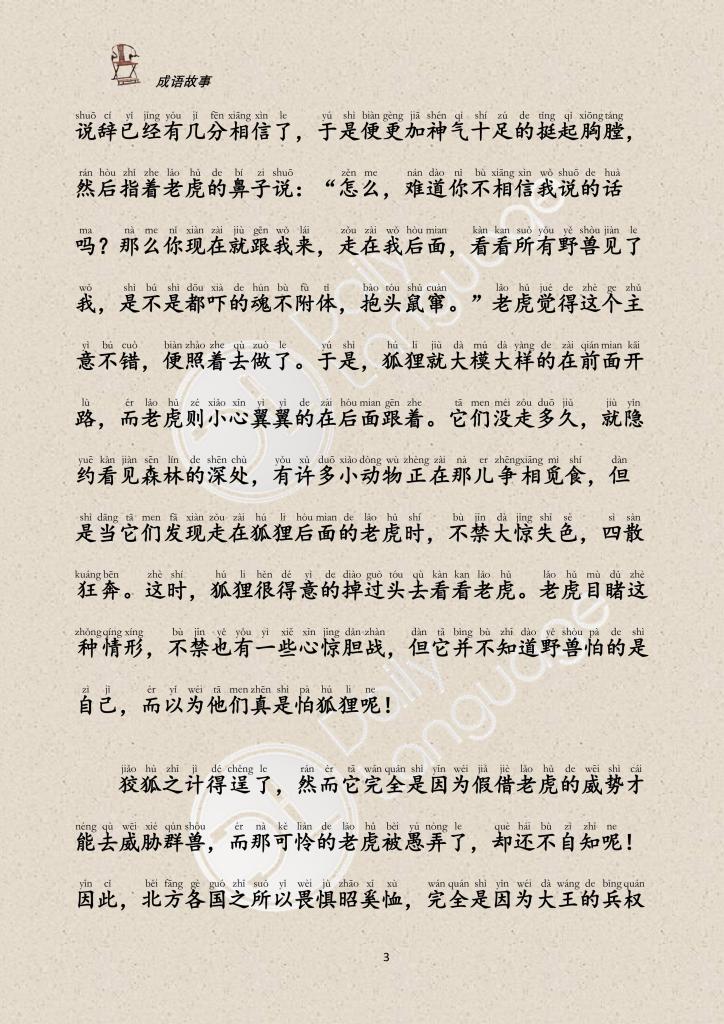
A tiger caught a fox in a forest, and was just about to eat it, when the fox said, “You mustn’t eat me. I was sent by Heaven to rule the animals. By eating me, You will violate the command of Heaven. If you don’t believe me, just follow me to see whether the animals are afraid of me.”
The tiger agreed, and followed the fox as it walked around the forest. The animals all ran away on seeing them. The tiger thought they were afraid of the fox, so he let it go. He didn’t realize that it was him that the beasts were really afraid of.













 Daily Language