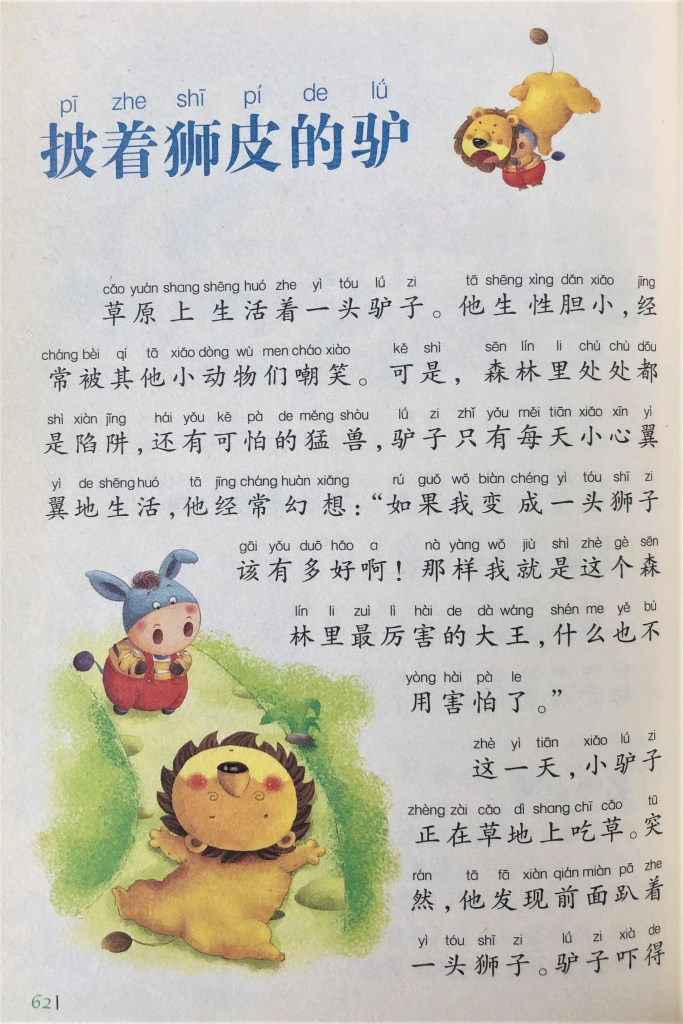
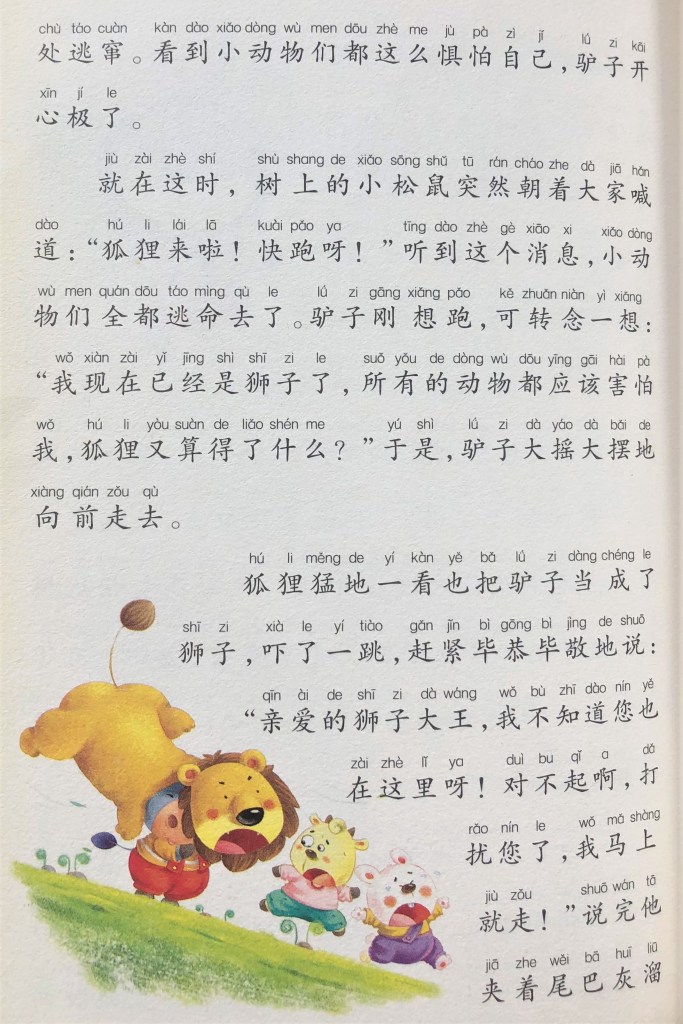
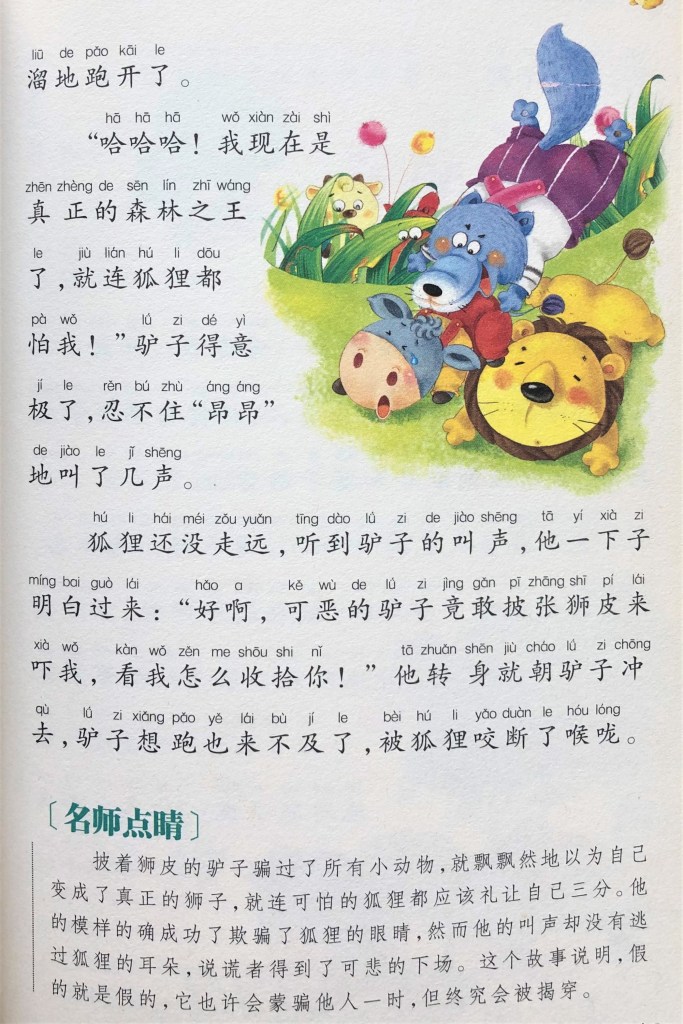
An ass, having put on a lion’s skin, roamed about, frightening all the silly animals he met with. Seeing a fox, he tried to alarm him also. But Reynard, having heard his voice, said, “Well, to be sure! And I should have been frightened too, if I had not heard you bray.”
They who assume a character that does not belong to them generally betray themselves.
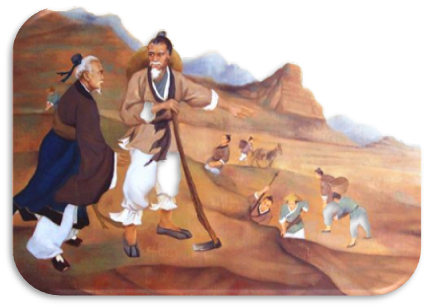
In ancient times, there was an old man named Yu Gong. He was nearly 90 years old. There were two mountains in front of his house. One was the Taihang Mountain, the other the Wangwu Mountain. It was very inconvenient for people to come and go.
One day, Yu Gong said to the whole family:
“These two mountains block the doorway of our house. It is very inconvenient for us to come and go. Let our whole family exert efforts to move away these two mountains. How about it?”
Upon hearing this, all his sons and grandsons said:
“You are right. Let us start tomorrow!”
But his wife felt it too difficult to move the mountains. She said:
“Do you know how high these two mountains are? How can you move such big mountains? Where can you put all the stones and earth?”
Everybody said:
“So long as we work hard together, we can certainly move away these two mountains. We can carry the stones and earth of the mountains to the sea.”
The following day, Yu Gong led the whole family and started to move the mountains. His neighbour was a widow with a son, only 7 or 8 years old. When he heard of this, he also came to help happily. They worked nonstop every day, fearing neither heat in summer nor cold in winter, neither wind nor rain.
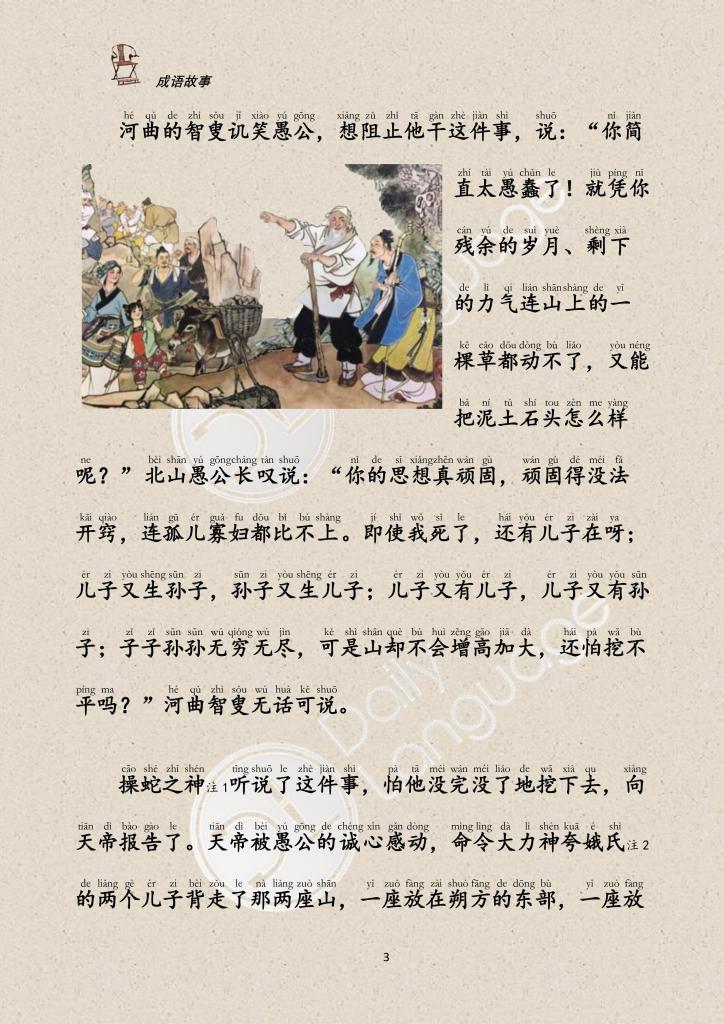
When a shrewd old man named Zhi Sou saw Yu Gong’s family moving the mountains, he thought it ridiculous and said to Yu Gong:
“You are so old that you can hardly walk. Can you move the mountains?”
Yu Gong replied:
“You are not even as clever as a child. Though I am about to die, I have sons. When my sons die, there are still grandsons. Generation after generation, my offspring are endless. But with more and more stones being removed, smaller and smaller will the mountains become. Not a grain of earth or a piece of stone will grow on the mountains. If we work without stop every day, why can’t we move away the mountains?”
Zhi Sou, who thought himself clever, had nothing more to say.
Yu Gong led his family digging the mountains continually from early morning till late night. They finally moved God, who sent two celestials to the world to move away these two mountains.
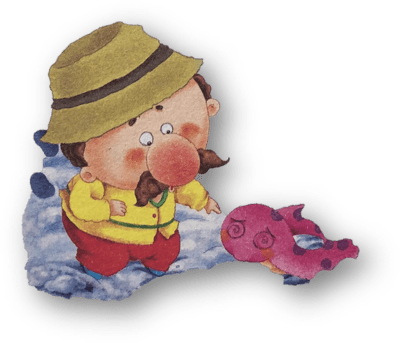
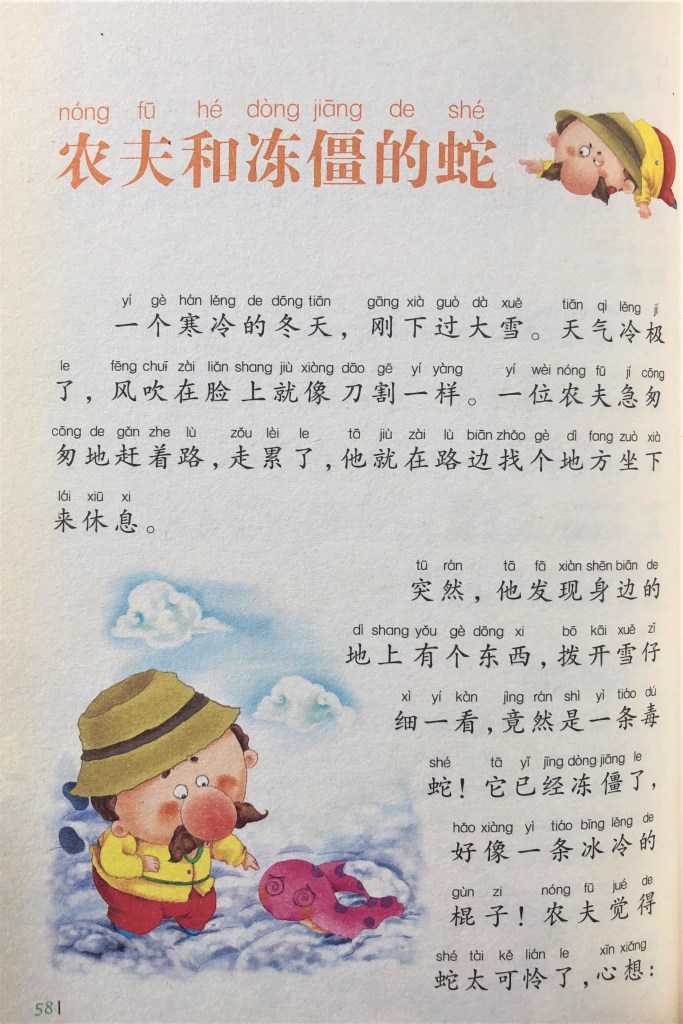
A countryman returning home one winter’s day found a snake by the hedge-side, half dead with cold.
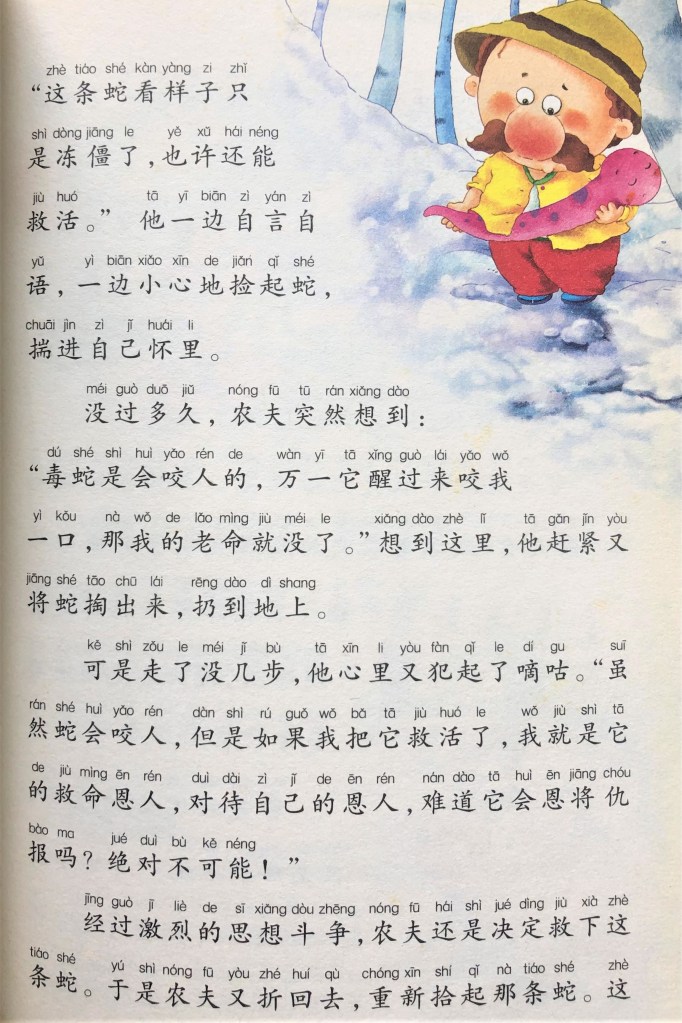
Taking compassion on the creature, he laid it in his bosom and brought it home to his fireside to revive it. No sooner had the warmth restored it, than it began to attack the children of the cottage.
Upon this the countryman, whose compassion had saved its life, took up a club and laid the snake dead at his feet.
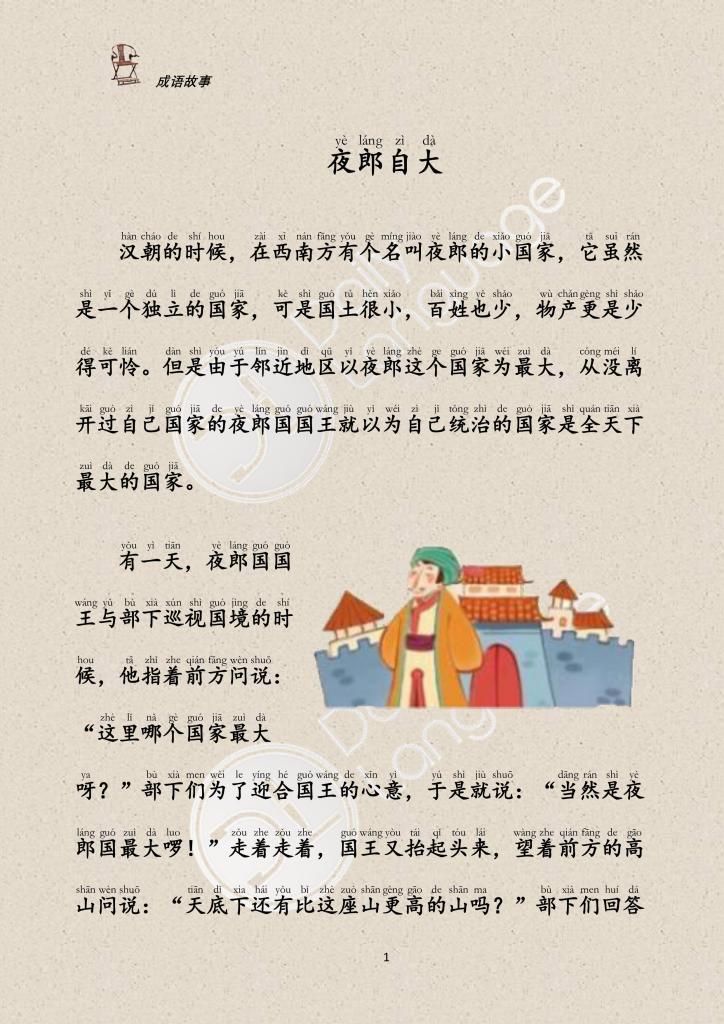
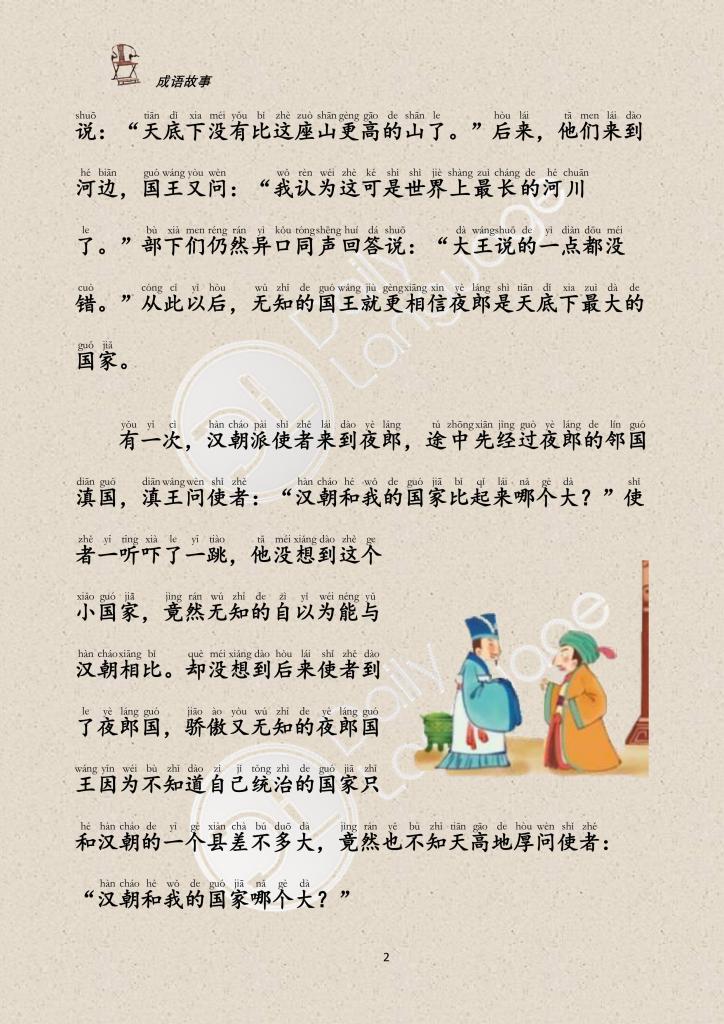
ye lang zi da(The state of Ye Lang/self-conceited)
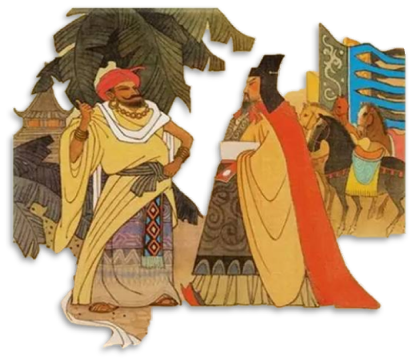
During the Han Dynasty, in the southwest there was a small country called Yelang, and although it was an independent nation, its territory was small, there weren’t many citizens, and its products were pitifully few. Because it was the largest kingdom in the near area, the Yelang king who’d never left his own country thought the country he ruled was the biggest on earth.
One day, the king of Yelang was on a national border inspection tour with his troops, when he pointed in front of him [to neighboring country] and said, “Which country is bigger?” In order to serve their own interests and make the king happy, the troops said, “Of course Yelang is bigger!” They walked along, and the king once again lifted up his head, gazed at the big mountain in the distance and asked: “Is there a taller mountain than this anywhere on earth?” And his men answered: “No, there’s no mountain taller than this one on earth.” After a while, they reached the river side, and the king asked again: “I think this is the world’s longest river.” And all his men said in unison “The king speaks truly.” After this, the ignorant king believed even more firmly that Yelang was the world’s biggest country.
Then one day, the Han Dynasty dispatched an envoy to Yelang, and on the way they passed the neighboring country of Dian, and the King of Dian asked the emissary: “If you compared the Han Dynasty and my Kingdom, which one would be bigger?” The emissary listened in astonishment, as he’d never have thought this small a country thought it could compare itself to the Han Dynasty. But he really never could have suspected that when he got to Yelang, the prideful and ignorant king who didn’t know that the kingdom he ruled was about the size of one Han county, would ask with an exaggerated opinion of his own worth, “Which is bigger: the Han Dynasty or my country?”
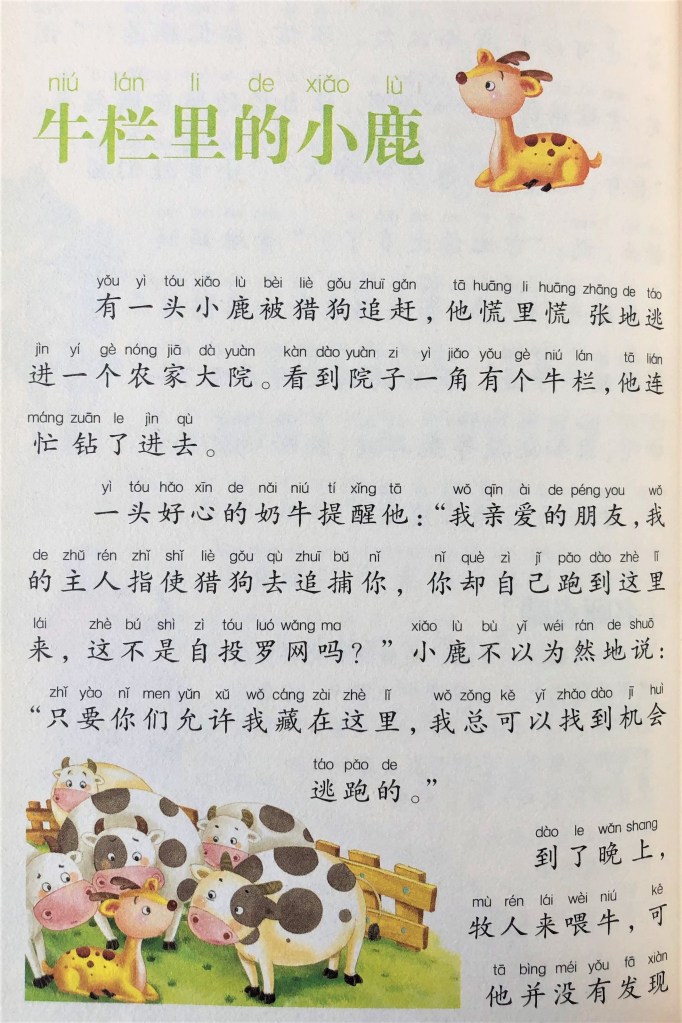
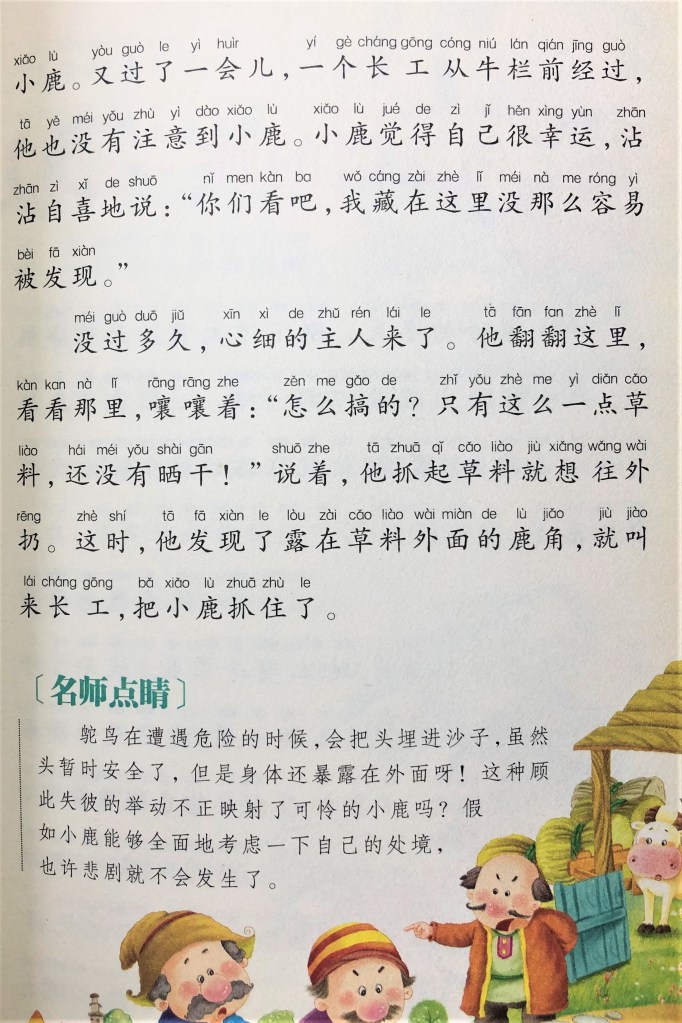
A hunted stag, driven out of the thicket and distracted by fear, made for the first farmhouse he saw and hid himself in an ox stall which happened to be open. As he was trying to conceal himself under the straw, “What can you mean,” said an ox, “by running into such certain destruction as to trust yourself to the haunts of man?” “Only do you not betray me,” said the stag, “and I shall be off again on the first opportunity.”
Evening came on; the herdsman foddered the cattle, but observed nothing. The other farm-servants came in and out. The stag was still safe. Presently the bailiff passed through; all seemed right. The stag, now feeling himself quite secure, began to thank the oxen for their hospitality. “Wait a while,” said one of them, “we indeed wish you well, but there is yet another person, one with a hundred eyes; if he should happen to come this way I fear your life will be still in jeopardy.”
While he was speaking, the master, having finished his supper, came round to see that all was safe for the night, for he thought that his cattle had not of late looked as well as they ought. Going up to the rack, “Why so little fodder here?” says he. “Why is there not more straw?” And “How long, I wonder, would it take to sweep down these cobwebs!” Prying and observing, here and there and everywhere, the stag’s antlers, jutting from out the straw, caught his eye, and calling in his servants he instantly made prize of him.
wo xin chang dan(To sleep on brushwood and taste gall)
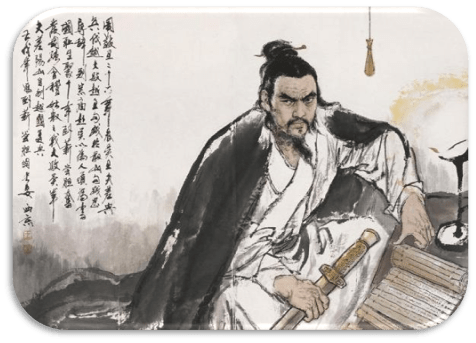
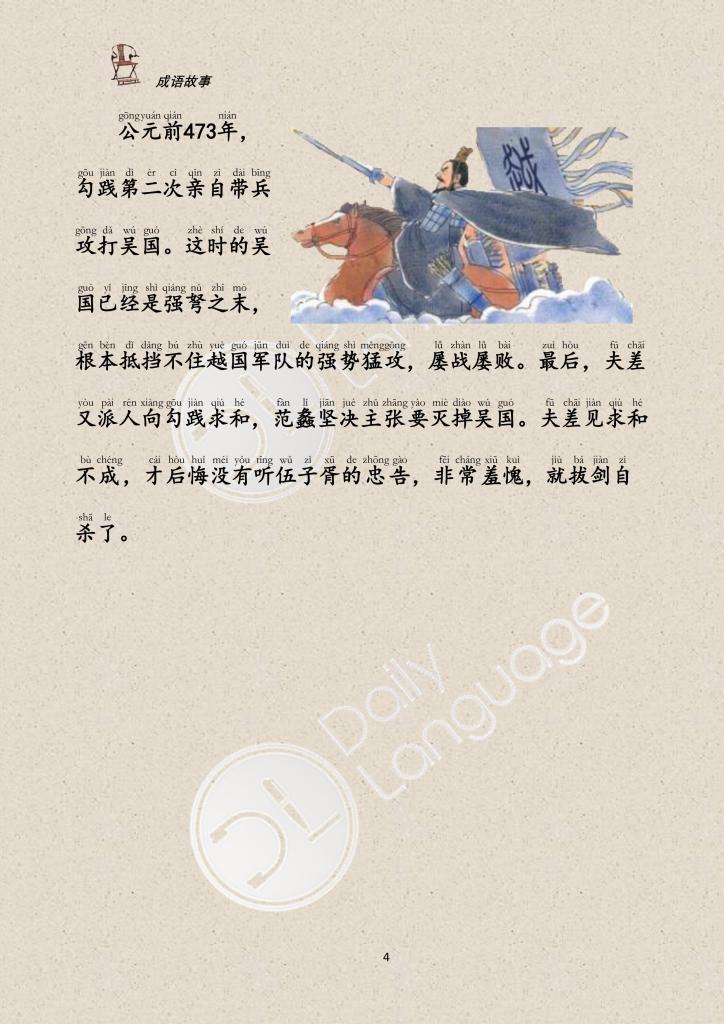
During the Spring and Autumn period (770-476BC), the State of Wu launched an attack against the State of Yue. The King of Wu was seriously wounded and soon died. His son Fu Chai became the new King. Fu was determined to get revenge. He drilled his army rigidly until it was a perfect fighting force. Three years later, he led his army against the State of Yue and caught its king Gou Jian. Fu took him to the State of Wu.
In order to avenge his father’s death, Fu let him live in a shabby stone house by his father’s tomb and ordered him to raise horses for him. Gou pretended to be loyal to Fu but he never forgot his humiliation. Many years later, he was set free. Gou secretly accumulated a military force after he went back to his own state. In order to make himself tougher he slept on firewood and ate a gall-bladder before having dinner and going to bed every night. At the same time he administered his state carefully, developing agriculture and educating the people. After a few years, his country became strong. Then Gou seized a favorable opportunity to wipe out the State of Wu.
Later, people use it to describe one who endures self-imposed hardships to strengthen one’s resolve to realize one’s ambition.
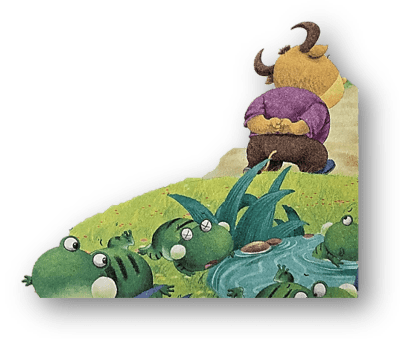
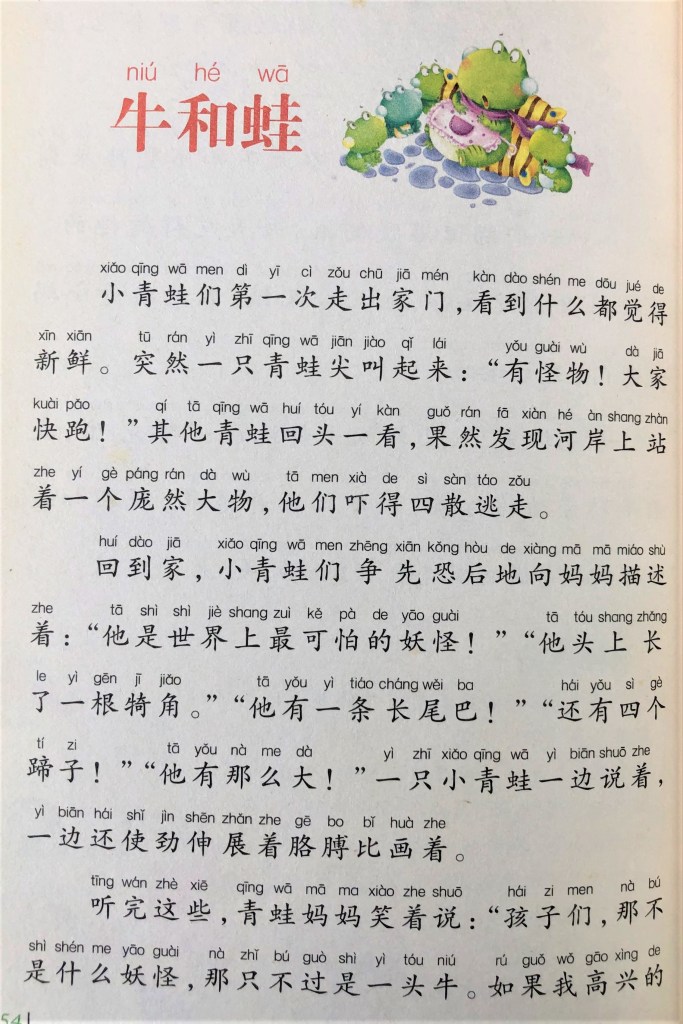
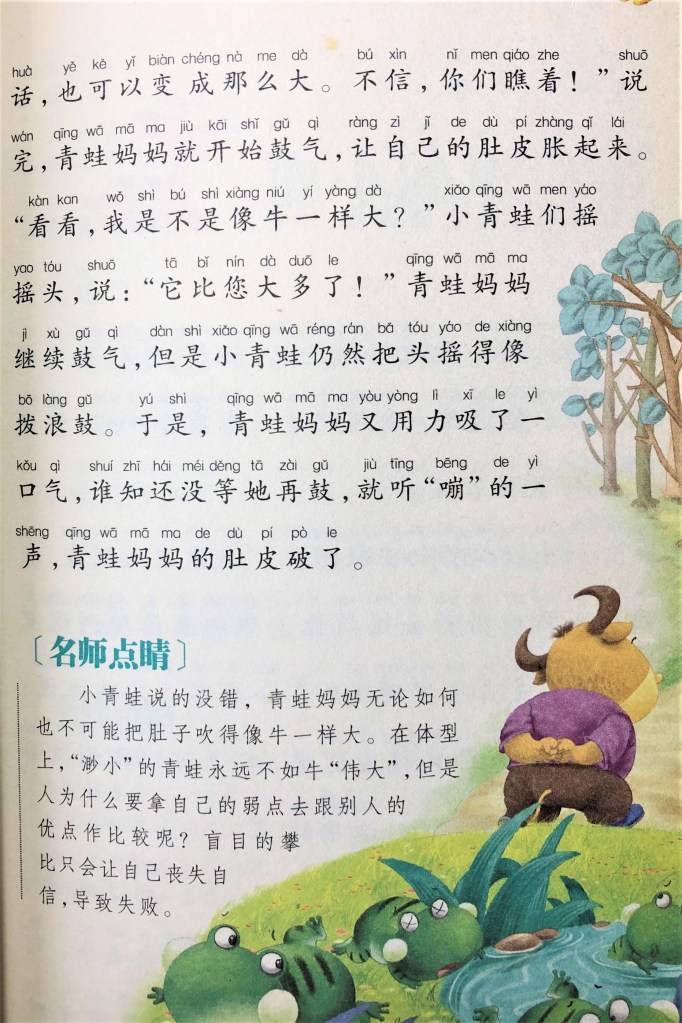
An ox, grazing in a swampy meadow, chanced to set his foot among a parcel of young frogs and crushed nearly the whole brood to death. One that escaped ran off to his mother with the dreadful news; “And, O mother!” said he, “it was a big four-footed beast that did it!”
“Big?” quote the old frog. “How big? Was it as big”?and she puffed herself out to a great degree?”as big as that?” “Oh!” said the little one, “a great deal bigger than that.” “Well, was it so big?” and she swelled herself out yet more.
“Indeed, mother, but it was; if you were to burst yourself, you would never reach half its size.” Provoked at such a disparagement of her powers, the old frog made one more trial, and burst herself indeed.
Men are ruined by attempting a greatness to which they have no claim.
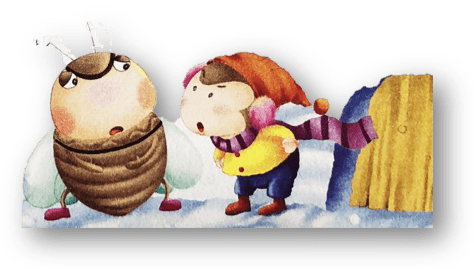
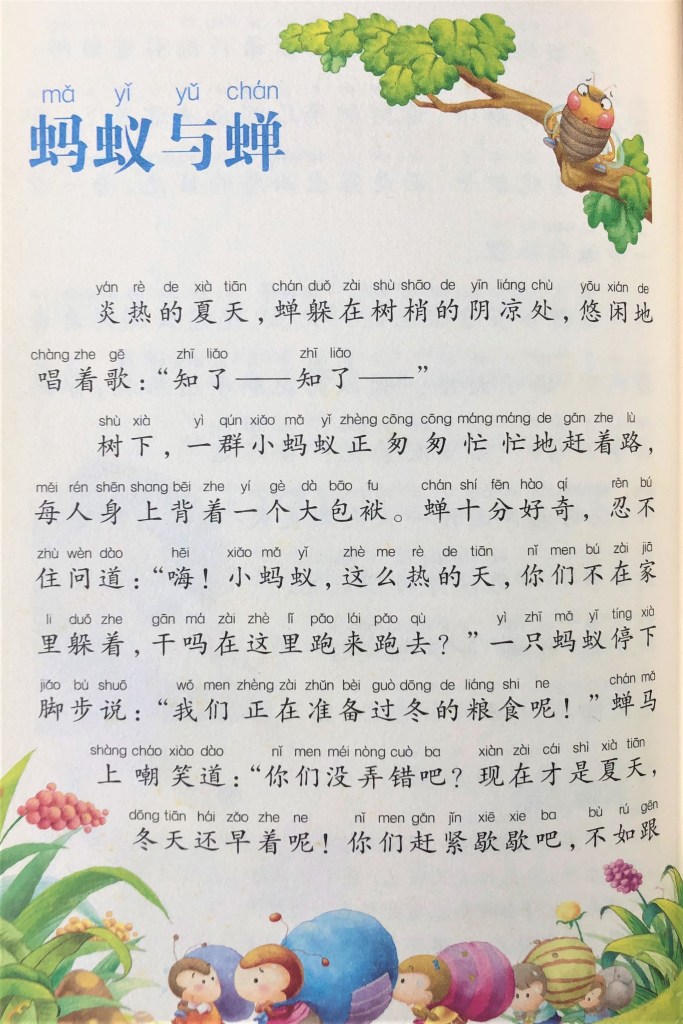
On a cold frosty day an ant was dragging out some of the corn that he had laid up in summer time, to dry it. A grasshopper, half-perished with hunger, besought the ant to give him a morsel of it to preserve his life.
“What were you doing,” said the ant, “this last summer?”
“Oh,” said the grasshopper, “I was not idle. I kept singing all the summer long.”
The ant, laughing and shutting up his granary, said, “Since you could sing all summer, you may dance all winter.”
shui di shi chuan(Constant dripping wears away the stone)
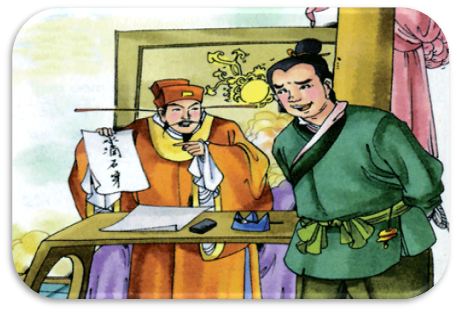
Long long ago, there was a person called Zhang Guaiya and he was a county leader. At that time the beadles always challenge their supervisor, even some of them insulted the generals. Guaiya wanted to make an change to chastise their doings.
One day, when Guaiya was perambulating, he saw a beadle coming out from the warehouse in a hurry. Guaiya asked him to stop and found there was a coin in his headband. After looking into, the beadle refuse to admit that he had stolen the money from the warehouse.
Guaiya sent the beadle to his office and wanted to punish him. But the beadle said angrily: “there is nothing to stole a coin, and why you punish me. You only can beat me but can not kill me.”
Guaiya heard that, saying without hesitate. “If you save one coin a day, you will get one thousand coins after one thousand days. The rope can make the wood broken, and the water can make the stone a hole.”
After judging that, Guaiya put away the pen and command the executioner to cut off the beadle’s head to display to the public.
The meaning is that the water keeps dropping and it can make a hole on the stone after a long time.
水滴石穿
shuǐ dī shí chuān,意思是指水滴不断地滴,可以滴穿石头;比喻坚持不懈,集细微的力量也能成就难能的功劳 。
















 Daily Language